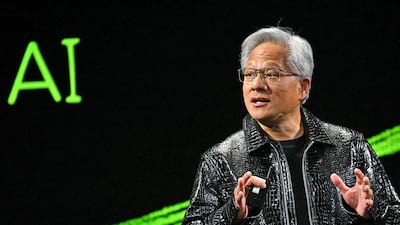

Nvidia's board of directors on Tuesday said it had formed a committee to oversee its security policies, export control compliance and global trade risk management.
The move came days after Jensen Huang was ousted as the company's chief executive over reports of extramarital affairs, including with a Chinese businesswoman whom US intelligence officials suspect of having links to Beijing's spy services.
The woman, Alice Huang, was previously chief executive of Singapore-based company Megaspeed, which is under investigation by the US for allegedly smuggling chips to China. Megaspeed denies the allegations.

The affair has rocked Washington politics, particularly among hawkish members of Congress who argue such a relationship could have given China access to Nvidia's most advanced AI chips. The US has banned the sale of those chips to China, citing national security concerns.
Mr Huang has agreed to appear for transcribed interviews with three US House of Representatives committees on December 1, the House Foreign Affairs Committee said in a statement. Nvidia's general counsel will appear before the committees on December 2.
"The American people need answers on Mr Huang and Nvidia’s role in allowing dangerous PRC actors to access our most advanced chips, as well as the role of a potential Chinese intelligence asset in this scandal," said Representatives Brian Mast, John Moolenaar and Rick Crawford, referring to the People's Republic of China.
Nvidia's existing National Security Team and Global Trade Compliance Team will report directly to the newly established National Security and Export Control Oversight Committee and to the interim chief executive, Colette Kress.
"Nvidia recognises that advanced silicon technologies and the emergence of artificial and super intelligence present unprecedented challenges for national security," Harvey Jones, chairman of Nvidia's board of directors, said in a statement.
“As the world’s leading advanced computing company, Nvidia has both a responsibility and an opportunity to lead the industry in addressing these challenges,” he said.
The announcement came a day after the US Commerce and Justice departments revealed they had initiated an investigation into Megaspeed in 2024 for potential export control violations.
“While we don't typically comment on ongoing investigations, it is in the public interest to provide the facts and address inaccurate information circulating in public reporting,” the statement said.
The agencies said investigators at the Commerce Department in May 2025 requested records from Nvidia concerning direct or indirect sales to the Singapore-based company.
Nvidia placed Megaspeed on its “no sell” list in June 2025. That same month, agents from the Commerce Department's Bureau of Industry and Security, along with law enforcement officials in Singapore, conducted an in-person check at Megaspeed and interviewed Ms Huang.
The Justice Department then took the lead in Megaspeed's criminal investigation, they said.
Earlier on Monday, the Bureau of Industry and Security released an interim final rule tightening access to advanced AI chips and servers.
The department said the rule was designed to ensure existing restrictions on access to sensitive US technology would not be circumvented through remote computing arrangements involving data centres in third countries.
“The United States is the global leader in advanced computing and super intelligence technology and is committed to promoting the global adoption of American technology for legitimate commercial purposes while ensuring that sensitive technologies are not exploited in ways that threaten US national security,” the agency said.
The announcement came as Commerce Secretary Howard Lutnick faced growing criticism his agency did not do enough to curb exports of advanced AI chips to China.

