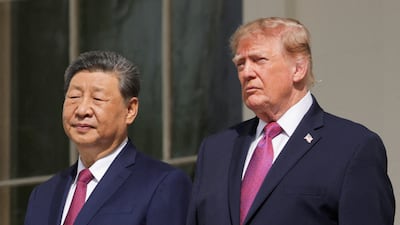

China has proposed new export controls on 40 strategic technology systems, including 23 linked to artificial intelligence, in a move that could test its fragile trade truce with the US and deepen the rivalry between the world's two largest economies.
The draft rules, unveiled on Friday, would give Beijing greater oversight of technology transfers spanning AI chips, large language models, solar energy and biotechnology.
China said the move was aimed at curbing the misuse of the technology. Most can still be exported without heavy restrictions and licensing would be simplified.
Beijing will seek public opinion on the proposal until November 15, after which it will announce a final version of the controls.
“The announcement is extremely expansive and it will take time to fully assess its implications,” said Leonhard Xu, a senior consultant at Sinolytics, a Berlin-based consultancy.
“AI seems to be the big centrepiece … but the registration requirement starts immediately, even for exports that have already started shipping. Also, always important to note that export control does not equal an export ban in most cases,” he said.
China and the US have been locked in a largely bitter trade war, as Washington seeks to control Beijing's global influence. Technology, and AI in particular, has become a major driver of the rivalry.
AI has become key for Chinese exports, which jumped more than 36 per cent year-on-year in September, markedly better than a previously anticipated 25.5 per cent, underscored by AI products, according to IndexBox data.
Industry observers believe the move will have notable implications on China's economic engine and its trade strategy against the US, with which it is competing for leadership in the AI race.
Last month, Washington and Beijing agreed to cut tariffs on $30 billion of goods and start dialogue on AI, after Chinese President Xi Jinping's visit to the White House.
Erin Browne, the US Treasury's undersecretary for international affairs, told Reuters that Washington was pushing for its partners in the International Monetary Fund to rename AI “super intelligence”, a term championed by the Trump administration.
China's move indicates that the “fragility of our trade truce cannot be overstated”, said Wendy Cutler, a senior vice president at the New York-based non-profit Asia Institute, who also warned that it is “only be a matter of time” until the US responds with its own restrictive measures.
“Despite the agreement on constructive strategic stability, China has announced it is working on a new export restriction tool on solar, AI and other products, allowing Beijing to have better control over export levels, destinations, etc,” she said.
“This once again shows that despite the two-month extension of our trade truce, Beijing is going full steam ahead in efforts to control exports of strategic goods to the US and others.”
Ting Peng, a partner at BZW Law Firm in Shenzhen who specialises in trade compliance, said the registration requirements extend beyond conventional technology transfers, as they cover certain cross-border IP transfers and licensing arrangements, as well as changes in ownership or actual control of domestic technology, to overseas entities.
These implications may extend to cross-border investment and corporate transactions, she noted.
“Companies involved in cross-border acquisitions, IP restructuring or international licensing arrangements should assess whether their transactions involving the relevant technologies trigger the new registration requirements,” Ms Ting said.
“This is particularly relevant to the biopharmaceutical sector, which has seen significant M&A [mergers and acquisitions] activity over the past two years.”

