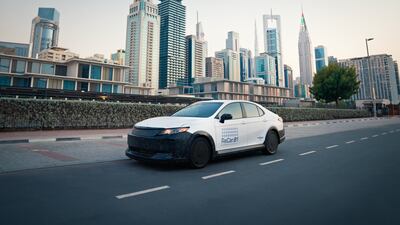

As the world embraces electric vehicles, addressing what to do with petrol-powered cars at the end of their life cycle is becoming increasingly important.
Zach Faizal, founder of Peec, believes he has come up with an innovative solution – converting these ageing vehicles and car scraps into EVs to effectively combat waste and reduce carbon emissions.
The company's name, although succinct, is a combination of the words petrol and electric.
“I went to study automotive engineering in the UK, and in my second year, the world was moving towards electric cars when I realised we have two billion cars worldwide, and one day, all of them will be electric,” Mr Faizal said in a recent interview at the World Congress and Exhibition on Intelligent Transport Systems in Dubai.
This realisation led him to ponder the fate of internal combustion engine-based vehicles, most of which would end up in scrap yards, and in turn, create another long-term environmental problem.
His company emerged from this concern with support from the University of Surrey, where it evolved into Mr Faizal's thesis project.

It now boasts a 50-person team and operates out of the UAE, where Mr Faizal was born and raised.
Peec specialises in converting old, petrol-powered vehicles into electric ones by using existing structures to minimise environmental impact. He said that once transformed to EVs, the vehicles are sold to businesses, making Peec's solution both sustainable and scalable for the commercial sector.
“Every year in the UAE, around 15,000 to 20,000 cars go to the scrap yard,” he explained. “We take these cars and completely rebuild and re-engineer electric cars from them.”
Mr Faizal explained that Peec's process involves stripping the petrol car down to its chassis, and removing all other components. From there, they re-engineer the vehicles entirely and redesign both the interior and exterior, along with the vehicle's technology. Once reassembled, the car undergoes rigorous testing and certification, ensuring it meets the standards of a new electric vehicle, ready for use on the road.
Mr Faizal said that the company aligns with the UAE’s environmental goals, which include a net zero mandate by 2050 and a 30 per cent electrification target by 2030.
He added that Peec is preparing to scale up its operations and begin selling recycled vehicles soon.
“From next year onwards, we’re planning to do about 3,000 cars yearly,” Mr Faizal said. He praised the crucial support of the Road and Transport Authority and the UAE government, which have enabled him to get all necessary approval to advance the project.

The company currently has three prototypes, with ReCar03 being the closest to a finished product.
“We are working with the country’s taxi operators and within the region. But we also have delivery guys, waste collection services, school buses, public transport buses, and essentially any large-scale fleet,” he said.
Currently, Peec only operates on a business-to-business model, but it hopes eventually to broaden its offerings to consumers.
“Hopefully, in the next three or four years, business to consumer should also be opened up,” Mr Faizal said. He added that a substantial investment from someone in Singapore has propelled the company forward, along with $20 million that was raised to expand production capabilities.
The company is also engaging with governments around the world and plans to enter the European market.
“We’re building a couple of prototypes for the European market, too. But yeah, the technology and the model are scalable everywhere,” Mr Faizal said.
Last year during Cop28, the company launched and formed a significant partnership with Beeah Group and the Sharjah Research, Technology, and Innovation Park.
This collaboration focuses on localised production and skill development in Sharjah, supporting circular economy principles and net zero emissions goals.
Mr Faizal said that Peec’s approach results in significant reduction of waste. “We’re essentially making the green transition 30 per cent less carbon intensive,” he explained.
Peec is hoping to introduce these converted EVs to the market next year.

