


Roman Axelrod has some grand ambitions – so grand that, eventually, he wants them to go beyond the realms of Earth.
Never mind that early investors and his own eventual co-founder for Dubai-based start-up Xpanceo thought of him as unconventional for his novel idea of miniaturising a computer and making them, literally, within sight of users, in the form of a smart contact lens.
“It's a funny story. When I realised the future computer would be a smart contact lens, I knew I needed experts … so I reached out to [nanophotonics expert] Valentyn Volkov,” he tells The National.
“Imagine you're a respected scientist and one day someone starts writing to you about building the computer of the future together.”
-

Valentyn Volkov, co-founder and scientific partner at Dubai-based start-up Xpanceo, holds a prototype smart contact lens. All photos: Antonie Robertson / The National -
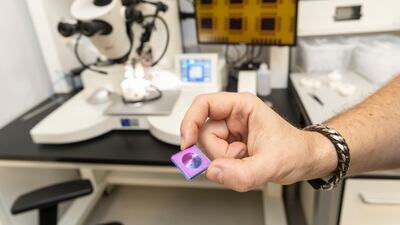
Xpanceo is developing techniques for embedding antennae in the lens at their Dubai lab -
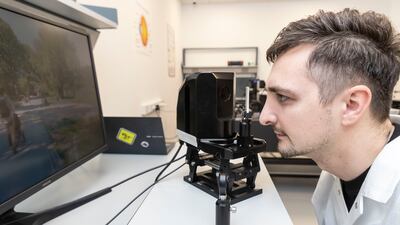
The product is 'the next generation of computing via an invisible and weightless smart contact lens that is as natural to the wearer as their own vision', Xpanceo says -

The lens gives users an 'infinite' extended reality view, the company says -

Mr Volkov explains the possible uses and applications that can be embedded in the lens -
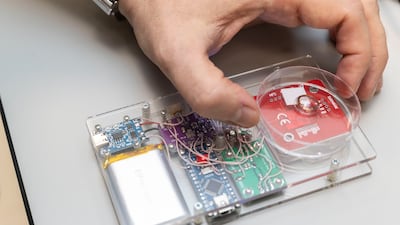
Fitting microprojectors, biosensors and power electronics into a small, comfortable lens is a challenge, Xpanceo says -
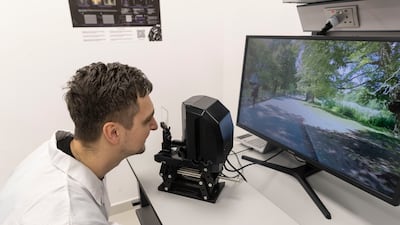
Its research and development team comprises 40 scientists and engineers from leading universities and research centres -

Mr Volkov and Roman Axelrod, co-founder and managing partner, with prototypes


“We began working on making a prototype of the idea and seeking investors" he said, adding that attempts to attract funding were usually met with skepticism yet yielded results.
Mr Axelrod is now the managing partner of Xpanceo, which is developing smart contact lenses that, as he shared with The National in December, aim to mimic the technology featured in the Iron Man films.
They will provide an “infinite” extended reality view in which tasks from documents to meetings and social media to gaming will be shown on the user's field of view and are visible only to the wearer.
The lenses, which are powered by artificial intelligence and machine learning, will also feature night vision and will be controlled using voice, gestures, glances and, “probably later, your mind”, Mr Axelrod said in December.
Since then, Xpanceo – which is also helping in cancer research – has made “significant progress”, focusing on refining the main components of its three prototypes.
There is no rush, and with good reason: the lenses are viewed as medical devices, and completing pre-clinical testing is the priority before ultimately starting human trials.
The final prototype is expected to enter its testing phase by 2026, with the market launch date and number of units for release dependent on the outcomes of those tests, Mr Axelrod says. Xpanceo is also in discussions with “several major companies”, which he did not identify.
The cost would be $900 annually, comprising $50 per month for replacement lenses, plus $300 per year for the subscription service that includes a companion device to charge the lenses and store them overnight.
Mr Axelrod is not ruling out partnerships with the likes of Apple and Google. He says Xpanceo has had talks with representatives from those companies, but cannot yet disclose any details.
“As for partnerships with AI giants, we're exploring opportunities to collaborate and leverage their expertise to further enhance our product,” he says.
If all goes to plan, Xpanceo hopes to attract an early-adopter user base of 15,000 by 2026, which leads to loftier goals: 500,000 by 2028, a million by 2029 and 10 million by 2032.

“We are currently in this process and hope to make substantial progress by the end of 2024. In the meantime, we've developed a system for testing smart contact lenses without human or animal testing,” Mr Axelrod says.
“Current solutions on the market only monitor 30 per cent of the required parameters, but our system covers them more comprehensively.”
The global smart contact lens market is projected to hit $682.67 million by 2031, from $264.18 million in 2023, at a compound annual growth rate of 12.60 per cent, according to Data Bridge Market Research.
Smart contact lenses are not a new concept – but market growth has been slow.
The most notable company to have worked on a smart contact lens was Google in 2014.
The Alphabet-owned company designed a lens to monitor blood sugar levels, but it was cancelled in 2018 due to various challenges, most notably around accuracy.
South Korea's Samsung Electronics and Japan's Sony have filed patents for the technology, though nothing of note has come out of them so far. California-based Mojo Vision, which raised $226 million for its own development, also pulled out, citing funding issues.
Switzerland-based Sensimed is the most notable company to have received approval to sell its smart contact lens, which captures spontaneous changes in the eye providing doctors with information to help guide glaucoma treatment.
Mr Axelrod distinguishes his company's innovations from these manufacturers' attempts.
“We've shifted our approach to technology: while current manufacturers are attempting to downsize the components of past gadgets to create future ones, we're implementing the latest technologies,” he says.
Novel materials and studying nanophotonics – a part of nanotechnology that looks at the behaviour of light – allow his team to pursue multiple avenues simultaneously, including health care technology, 2D materials development and creating super vision technology, along with the development of smart contact lenses.
“This forward-thinking approach minimises the risk of repeating past mistakes,” he says.
As for funding, Mr Axelrod says that is not a priority at the moment: the company attracted $40 million in investment in 2023 – the second-biggest seed round in the Middle East and North Africa and the 24th-largest globally last year, according to US industry data tracker Eqvista.
The majority of Xpanceo's funds are earmarked for research and development, supporting a team of more than 50 engineers and scientists. Its laboratory in Dubai alone costs upwards of $6 million.
“If we see an opportunity to further enhance our product with additional resources, we may consider it in the future,” Mr Axelrod says.
“We're in touch with various funds, both regionally and internationally, so if we decide to raise more funds, we'll be open to exploring different avenues and opportunities.”
Mr Axelrod says his dream has always been to contribute to humanity's advancement by merging people with technology, enhancing current human functions and creating entirely new ones.
He believes that the future human race will eventually morph into beings that have capabilities straight out of a sci-fi movie – perhaps not so far-fetched considering the rapid pace of innovation.
“I believe this advanced species will be capable of effortlessly controlling devices with their minds, learning instantaneously, exchanging information seamlessly and enjoying longer, healthier lives,” Mr Axelrod says.
“Ultimately, I would explore other ideas that would contribute to our evolution into an interplanetary species, perhaps in the fields of medical devices or neural interfaces.”
Q&A with Roman Axelrod, founder and managing partner of Xpanceo

Do you believe smart contact lenses will be sustainable?
Modern gadgets have drawbacks that are harmful to people and the environment: they're heavy, fragile – the list of shortcomings is endless. Therefore, creating a truly convenient gadget was one of my main goals.
I firmly believe that when the lens becomes available, it will make life easier. We'll be able to communicate without extra screens, control devices with our thoughts, and significantly reduce eye strain. Consequently, I don't think that once people experience something as convenient as this, they'll want to revert to something that was outdated 10 years ago.
How is AI powering your devices?
AI certainly plays a significant role in two main aspects: shaping the functionality of the end product, and in our development processes.
For development, we are utilising new two-dimensional materials with unique properties that we are studying and tailoring to our needs. Our custom models for studying these materials drastically reduce the time spent searching for new solutions.
In the final product, AI will facilitate device control through voice, gesture, gaze and thoughts. For instance, we've already developed a model that helps interpret data from an intraocular pressure (IOP) sensor. IOP is the amount of pressure or force inside the eyes.
How does the UAE’s start-up scene compare to other global tech hubs?
Before establishing our laboratory, we conducted extensive research to determine the most suitable country to accommodate our international team. The UAE, particularly Dubai, stood out as the optimal choice due to Dubai's flourishing market and convenient location between Europe and Asia.
The market here is really different from other places, mainly thanks to the government's proactive approach to supporting technological advancements. All of this creates a business-friendly, dynamic and entrepreneurial atmosphere.
What do you do in your free time?
I spend time with my family. I love engaging with my three-year-old son and it is the only activity that helps me unwind from work and take my mind off things. I also have a passion for hip-hop and video games.
What is your advice to budding entrepreneurs?
Focus on creating as much value for humanity as possible. If you find what is truly important to you, it will be much easier to create a detailed plan, attract investment and move towards your goal, no matter how big your dream is.

