Scientists at NYU Abu Dhabi bring harsh realities of distant worlds to Earth


Sarwat Nasir
  • English
  • Arabic

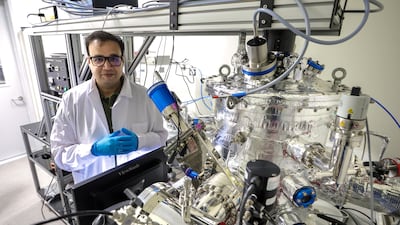
A new planetary simulation chamber at New York University Abu Dhabi could transform how scientists in the UAE conduct space research, allowing them to recreate extreme planetary environments.

Researchers will be able to replicate the surface conditions of the Moon, Mars, asteroids and the Martian atmosphere by adjusting the gas composition, pressure and temperature inside the controlled chamber.

Dr Dimitra Atri, an astrophysicist at NYUAD and manager of the project, told The National in an exclusive interview that research from the chamber will complement data being gathered by UAE spacecraft on other planets and asteroids.

“Initially it was called the Mars Simulation Chamber because our focus was Mars, but then we got involved in the Emirates lunar programme and the asteroid belt mission,” he said. “So now we have a very flexible system in the chamber where we can explore different parts of the solar system, starting from our neighbour, the Moon, all the way to asteroids.”

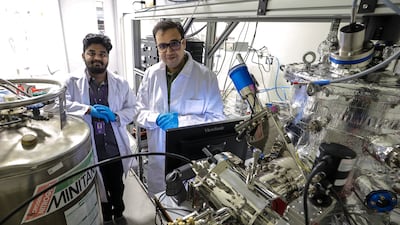
  • Dr Dimitra Atri, an astrophysicist at New York University Abu Dhabi, next to the new planetary simulation chamber. All photos: Victor Besa / The National
    Dr Dimitra Atri, an astrophysicist at New York University Abu Dhabi, next to the new planetary simulation chamber. All photos: Victor Besa / The National
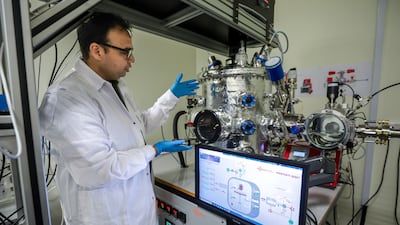
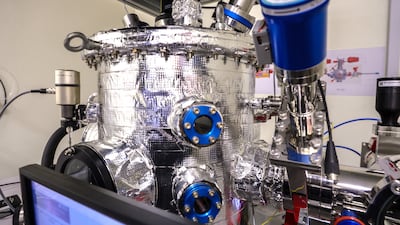
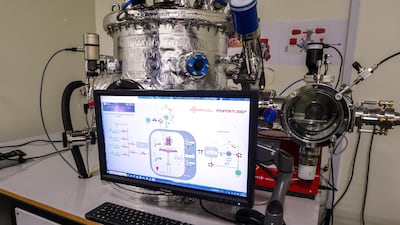
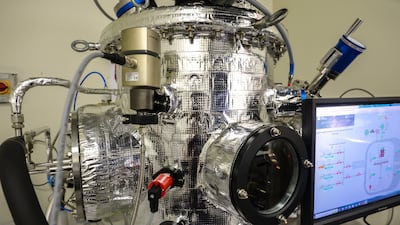
  • The high-tech system can recreate the extreme environments of Mars, the Moon and asteroids, helping scientists to analyse planetary conditions and test instruments.
    The high-tech system can recreate the extreme environments of Mars, the Moon and asteroids, helping scientists to analyse planetary conditions and test instruments.
  • Researchers will be able to replicate the surface conditions on other celestial bodies by adjusting the gas composition, pressure and temperature inside the controlled chamber.
    Researchers will be able to replicate the surface conditions on other celestial bodies by adjusting the gas composition, pressure and temperature inside the controlled chamber.
  • The research from the chamber will complement data being gathered by UAE spacecraft on other planets and asteroids.
    The research from the chamber will complement data being gathered by UAE spacecraft on other planets and asteroids.
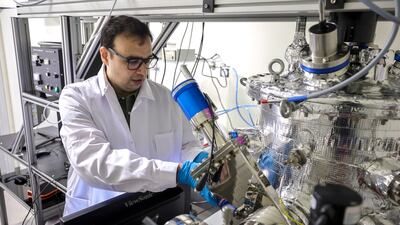
  • Dr Atri with research assistant, Vignesh Krishnamoorthi, at the Space Exploration Laboratory in NYUAD.
    Dr Atri with research assistant, Vignesh Krishnamoorthi, at the Space Exploration Laboratory in NYUAD.
  • The lab is also equipped to create simulated regolith - the loose rock and dust that covers planetary surfaces - allowing scientists to better understand the physics and chemistry of these environments.
    The lab is also equipped to create simulated regolith - the loose rock and dust that covers planetary surfaces - allowing scientists to better understand the physics and chemistry of these environments.
  • It has an optical system capable of recreating solar conditions across different regions of the solar system. Scientists will be able to expose samples to intense ultraviolet radiation, mimicking the effects of prolonged space exposure.
    It has an optical system capable of recreating solar conditions across different regions of the solar system. Scientists will be able to expose samples to intense ultraviolet radiation, mimicking the effects of prolonged space exposure.

The lab is also equipped to create simulated regolith – loose rock and dust that covers the surface of planets – allowing scientists to better understand the science behind these environments.

“We can mix them with different types of minerals and chemicals, which are found in space conditions, and we can understand the physics and chemistry of what is going on,” he said. “When space probes send back data, we’ll be able to analyse the underlying mechanisms behind the different observations they capture.”

How the chamber can help future missions

The chamber also has an optical system capable of recreating solar conditions across different regions of the solar system. Researchers will be able to expose samples to intense ultraviolet radiation, mimicking the effects of prolonged space exposure.

Dr Atri is part of the scientific team behind several UAE-led missions, including the Hope probe that is orbiting Mars, the Moon exploration programme and the space flight to an asteroid belt between Mars and Jupiter.

The parts of most of these craft are usually sent abroad for environmental testing to ensure they can survive the harsh conditions of space travel. Dr Atri said the chamber can be used for testing.

“To test whether an instrument can go into space, it must be space certified, it needs to be put in those extremely low and high temperatures, extremely low pressures of space,” he said. “And generally, people ship it to the US, mostly to JPL [Nasa’s Jet Propulsion Laboratory] to test these things, but now we’ll be able to do it in our lab itself.”

This could be the first such technology in the UAE that replicates the environment of a number of celestial bodies. Although Zayed University operates a small Mars simulation chamber and Khalifa University has a compact thermal vacuum chamber, which aims to ensure satellites can survive the harsh environment of space, NYUAD’s chamber also has vacuum capabilities for testing components, including for spacecraft that are bound for other celestial bodies.

“We have a load-lock chamber. It works exactly like an airlock so we can maintain vacuum conditions for several months at a time,” said Dr Atri. “This load-lock chamber can be depressurised or pressurised. We can change its atmospheric composition and temperature, allowing us to transport samples continuously in and out of the space environment.”

On a global scale, planetary simulation chambers are used by some of the world’s leading space agencies and institutions. JPL's Dustie, for example, simulates the temperature and air pressure of other planets. It was used to replicate the carbon dioxide ice found on Mars' southern hemisphere, supporting the study of Martian geological formations known as araneiform terrain.

“We can also train students and scientists here,” said Dr Atri. “One of the main goals of the UAE government is local capability development, and the chamber is an example of a technological and scientific capability.”


Mercer, the investment consulting arm of US services company Marsh & McLennan, expects its wealth division to at least double its assets under management (AUM) in the Middle East as wealth in the region continues to grow despite economic headwinds, a company official said.

Mercer Wealth, which globally has $160 billion in AUM, plans to boost its AUM in the region to $2-$3bn in the next 2-3 years from the present $1bn, said Yasir AbuShaban, a Dubai-based principal with Mercer Wealth.

Within the next two to three years, we are looking at reaching $2 to $3 billion as a conservative estimate and we do see an opportunity to do so,” said Mr AbuShaban.

Mercer does not directly make investments, but allocates clients’ money they have discretion to, to professional asset managers. They also provide advice to clients.

“We have buying power. We can negotiate on their (client’s) behalf with asset managers to provide them lower fees than they otherwise would have to get on their own,” he added.

Mercer Wealth’s clients include sovereign wealth funds, family offices, and insurance companies among others.

From its office in Dubai, Mercer also looks after Africa, India and Turkey, where they also see opportunity for growth.

Wealth creation in Middle East and Africa (MEA) grew 8.5 per cent to $8.1 trillion last year from $7.5tn in 2015, higher than last year’s global average of 6 per cent and the second-highest growth in a region after Asia-Pacific which grew 9.9 per cent, according to consultancy Boston Consulting Group (BCG). In the region, where wealth grew just 1.9 per cent in 2015 compared with 2014, a pickup in oil prices has helped in wealth generation.

BCG is forecasting MEA wealth will rise to $12tn by 2021, growing at an annual average of 8 per cent.

Drivers of wealth generation in the region will be split evenly between new wealth creation and growth of performance of existing assets, according to BCG.

Another general trend in the region is clients’ looking for a comprehensive approach to investing, according to Mr AbuShaban.

“Institutional investors or some of the families are seeing a slowdown in the available capital they have to invest and in that sense they are looking at optimizing the way they manage their portfolios and making sure they are not investing haphazardly and different parts of their investment are working together,” said Mr AbuShaban.

Some clients also have a higher appetite for risk, given the low interest-rate environment that does not provide enough yield for some institutional investors. These clients are keen to invest in illiquid assets, such as private equity and infrastructure.

“What we have seen is a desire for higher returns in what has been a low-return environment specifically in various fixed income or bonds,” he said.

“In this environment, we have seen a de facto increase in the risk that clients are taking in things like illiquid investments, private equity investments, infrastructure and private debt, those kind of investments were higher illiquidity results in incrementally higher returns.”

The Abu Dhabi Investment Authority, one of the largest sovereign wealth funds, said in its 2016 report that has gradually increased its exposure in direct private equity and private credit transactions, mainly in Asian markets and especially in China and India. The authority’s private equity department focused on structured equities owing to “their defensive characteristics.”

2020 Oscars winners: in numbers
  • Parasite – 4
  • 1917– 3
  • Ford v Ferrari – 2
  • Joker – 2
  • Once Upon a Time ... in Hollywood – 2
  • American Factory – 1
  • Bombshell – 1
  • Hair Love – 1
  • Jojo Rabbit – 1
  • Judy – 1
  • Little Women – 1
  • Learning to Skateboard in a Warzone (If You're a Girl) – 1
  • Marriage Story – 1
  • Rocketman – 1
  • The Neighbors' Window – 1
  • Toy Story 4 – 1
The five pillars of Islam

1. Fasting 

2. Prayer 

3. Hajj 

4. Shahada 

5. Zakat 

Living in...

This article is part of a guide on where to live in the UAE. Our reporters will profile some of the country’s most desirable districts, provide an estimate of rental prices and introduce you to some of the residents who call each area home.

UAE currency: the story behind the money in your pockets
%3Cp%3EThe%20Punishment%20of%20Luxury%3Cbr%3EOMD%3Cbr%3E100%25%20Records%3C%2Fp%3E%0A
Tamkeen's offering
  • Option 1: 70% in year 1, 50% in year 2, 30% in year 3
  • Option 2: 50% across three years
  • Option 3: 30% across five years 
Full Party in the Park line-up

2pm – Andreah

3pm – Supernovas

4.30pm – The Boxtones

5.30pm – Lighthouse Family

7pm – Step On DJs

8pm – Richard Ashcroft

9.30pm – Chris Wright

10pm – Fatboy Slim

11pm – Hollaphonic


Our legal consultant

Name: Hassan Mohsen Elhais

Position: legal consultant with Al Rowaad Advocates and Legal Consultants.

Terminal High Altitude Area Defense (THAAD)

What is THAAD?

It is considered to be the US' most superior missile defence system.

Production:

It was first created in 2008.

Speed:

THAAD missiles can travel at over Mach 8, so fast that it is hypersonic.

Abilities:

THAAD is designed to take out projectiles, namely ballistic missiles, as they are on their downward trajectory towards their target, otherwise known as the "terminal phase".

Purpose:

To protect high-value strategic sites, such as airfields or population centres.

Range:

THAAD can target projectiles both inside and outside of the Earth's atmosphere, at an altitude of 93 miles above the Earth's surface.

Creators:

Lockheed Martin was originally granted the contract to develop the system in 1992. Defence company Raytheon sub-contracts to develop other major parts of the system, such as ground-based radar.

UAE and THAAD:

In 2011, the UAE became the first country outside of the US to buy two THAAD missile defence systems. It then deployed them in 2016, becoming the first Gulf country to do so.

White hydrogen: Naturally occurring hydrogenChromite: Hard, metallic mineral containing iron oxide and chromium oxideUltramafic rocks: Dark-coloured rocks rich in magnesium or iron with very low silica contentOphiolite: A section of the earth’s crust, which is oceanic in nature that has since been uplifted and exposed on landOlivine: A commonly occurring magnesium iron silicate mineral that derives its name for its olive-green yellow-green colour

Director: Laxman Utekar

Cast: Vicky Kaushal, Akshaye Khanna, Diana Penty, Vineet Kumar Singh, Rashmika Mandanna

Rating: 1/5

COMPANY PROFILE
Name: Kumulus Water
 
Started: 2021
 
Founders: Iheb Triki and Mohamed Ali Abid
 
Based: Tunisia 
 
Sector: Water technology 
 
Number of staff: 22 
 
Investment raised: $4 million 
UAE players with central contracts

Rohan Mustafa, Ashfaq Ahmed, Chirag Suri, Rameez Shahzad, Shaiman Anwar, Adnan Mufti, Mohammed Usman, Ghulam Shabbir, Ahmed Raza, Qadeer Ahmed, Amir Hayat, Mohammed Naveed and Imran Haider.

Which honey takes your fancy?

Al Ghaf Honey

The Al Ghaf tree is a local desert tree which bears the harsh summers with drought and high temperatures. From the rich flowers, bees that pollinate this tree can produce delicious red colour honey in June and July each year

Sidr Honey

The Sidr tree is an evergreen tree with long and strong forked branches. The blossom from this tree is called Yabyab, which provides rich food for bees to produce honey in October and November. This honey is the most expensive, but tastiest

Samar Honey

The Samar tree trunk, leaves and blossom contains Barm which is the secret of healing. You can enjoy the best types of honey from this tree every year in May and June. It is an historical witness to the life of the Emirati nation which represents the harsh desert and mountain environments

Dr Afridi's warning signs of digital addiction

Spending an excessive amount of time on the phone.

Neglecting personal, social, or academic responsibilities.

Losing interest in other activities or hobbies that were once enjoyed.

Having withdrawal symptoms like feeling anxious, restless, or upset when the technology is not available.

Experiencing sleep disturbances or changes in sleep patterns.

What are the guidelines?

Under 18 months: Avoid screen time altogether, except for video chatting with family.

Aged 18-24 months: If screens are introduced, it should be high-quality content watched with a caregiver to help the child understand what they are seeing.

Aged 2-5 years: Limit to one-hour per day of high-quality programming, with co-viewing whenever possible.

Aged 6-12 years: Set consistent limits on screen time to ensure it does not interfere with sleep, physical activity, or social interactions.

Teenagers: Encourage a balanced approach – screens should not replace sleep, exercise, or face-to-face socialisation.

Source: American Paediatric Association
Timeline

2012-2015

The company offers payments/bribes to win key contracts in the Middle East

May 2017

The UK SFO officially opens investigation into Petrofac’s use of agents, corruption, and potential bribery to secure contracts

September 2021

Petrofac pleads guilty to seven counts of failing to prevent bribery under the UK Bribery Act

October 2021

Court fines Petrofac £77 million for bribery. Former executive receives a two-year suspended sentence 

December 2024

Petrofac enters into comprehensive restructuring to strengthen the financial position of the group

May 2025

The High Court of England and Wales approves the company’s restructuring plan

July 2025

The Court of Appeal issues a judgment challenging parts of the restructuring plan

August 2025

Petrofac issues a business update to execute the restructuring and confirms it will appeal the Court of Appeal decision

October 2025

Petrofac loses a major TenneT offshore wind contract worth €13 billion. Holding company files for administration in the UK. Petrofac delisted from the London Stock Exchange

November 2025

180 Petrofac employees laid off in the UAE

Updated: March 07, 2025, 3:05 AM