


Live updates: follow the latest news on Omicron
India reported 264,202 new Covid-19 cases on Friday, the highest daily tally in nearly seven months, as the third wave of the pandemic spreads from large cities to smaller towns and rural areas.
The rapid increase in cases — India reported at total of 27,553 new cases two weeks earlier — is in line with a worldwide surge attributed to the highly transmissible Omicron variant of coronavirus.
India has confirmed only 5,733 infections caused by Omicron since the first case was detected in early December, but experts say it is a massive undercount.
“The spread cannot be prevented as it is a highly infectious variant. It has happened all over the world,” Dr Sanjay K Rai, an epidemiologist practising in Delhi, told The National.
The country’s overall Total Positivity Rate — the number of tests returning positive — stood at 14.78 per cent on Friday, with some remote areas reporting much higher rates of infection.
Upper Siang district in north-eastern Arunachal Pradesh state reported a 75 per cent positivity rate — the highest in India. Lahaul and Spiti, the remotest district in the state of Himachal Pradesh, had the fourth-highest positivity rate in the country, with 41 per cent.
Remote districts in the north-eastern state of Assam also reported a sudden surge in infections, with a 10 per cent positivity rate. In bordering Tripura state, the test positivity rate rose to 9.18 per cent this week from 0.69 per cent on January 1.
In Mizoram, also in the north-east, 70 per cent of new cases are being reported in rural areas, said Dr Pachuau Lalmalsawma, state officer for the federal government’s Integrated Disease Surveillance Programme.
“There is a drastic increase in cases, particularly in rural districts, in the last week. Earlier, 50 per cent of the total cases were in the capital Aizawl but now 70 per cent of the cases are in rural areas. But there is no case of Omicron yet,” Dr Lalmalsawma told The National.
“These are all Delta cases, but we fear Omicron [may enter] any time in the country, transmitted from local tourists,” he said
The Delta variant drove India’s devastating second wave in April and May last year.
-

A health worker takes a swab sample for the coronavirus from a policeman as pilgrims begin arriving for the Hindu religious festival of Gangasagar Mela on Sagar Island, about 150 kilometres south of Kolkata, West Bengal. AFP -
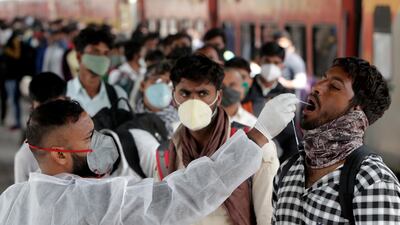
A health worker collects a swab sample from a traveller at a railway station to test for the coronavirus before allowing him to enter Mumbai, India. AP -
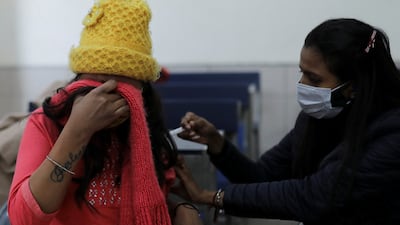
A woman receives a dose of the Covishield vaccine against the coronavirus at a centre in New Delhi, India. Reuters -
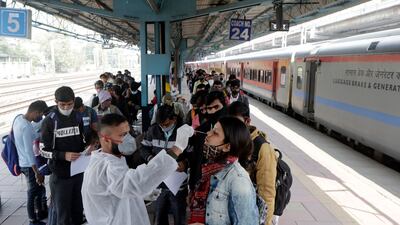
A health worker collects a swab sample from a traveller at a railway station to test for the coronavirus before allowing her to enter Mumbai, India. AP -

A health worker prepares a Covishield vaccine shot at a temple complex in Hyderabad, India. AP -
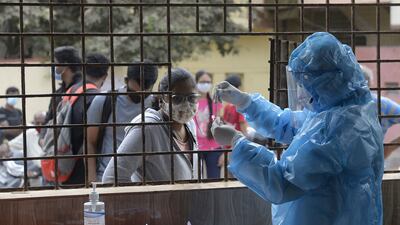
A health worker collects a swab sample from a woman to test for the coronavirus at a community hall in Hyderabad. AFP -
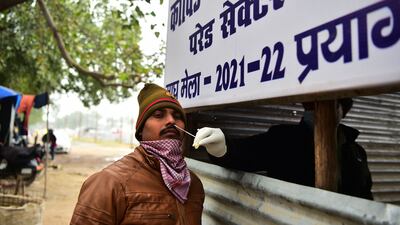
A health worker takes a swab sample from a policeman at a coronavirus testing station before the Magh Mela festival in Allahabad, Uttar Pradesh, India. AFP -

A health worker collects a swab sample from a man at a railway station in New Delhi, India. Reuters


The second wave overloaded the healthcare system, with the number of patients requiring treatment or admission to hospital, leading to severe shortages of beds, oxygen and medicines.
Dr Lalmalsawma said the hospital admission rate was lower now as many of the patients had been vaccinated and were recovering at home.
India has administered 1.5 billion doses of Covid-19 vaccines so far, with 63.6 per cent of the adult population fully vaccinated with two doses and 88 per cent having received at least one dose.
Dr Rai said the severity of the new wave would be reduced by the high immunisation rate as well as the milder symptoms caused by the Omicron variant.
“We anticipate the [daily] number of cases may go up, may cross 400,000, but the impact will be low as it is much milder than Delta,” he said.
India last reported a similar daily case count on May 17, with 263,045 new infections and 4,738 deaths. On Friday, the health ministry reported about 300 deaths.
Curfew imposed in New Delhi to fight coronavirus - in pictures
-
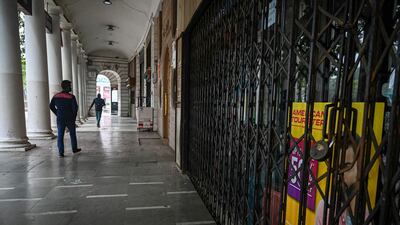
A man walks past closed shops during a state-wide weekend curfew to curb the spread of Covid-19 in New Delhi, India, on January 15. All photos: Prakash Singh / AFP -

Tourists cross a quiet road in New Delhi. -

Pigeons flock to an empty car park in the city's market district. -
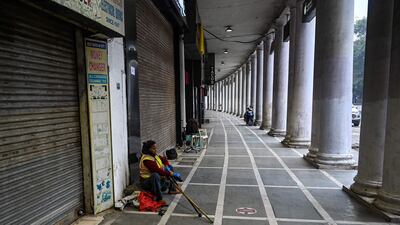
A New Delhi Municipal Corporation worker sits in front of closed shops. -
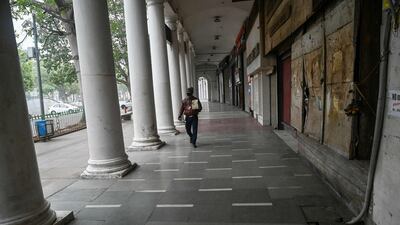
Once bustling streets are now deserted.



