


Live updates: follow the latest news on Covid-19 variant Omicron
Italy took aim at the unvaccinated with new coronavirus restrictions on Monday, with proof of vaccination or recovery from a recent infection required to enter public transport, cafes, hotels, gyms and other venues.
The new “super” health pass requirement eliminates the ability to show just a negative test to gain access to services.
Many Italians are returning to work and school after the Christmas and New Year holidays as Italy’s Covid-19 infections are soaring past 100,000 a day.
The government has responded to the Omicron-fuelled wave of infections by passing restrictions aimed at encouraging people to be vaccinated or be increasingly shut out of recreational and even essential venues, such as taking a bus or tube to work.
Italians have generally supported the restrictions, which in recent months have also included compulsory masks outdoors and a standard health pass to enter workplaces.
The new restriction were enforced Monday by police at train stations checking passengers’ vaccine status and making sure they were wearing the more protective Ffp2 face masks, which are now required on public transport.
“I’m happy that they are controlling everywhere,” said Carola Pasqualotto, a member of the Imperi sport centre where the front desk was checking members’ vaccination status.
“I am in favour of mandatory vaccines for all.”
But Prime Minister Mario Draghi has faced criticism for his government’s decision last week to make mandatory vaccinations for anyone 50 and older.
Critics say the fine for non-compliance, which starts at €100 ($113), is far too low a punishment.
But the fines rise to €1,600 for those in that age group who enter their workplaces starting in mid-February if they are not vaccinated.
On Monday, Mr Draghi defended the vaccine obligation.
“The data tells us that those older than 50 run greater risks, and that intensive care units are occupied by two thirds of those not vaccinated,” he said.
-
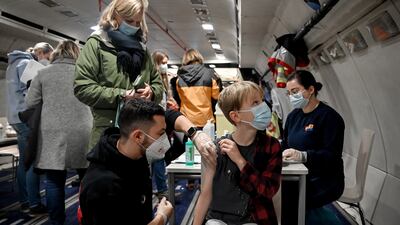
Jannik, 9, gets vaccinated in an airplane at Cologne Bonn Airport in Germany. The city is hosting a special vaccination event for children aged 5 to 11 in a decommissioned Airbus A300 Zero G. EPA -
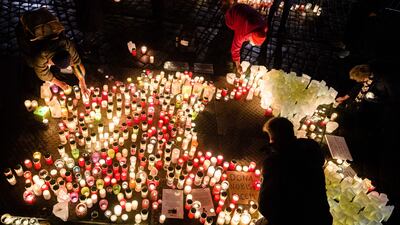
People place candles in Neumarkt Square, Dresden to commemorate the 1,400 lives lost to the coronavirus in the German city. AFP -
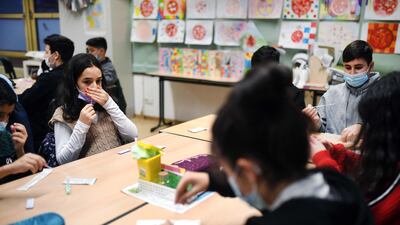
Pupils take a sample for a rapid test during the first lesson after Christmas holidays at the Freiherr-vom-Stein secondary school in Bonn, western Germany. AFP -

Protesters demonstrate against Covid-19 measures and compulsory vaccination in Frankfurt, Germany. AP -
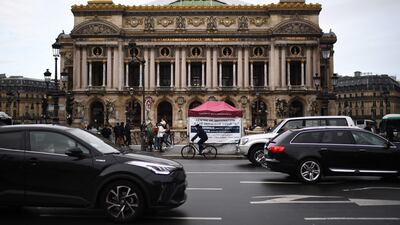
A cyclist rides past a tent where patients are undergoing coronavirus tests, at the Opera square in Paris. AFP -
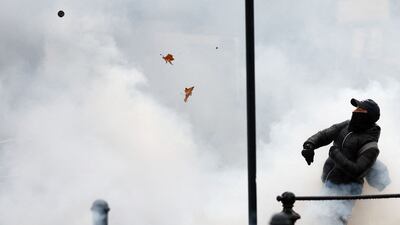
A protestor in Nantes, France throws a tear gas canister during a demonstration against a bill that would transform the country's current coronavirus health pass into a 'vaccine pass'. Reuters -

A group of young students wearing masks disinfect their hands before entering the Luis Amigo school after the Christmas holidays, in Pamplona, northern Spain. AP -
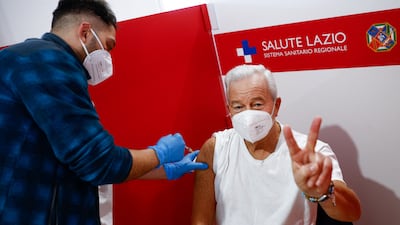
A man receives a dose of a Covid-19 vaccine at a Red Cross centre in Rome. Reuters -
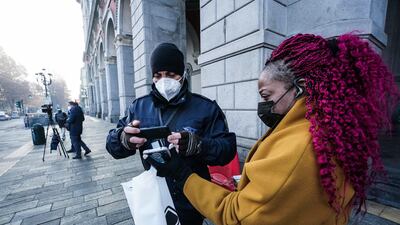
Traffic police check the green pass of public transport passengers in Turin, Italy. EPA -
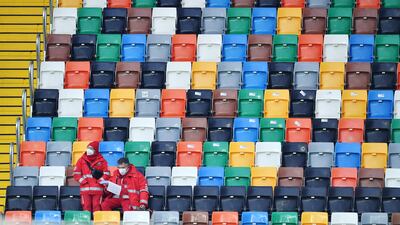
Empty seats inside the stadium before a football match between Udinese and Atalanta, as coronavirus restrictions limit the capacity to 50 percent in Udine, Italy. Reuters -

People sit in a waiting area in case of an immediate reaction after receiving booster shots at a Covid-19 vaccination centre set up in Schiphol Airport in Amsterdam. AFP -
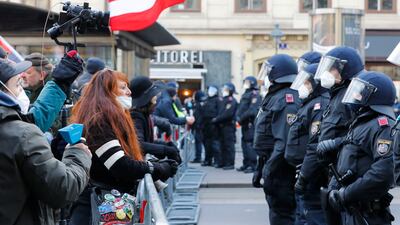
People in Vienna scream at police as officers stop a demonstration against Austria's coronavirus restrictions. AP


Doctors have also been warning that the rise of Covid-19 patients in recent weeks creates the risk that hospitals will not be able to perform regular operations or offer proper care to non-Covid-19 patients.
Italy, where the coronavirus outbreak began in Europe in February 2020, has fully vaccinated 86 per cent of its population aged 12 and over, and nearly 75 per cent of those who are eligible have received a booster.
But 2 million people of Italy’s population of 60 million are infected, affecting essential services.
School districts have complained that they do not have enough teachers to reopen, because so many are infected or in quarantine.
Two southern regions, Sicily and Campania, which includes Naples, defied the government by keeping their schools closed on Monday.
But after a parent challenged the closure in court, the schools in Campania were ordered to reopen on Tuesday.
Mr Draghi said he wanted to depart from the previous government’s decision to close schools during the first year of the pandemic, saying they were “fundamental to democracy.”
“We want to be cautious, very cautious, but also to minimise the economic and social effects, but above all on kids, who suffered the most” by the long school closures, he said.
Young people “in the evening go to pizzerias, they do sports all afternoon", Mr Draghi said. ”It makes no sense to close schools and to not close the rest” of society.
Italian teachers are required to be vaccinated and about 99 per cent are, Education Minister Patrizio Bianchi said.

