• Jannik, 9, gets vaccinated in an airplane at Cologne Bonn Airport in Germany. The city is hosting a special vaccination event for children aged 5 to 11 in a decommissioned Airbus A300 Zero G. EPA
    Jannik, 9, gets vaccinated in an airplane at Cologne Bonn Airport in Germany. The city is hosting a special vaccination event for children aged 5 to 11 in a decommissioned Airbus A300 Zero G. EPA
  • People place candles in Neumarkt Square, Dresden to commemorate the 1,400 lives lost to the coronavirus in the German city. AFP
    People place candles in Neumarkt Square, Dresden to commemorate the 1,400 lives lost to the coronavirus in the German city. AFP
  • Pupils take a sample for a rapid test during the first lesson after Christmas holidays at the Freiherr-vom-Stein secondary school in Bonn, western Germany. AFP
    Pupils take a sample for a rapid test during the first lesson after Christmas holidays at the Freiherr-vom-Stein secondary school in Bonn, western Germany. AFP
  • Protesters demonstrate against Covid-19 measures and compulsory vaccination in Frankfurt, Germany. AP
    Protesters demonstrate against Covid-19 measures and compulsory vaccination in Frankfurt, Germany. AP
  • A cyclist rides past a tent where patients are undergoing coronavirus tests, at the Opera square in Paris. AFP
    A cyclist rides past a tent where patients are undergoing coronavirus tests, at the Opera square in Paris. AFP
  • A protestor in Nantes, France throws a tear gas canister during a demonstration against a bill that would transform the country's current coronavirus health pass into a 'vaccine pass'. Reuters
    A protestor in Nantes, France throws a tear gas canister during a demonstration against a bill that would transform the country's current coronavirus health pass into a 'vaccine pass'. Reuters
  • A group of young students wearing masks disinfect their hands before entering the Luis Amigo school after the Christmas holidays, in Pamplona, northern Spain. AP
    A group of young students wearing masks disinfect their hands before entering the Luis Amigo school after the Christmas holidays, in Pamplona, northern Spain. AP
  • A man receives a dose of a Covid-19 vaccine at a Red Cross centre in Rome. Reuters
    A man receives a dose of a Covid-19 vaccine at a Red Cross centre in Rome. Reuters
  • Traffic police check the green pass of public transport passengers in Turin, Italy. EPA
    Traffic police check the green pass of public transport passengers in Turin, Italy. EPA
  • Empty seats inside the stadium before a football match between Udinese and Atalanta, as coronavirus restrictions limit the capacity to 50 percent in Udine, Italy. Reuters
    Empty seats inside the stadium before a football match between Udinese and Atalanta, as coronavirus restrictions limit the capacity to 50 percent in Udine, Italy. Reuters
  • People sit in a waiting area in case of an immediate reaction after receiving booster shots at a Covid-19 vaccination centre set up in Schiphol Airport in Amsterdam. AFP
    People sit in a waiting area in case of an immediate reaction after receiving booster shots at a Covid-19 vaccination centre set up in Schiphol Airport in Amsterdam. AFP
  • People in Vienna scream at police as officers stop a demonstration against Austria's coronavirus restrictions. AP
    People in Vienna scream at police as officers stop a demonstration against Austria's coronavirus restrictions. AP

How can the common cold help fight Covid?


Neil Murphy
  • English
  • Arabic

Live updates: follow the latest news on Covid-19 variant Omicron

Scientists hope analysis of T-cells could pave the way for a new generation of Covid-19 vaccines that are more resistant to troubling variants.

A study by Imperial College London looked at T-cells generated by the common cold in 52 people.

All were household contacts of people who had tested positive for Covid-19, and at the start of the study all had tested negative.

Within days, half of this group tested positive.

Researchers then examined blood samples of the 26 who were not infected. Significantly more T-cells were found in this cohort than in the people who caught the virus.

The findings of the study, which began in September 2020, suggest that the T-cells produced in previous infections with the common cold recognise the Sars-CoV-2 virus and help reduce the chance of infection.

“Being exposed to the Sars-CoV-2 virus doesn’t always result in infection, and we’ve been keen to understand why,” said Rhia Kundu, the study’s lead author and a researcher at Imperial’s National Heart and Lung Institute.

“We found that high levels of pre-existing T-cells, created by the body when infected with other human coronaviruses like the common cold, can protect.”

T-cells are believed to stay in the body longer compared with antibodies.

The authors of the study, published on Monday in Nature Communications, also said that the internal proteins of the Sars-CoV-2 virus, which are targets of the T cells, could be a new target for vaccine makers.

Several current Covid-19 vaccines target the spike protein. But certain mutations, such as those seen in the Delta and Omicron variants, can make the spike harder to recognise, reducing the shots’ efficacy.

“In contrast, the internal proteins targeted by the protective T-cells we identified mutate much less,” Professor Ajit Lalvani, co-author of the study, said.

“Consequently, they are highly conserved between the various Sars-CoV-2 variants, including Omicron. New vaccines that include these conserved, internal proteins would therefore induce broadly protective T-cell responses that should protect against current and future Sars-CoV-2 variants.”

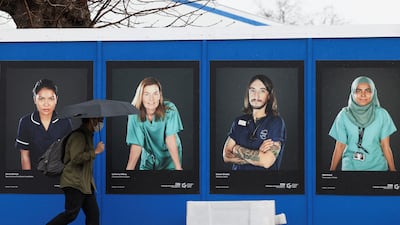
  • Images of NHS workers displayed on hoardings outside a temporary field hospital at St George's Hospital in London. The UK declared 141,472 new Covid-19 cases on Sunday, a sharp reduction from the more than 200,000 reported daily over the Christmas and New Year period. Reuters
    Images of NHS workers displayed on hoardings outside a temporary field hospital at St George's Hospital in London. The UK declared 141,472 new Covid-19 cases on Sunday, a sharp reduction from the more than 200,000 reported daily over the Christmas and New Year period. Reuters
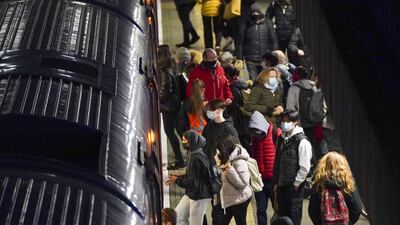
  • Commuters wait to catch a London-bound train in Bracknell, Berkshire. Workers are returning to offices in the first full working week of 2022 even though guidance under England’s current plan B measures is to work from home. PA
    Commuters wait to catch a London-bound train in Bracknell, Berkshire. Workers are returning to offices in the first full working week of 2022 even though guidance under England’s current plan B measures is to work from home. PA
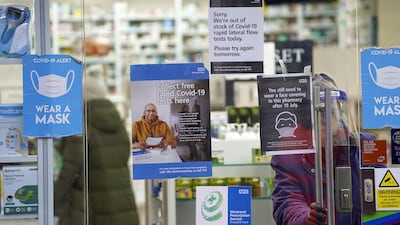
  • No lateral flow tests are available at this pharmacy in Chertsey, Surrey. PA
    No lateral flow tests are available at this pharmacy in Chertsey, Surrey. PA
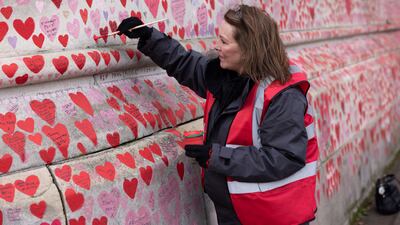
  • A woman adds hearts to the National Covid Memorial Wall near St Thomas' Hospital in London. Getty Images
    A woman adds hearts to the National Covid Memorial Wall near St Thomas' Hospital in London. Getty Images
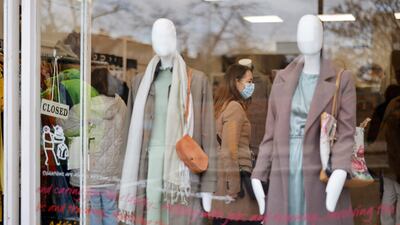
  • A shopper wearing a face covering browses clothes in a charity shop in north London. AFP
    A shopper wearing a face covering browses clothes in a charity shop in north London. AFP
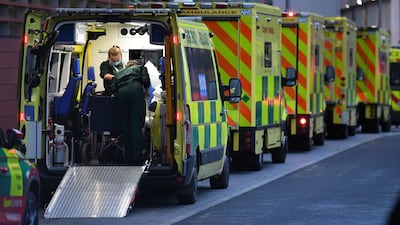
  • Ambulances parked outside the Royal London Hospital in east London. AFP
    Ambulances parked outside the Royal London Hospital in east London. AFP
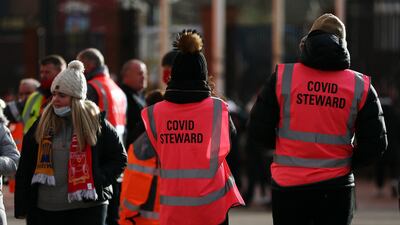
  • Fans show their coronavirus passes for checking outside Anfield stadium before the FA Cup tie between Liverpool and Shrewsbury Town, which the home side won 4-1. Reuters
    Fans show their coronavirus passes for checking outside Anfield stadium before the FA Cup tie between Liverpool and Shrewsbury Town, which the home side won 4-1. Reuters
  • People take part in the so-called Freedom Rally, an anti-vaccine demonstration organised by campaign group Scotland Against Lockdown, in Glasgow city centre. PA
    People take part in the so-called Freedom Rally, an anti-vaccine demonstration organised by campaign group Scotland Against Lockdown, in Glasgow city centre. PA
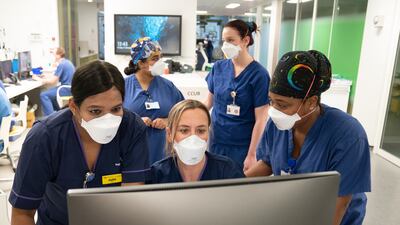
  • Staff working at a Covid-19 intensive care unit at Kings College Hospital in south London. PA
    Staff working at a Covid-19 intensive care unit at Kings College Hospital in south London. PA

What are T-cells?

T-cells are white blood cells produced in bone marrow. A core component of the immune system, they and work in tandem with antibodies to attack infected cells.

It is believed that humanity’s best vaccines, such as MMR, the combined shot against measles, mumps and rubella, generate both types of immunity but the optimal balance of antibodies and T cells is not known.

Compared with antibodies, T-cells tend to survive longer in the body and continue to kill infected cells, preventing serious illness.

They also tend to attack a wider variety of related pathogens than antibodies, which allows for a greater degree of cross-protection across different viruses or strains, according to the UK’s Science Media Centre.

Immunity against Covid-19 is a complex picture and some evidence has long pointed to waning antibody levels six months after vaccination.

Last year, the chief executive of AstraZeneca, Pascal Soriot, strongly implied, but could not prove, that his company’s viral vector vaccine was likely to produce a more robust T-cell response compared with shots that use mRNA technology.

He suggested that mRNA vaccines showed a waning antibody response may be linked to rising hospital admissions among older people in the EU, where relatively few people aged 60-plus received the AstraZeneca shot. Some scientists have rejected this theory.


Updated: January 11, 2022, 5:30 AM