
Live updates: follow the latest news on Covid-19 variant Omicron
British troops are to take up postings in London to support a National Health Service faced with growing staff shortages because of Covid-19, the Ministry of Defence said.
About 200 armed forces personnel are being made available to hospitals across the capital, which has been the centre of the Omicron outbreak with a surge in case numbers.
UK Prime Minister Boris Johnson said this week that ministers hoped to “ride out” the latest wave without the need for further restrictions in England.
Despite the deployment of the military personnel, there were signs this week that the Omicron wave sweeping across Britain could be slowing.
On Thursday the UK announced 179,756 new cases, a drop from the record 218,000 infections announced on Tuesday.
Thursday’s figures marked the second day of falling numbers and offered hope that the winter surge of Covid may be starting to tail off.
The ministry said personnel being made available to hospitals include 40 military medics and 160 general duty personnel to help fill gaps caused by NHS staff being unable to work because of illness or isolation.
They will be sent in 40 teams of five — one medic and four support personnel — and will go to areas where the need is greatest.
It is expected they will be “on task” for the next three weeks.
Thirty-two military responders are also being provided to support the South Central Ambulance Service, working alongside paramedics until the end of March.
“The men and women of our armed forces are once again stepping up to support their dedicated colleagues in the NHS as they work hand-in-hand to protect the nation from Covid-19,” said Defence Secretary Ben Wallace.
“They have shown their worth time and again throughout this pandemic, whether driving ambulances, administering vaccines or supporting patients in hospital, and they should be proud of their contribution to this truly national effort.”
-

A woman passes Britain's National Covid Memorial Wall, in Westminster, London. The UK has recorded more than 200,000 coronavirus cases in a day for the first time. PA -
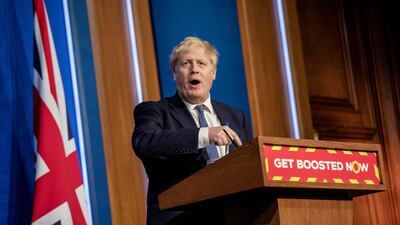
Prime Minister Boris Johnson attends a briefing on the coronavirus pandemic. Reuters -
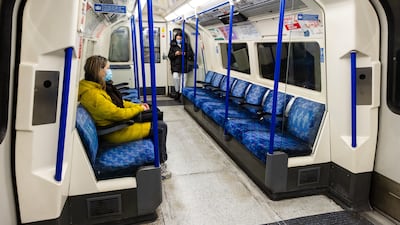
Two women wearing face masks sit in an empty Tube train in London. The latest figures indicate that 1.2 million Britons have tested positive for Covid-19 over the past week. EPA -
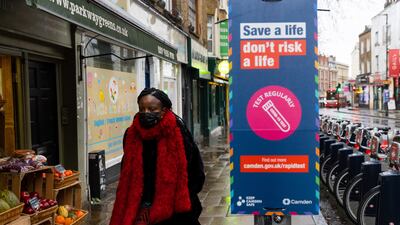
A woman walks past a Covid-19 testing sign in London. EPA -
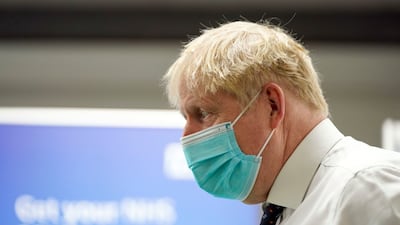
Boris Johnson visits a vaccination centre at Stoke Mandeville Stadium in Aylesbury, England. AP -
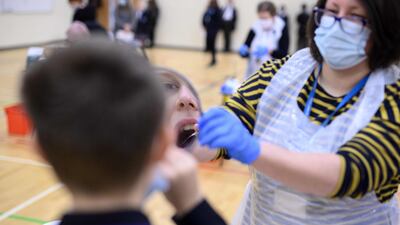
A member of staff at Park Lane Academy in Halifax, England, assists a student as he takes a Covid-19 lateral flow test. AFP -

Overflowing bins in the Walton area of Liverpool, England await collection by refuse workers after coronavirus-related staff shortages. -
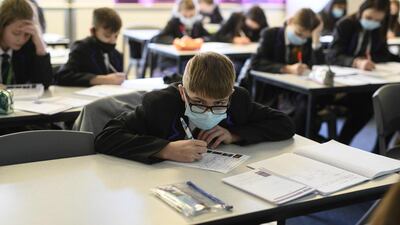
Year 8 students wear masks during class at the Park Lane Academy in Halifax, England. AFP -
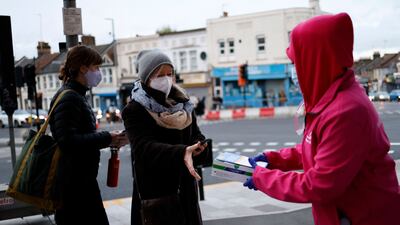
Volunteers hand out boxes of Covid-19 lateral flow tests in north-east London. AFP -
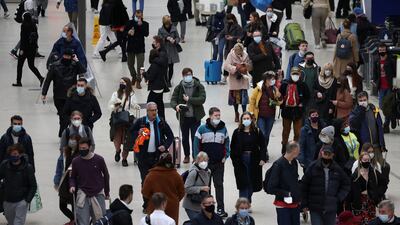
People wearing protective masks walk through Waterloo train station in London. Reuters -
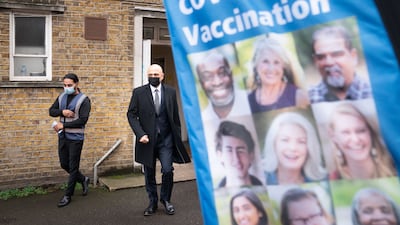
Health Secretary Sajid Javid visits the Montgomery Hall vaccination centre in Kennington, south London. PA -
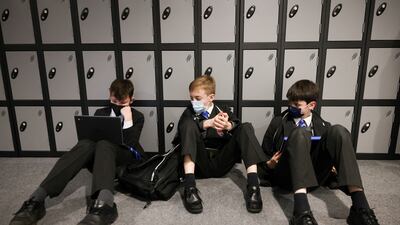
Pupils sit next to lockers at the Fulham Boys School in London. Reuters -
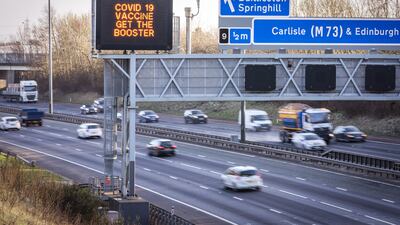
Information signs above the M8 motorway in Glasgow, Scotland. PA -
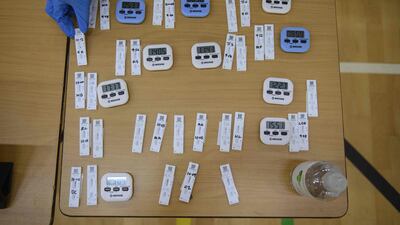
Staff at Park Lane Academy in Halifax process students' Covid-19 lateral flow rapid antigen tests. AFP -

A sign advising customers that there are no lateral flow test kits available in the window of Wanstead Pharmacy in east London. PA


But the Royal College of Nursing’s director for England, Patricia Marquis, said sending in the military meant the government could no longer deny there was a “staffing crisis” in the NHS.
“The prime minister and others can no longer be dismissive of questions about the ability of NHS staff to deliver safe care,” Ms Marquis said.
“Once the military has been brought in, where does the government turn next in its bid to ‘ride out’ the wave rather than deal with it?”
About 1,800 service personnel are already posted across the UK to support civil authorities in their response to the pandemic.
They include 313 people who have been made available to the Welsh Ambulance Service NHS Trust and 96 to the Scottish Ambulance Service.
More than 1,000 service personnel are supporting the vaccine booster programme.
The Mod said troops would also be sent to hospitals in the north of England to help them cope under the strain of the Omicron wave.
James Heappey, minister for the armed forces, said the troops would help hospitals cope with “an extraordinary situation that has put the NHS on a war footing”.
Matthew Taylor, chief executive of the NHS Confederation, said the Omicron crisis is “moving up the country” and said it is essential for NHS staff to have access to tests so that they can return to work.
“We’ve suggested that as a very short-term expedient we should think about clinical students working at the front line — we don’t want that to happen for long, but that’s something again we’ve done in the past,” he said.
“We are in a very, very difficult set of circumstances — we all hope this will last a few weeks, but in those circumstances we have to do everything we can, and we as the public have to understand the pressure the health service is in.”
The latest data from NHS England shows 39,142 NHS staff at hospital trusts in England were absent for Covid reasons on January 2, up 59 per cent on the previous week (24,632) and more than three times the number at the start of December (12,508).
In north-west England 7,338 NHS staff at hospital trusts were absent due to the virus on January 2, up 85 per cent week-on-week from 3,966, while in north-east England and Yorkshire there were 8,788 absences, more than double the number a week earlier.
In London, absences were up 4 per cent week-on-week, from 4,580 to 4,765.
Overall, there were 82,384 NHS staff at hospital trusts in England who were absent for all sickness reasons on January 2, including self-isolation and mental health reasons, up 21 per cent on the previous week (68,082) and up 37 per cent from the start of December (60,136).
NHS national medical director Professor Stephen Powis said rising number of cases were “piling even more pressure” on hospital trust workers.
“Omicron means more patients to treat and fewer staff to treat them,” he said.
“In fact, around 10,000 more colleagues across the NHS were absent each day last week compared with the previous seven days and almost half of all absences are now down to Covid.”
As of Friday morning, there were 16 hospital trusts in England that were in critical measures.
On Wednesday evening there were more than 20 hospitals which had announced critical incidents, which are declared when a trust believes it may not be able to provide priority services to patients, such as emergency care.
Small business minister Paul Scully reiterated the prime minister’s view that additional restrictions were not needed at this stage to tackle the crisis.
He said ministers would review the Plan B package in place before January 26 and decide whether to impose tighter restrictions.
Asked about the economic damage caused by millions of people working from home, Mr Scully said the government’s move was the “right thing to do” but also said: “We’ve said we are sticking to Plan B at the moment … but clearly we’ve got to get that difficult balance right.”
Mr Scully was also pressed about reports suggesting cabinet members were at odds about what direction the country should take.
The Times reported that Health Secretary Sajid Javid was strongly opposed to the decision to ease some travel testing measures and believes more lockdowns could be on the horizon.
Mr Javid is understood to have argued in a Covid-O cabinet committee meeting this week that removing the PCR pre-departure test requirement for travellers could lead to “having to shut down the entire economy”.
But Mr Scully rejected the notion that full nationwide shutdowns were necessary, telling Sky News: “I don’t believe at this stage that we need any more lockdowns.
“What we are doing today is announcing the fact that the money for hospitality, retail, leisure and accommodation is available now for those businesses who have been hard pressed throughout this pandemic, and especially that Christmas period when Plan B came in, for those businesses to be able to approach their local authorities and get the financial support they need,” Mr Scully said.
“But what we’ve got to do is make sure we can balance the needs of everybody in what is an incredibly difficult situation — the pressures on the NHS, but also the pressures on the economy, the pressures on households, jobs, livelihoods, and indeed money that is coming in to pay for the public services in the first place.”
He said vaccination “remains our best weapon against the pressures on the NHS” and urged people to come forward for boosters.
Paul Whiteman, general secretary of the NAHT, said just days after children returned to classrooms that schools were “teetering on the edge” with considerable staffing shortages.
Meanwhile, the Welsh government has said that Alert 2 measures introduced after Christmas — including limits on people mixing — will remain in place for at least another week.
After the latest review of the regulations, First Minister Mark Drakeford said the country was facing a “difficult month ahead” as case numbers, which have risen to their highest levels yet, look likely to surge further.

