


The UAE's comprehensive economic partnership agreements (Cepas) with countries around the world are opening “new pathways for green investments”, its trade minister has said, noting that global trade can hasten the adoption of climate change policies.
Investments in the energy transition and renewables are a key part of the UAE's Cepas, which aim to boost bilateral trade and investment flows, Dr Thani Al Zeyoudi, Minister of State for Foreign Trade, told a Cop28 panel on Monday.
Easing customs procedures and other barriers is also “critical” to avoid a situation in which commodities spend more time at the ports of the Emirates and its trade partners, he said.
“The consequence of this is reducing the carbon footprint from both sides,” Dr Al Zeyoudi said.
The UAE is working towards signing 26 Cepas as it seeks to attract more investment and to diversify its economy.
It has signed Cepas with India, Israel, Turkey, Indonesia, Cambodia and Georgia, each of which are designed to boost economic activity and secure vital supply chains. The first four agreements have already come into effect.
Dr Al Zeyoudi's remarks came during a day dedicated to trade talks at the UN climate summit in Dubai.
In past UN climate gatherings, trade players were almost completely absent or seen as part of the problem.
However, Cop28 in Dubai has been more inclusive, with a dedicated trade-themed day and a trade pavilion, World Trade Organisation's director general Ngozi Okonjo-Iweala said on Monday.
-
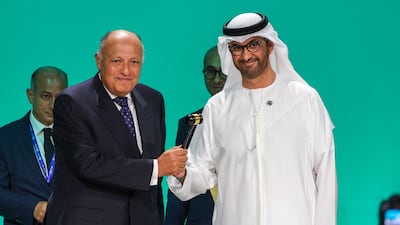
Cop27 President Sameh Shoukry, left, hands over the gavel to Cop28 President Dr Sultan Al Jaber at the UN climate conference's opening ceremony. AFP -
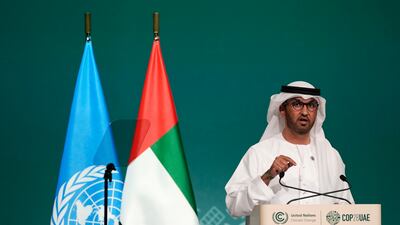
Dr Sultan Al Jaber speaks during the opening session at Expo City Dubai. AP -
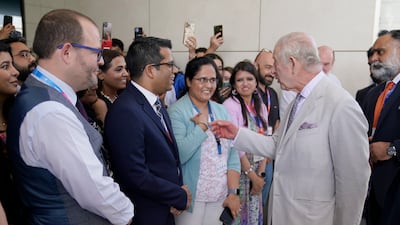
King Charles III visiting Heriot-Watt University Dubai Campus during the Cop28 summit. PA -

Sameh Shoukry, Cop27 President, centre, attends the opening session. AP -
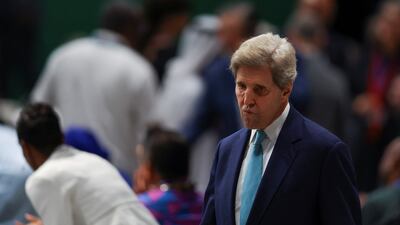
US Special Presidential Envoy for Climate John Kerry attends the Cop28 opening session. Reuters -

Raquel Sousa Chaves from Brazil at Cop28. Chris Whiteoak / The National -

Visitors on the first day of Cop28. Chris Whiteoak / The National -

Recyclable wind turbines on show on the first day of Cop28. Chris Whiteoak / The National -

A plant-based food cafe at Cop28. Chris Whiteoak / The National -

Vegan activists on the first day of Cop28. Chris Whiteoak / The National -

Pollution Pods, an installation by British artist Michael Pinsky, where Cop28 visitors can safely experience the air pollution in Beijing and other cities. Chris Whiteoak / The National -

Indigenous leaders and climate campaigners are among the attendees at Cop28. Chris Whiteoak / The National -

Fair-trade vegan chocolate being handed out at Cop28. Chris Whiteoak / The National -

Day one at Cop28, Dubai. Chris Whiteoak / The National -

Cop28, Dubai Expo City. Chris Whiteoak / The National -

The first day of Cop28. Chris Whiteoak / The National -

Cop28, Dubai. Chris Whiteoak / The National -

The first day of Cop 28 at Expo City, Dubai. Chris Whiteoak / The National -
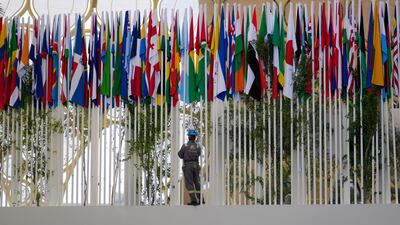
National flags on display at the UN climate summit. AP -
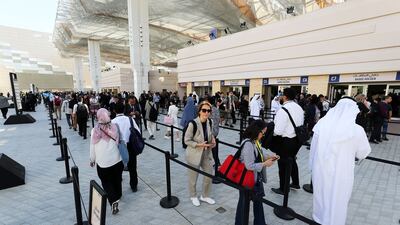
Delegates arriving for the opening of Cop28. Pawan Singh / The National -
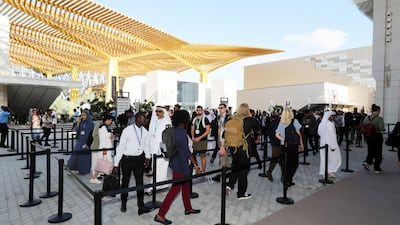
More than 70,000 delegates, including world leaders, climate scientists, business leaders and young people, are expected to attend. Pawan Singh / The National -
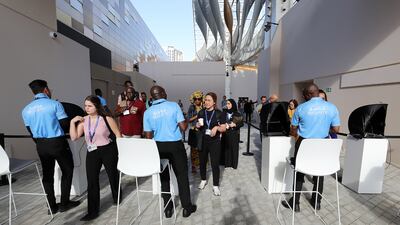
Delegates will engage in a stock take to see how pledges to limit global warming are being implemented. Pawan Singh / The National -

The summit aims to keep on track efforts to restrict global warming to less than 1.5C above pre-industrial levels. Pawan Singh / The National -

Hora – The Unity Dance artwork, by Marius Diaconu, on display at Cop28. Chris Whiteoak / The National -

Cop28 runs until December 12. Chris Whiteoak / The National


“We cannot get to net-zero [goals] without trade because it is indispensable for spreading low-carbon technology everywhere it is needed,” she said.
The World Trade Organisation issued a white paper during the Cop28 conference on how incorporating trade policy tools, such as the review of import tariffs on low-carbon goods, into national strategies can help economies mitigate the effects of climate change.
The WTO's policy recommendations include speeding up customs clearance and reducing greenhouse gas emissions stemming from inefficient customs procedures and road freight, according to its report.
Adopting trade facilitation measures, such as the use of electronic documentation, can help to reduce border control delays and related energy consumption, leading to emissions reductions of up to 85 per cent at certain land border crossings, according to the WTO.
The digitalisation of paper-based trade processes could also reduce waste and lower associated emissions by as much as 63 per cent per invoice.
One of the key challenges facing global trade in reducing its environmental footprint is customs delays at borders, which leads to lorries idling and consuming fuel without moving cargo, Sultan bin Sulayem, chairman and group chief executive of global ports operator DP World, said during the panel discussion.
Countries can also lower carbon emissions by using government procurement as a tool, the WTO said.
Government procurement of goods and services accounts for about 13 per cent of world gross domestic product (about $13 trillion per year). However, it is estimated to be directly or indirectly responsible for 15 per cent of greenhouse gas emissions.
Focusing on green government procurement policies can significantly reduce emissions while producing major economic benefits, such as new green jobs and enhanced energy efficiency, the WTO report said.
Countries can also revise their current import tariffs, which tend to be lower for carbon-intensive industries than clean industries, it said.
For example, key fossil fuels such as crude oil and coal face average applied tariffs of 0.8 and 1.6 per cent, respectively, in the top 10 importing markets while renewable energy equipment faces average tariffs of 3.2 per cent, with some members applying tariffs as high as 12 per cent, it said.
In the automotive sector, low-carbon vehicles exported to major markets face applied tariffs that are 1.6 to 3.9 percentage points higher than for conventional combustion vehicles.
“Import tariffs could be reviewed with a view to promoting the affordability and uptake of products such as renewable energy equipment and electric vehicles needed for the transition to a low-carbon economy,” the WTO said.
Governments can also unlock additional money to assist climate action by reforming environmentally harmful subsidies, the report said.
The WTO recommends increasing trade finance, such as trade credit and insurance/guarantees, to help support SMEs, women-led businesses and climate-related technologies.

