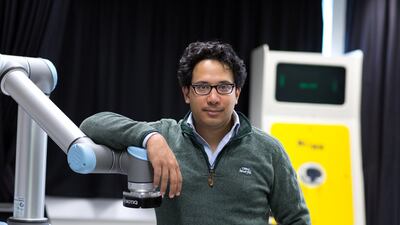
Aldo Faisal is professor of AI and Neuroscience at the Departments of Computing and Bioengineering at Imperial College London. Courtesy Imperial College London

How Artificial Intelligence has played a major role in fighting Covid


Layla Maghribi
  • English
  • Arabic

From the personal to the professional and the micro to the macro-economic, the pandemic has highlighted just how crucial the state of global health – and the policies that underpin it – are to our collective survival and prosperity. Perhaps lesser appreciated, but certainly no less significant, is just how big a part Artificial Intelligence has to play, says a leading expert in the field.

“We’ve had an unprecedented amount of sharing of data globally, of live daily updates on data across the board, whether it has to do with death rates or infection rates. In the UK, we had our live tracker, we have track-and-trace that also collected data. All of this is underpinning the work that was being done to fight Covid. It is also what is ultimately the foundation for artificial intelligence,” says Aldo Faisal, Professor of AI and Neuroscience at the Departments of Computing and Bioengineering at Imperial College London.

Prof Faisal leads the Brain and Behaviour Lab, which uses and develops statistical AI techniques to analyse data and predict behaviour, as well as producing medical-related robotics. Last year he was awarded a five-year UK Research and Innovation Turing AI Fellowship to develop an "AI Clinician" that will help doctors make complex decisions and relieve pressure on the NHS.

Having spent years harnessing the power of AI to develop better health care, Covid-19 was certainly no exception and Prof Faisal redirected a large portion of his lab's resources to the national effort at the outset of the pandemic.

Just last month he and a team of researchers revealed their work in using machine learning to predict which Covid-19 patients in intensive care units might get worse and not respond positively to being turned on to their stomachs – a technique that is commonly used to improve oxygenation of the lungs.

“This only happened because we look at the trajectories of patients on a daily basis,” says Prof Faisal, who first studied in Germany, where he received a number of awards and distinctions, before continuing his education as a Junior Fellow at the University of Cambridge.

Formula E racing driver Lucas di Grassi during an experiment. Courtesy Imperial College London

In collaboration with a digital healthcare company his lab ran a survey of Covid-19 symptoms worldwide with one million respondents which, though not yet peer-reviewed, has shown that standard Covid-19 symptoms, such as loss of taste and smell, are not consistent across countries.

"Suddenly symptoms in Africa or India present themselves very differently from symptoms in Europe. Why is that important? Because we're always talking about asymptomatic transmission, and the challenges [involved]," the German-born professor tells The National.

From lung scan imaging for preliminary detection to the rapid review of research and, of course, the worldwide dissemination of mortality figures, algorithms have been deployed far and wide to help better understand and combat the virus.

“I've seen things advance in weeks, that would have taken probably a decade to happen. And the question is, how much of that legacy experience from a citizen's viewpoint is going to transform in the long term? What is acceptable?” asks Prof Faisal, who is also the Founding Director of the £20 million ($28.3m) UKRI Centre for Doctoral Training in AI for Healthcare.

Privacy, data and bias remain the omnipresent issues trailing behind the proliferation of AI across sectors, but a public health emergency like Covid-19 tends – for better or worse – to quieten such resistance.

There is a massive shortage of doctors worldwide. What AI can do is address some of the unmet personnel needs

Nevertheless, ardent proponents of AI welcome the legislative safeguards and frameworks they say would help foster greater trust among the public, as well as increased collaboration among institutions.

Addressing an online forum of AI Healthcare experts earlier this year, the Conservative MP and former Minister of State, George Freeman, said governments had a difficult but important role to play in instilling excitement instead of fear into the public. "The big challenge in this space is to create a trust framework where people out on the streets can have confidence that this big system for using massive computer power to find value in the healthcare system is working for them, not on them," said the founder of Reform for Resilience, an international initiative aimed at promoting strategic reform of health care.

Mr Freeman said the steady rise in the wellness and wearable technology in healthcare industries suggests people are increasingly willing to take responsibility for their health but needed better architecture to do so.

“We need to set some global international protocols and standards for what is and is not legitimate good practice use of AI,” he said at the online forum.

“I think we need to frame AI within a UK system approach in which the public would have real trust that we're going to embed that properly in a system that will make the sacrifices of this last year mean that the next generation don't have to experience it.”

Regardless of where the legislation is going, the increased integration of health care with personal digital technologies is unlikely to turn back. Utilising AI does not, however, mean dispensing with doctors and medical professionals, says Amr Nimer, a neurosurgeon at Imperial College NHS Trust and a colleague of Prof Faisal.

"There is a massive shortage of doctors worldwide. What AI can do is address some of the unmet personnel needs. The idea behind the deployment of AI agents is not to replace doctors or healthcare professionals, but to help automate some of the tasks that can be done much more efficiently by machines, so that we as healthcare professionals can concentrate on actual patient care. AI will augment, rather than replace, healthcare professionals," Mr Nimer told The National.

Over the past year the Dubai-born neurosurgeon has been working with Prof Faisal in the Brain Behaviour Lab on a project to train surgeons using AI.

"It's based on the principles of economy of movement and surgical efficacy. We use state-of-the art motion sensors to collect movement data from expert surgeons, and then utilise AI algorithms to answer the questions: what defines manual surgical expertise, or what makes an expert, an expert? What does behavioural data show us about the manual skills of surgical experts [versus] novices? Once we have an entirely data-driven objective definition of expertise in a particular procedure, we can use AI algorithms to help junior surgeons perform that procedure much more efficiently on models, rather than practising on patients first," Mr Nimer said.

Showing the wide applicability of AI, this research project shares similar research principles with that undertaken by Prof Faisal’s team last year with Formula E World Champion, Lucas di Grassi. Wearing a wireless electroencephalogram helmet to track his brain activity, the racing driver’s eye and body movements were monitored under real-time extreme conditions. The first-time experiment aimed to better understand how an expert driver performs, so that more targeted and useful information can be given to self-driving cars.

After more than a year responding to the severities of Covid-19, the healthcare system is overwhelmingly strained. The long-term direct and indirect health effects of the virus are still revealing themselves, but initial assessments suggest a long road of continued care ahead and waiting times to treat other illnesses are now several years long. Healthcare facilities will need a huge injection of both human and financial capital, as well as the latest technology has to offer in order to cope.

The crisis precipitated a hastening of AI’s foray into the medical sphere with an unprecedented sharing of data and collaboration across institutions. With medics facing ominous healthcare challenges for years to come, former sceptics may now be more willing to embrace tech that can lessen the burden. It remains to be seen, however, whether the government can provide the necessary regulatory framework to protect the interests of both the patient and the professional.


Who's who in Yemen conflict

Houthis: Iran-backed rebels who occupy Sanaa and run unrecognised government

Yemeni government: Exiled government in Aden led by eight-member Presidential Leadership Council

Southern Transitional Council: Faction in Yemeni government that seeks autonomy for the south

Habrish 'rebels': Tribal-backed forces feuding with STC over control of oil in government territory

The President's Cake

Director: Hasan Hadi

Starring: Baneen Ahmad Nayyef, Waheed Thabet Khreibat, Sajad Mohamad Qasem 

Rating: 4/5

Arabian Gulf League fixtures:

Friday:

  • Emirates v Hatta, 5.15pm
  • Al Wahda v Al Dhafra, 5.25pm
  • Al Ain v Shabab Al Ahli Dubai, 8.15pm

Saturday:

  • Dibba v Ajman, 5.15pm
  • Sharjah v Al Wasl, 5.20pm
  • Al Jazira v Al Nasr, 8.15pm
Saudi Cup race day

Schedule in UAE time

5pm: Mohamed Yousuf Naghi Motors Cup (Turf), 5.35pm: 1351 Cup (T), 6.10pm: Longines Turf Handicap (T), 6.45pm: Obaiya Arabian Classic for Purebred Arabians (Dirt), 7.30pm: Jockey Club Handicap (D), 8.10pm: Samba Saudi Derby (D), 8.50pm: Saudia Sprint (D), 9.40pm: Saudi Cup (D)

Dengue%20fever%20symptoms
%3Cp%3EHigh%20fever%20(40%C2%B0C%2F104%C2%B0F)%3Cbr%3ESevere%20headache%3Cbr%3EPain%20behind%20the%20eyes%3Cbr%3EMuscle%20and%20joint%20pains%3Cbr%3ENausea%3Cbr%3EVomiting%3Cbr%3ESwollen%20glands%3Cbr%3ERash%26nbsp%3B%3C%2Fp%3E%0A

Mercer, the investment consulting arm of US services company Marsh & McLennan, expects its wealth division to at least double its assets under management (AUM) in the Middle East as wealth in the region continues to grow despite economic headwinds, a company official said.

Mercer Wealth, which globally has $160 billion in AUM, plans to boost its AUM in the region to $2-$3bn in the next 2-3 years from the present $1bn, said Yasir AbuShaban, a Dubai-based principal with Mercer Wealth.

Within the next two to three years, we are looking at reaching $2 to $3 billion as a conservative estimate and we do see an opportunity to do so,” said Mr AbuShaban.

Mercer does not directly make investments, but allocates clients’ money they have discretion to, to professional asset managers. They also provide advice to clients.

“We have buying power. We can negotiate on their (client’s) behalf with asset managers to provide them lower fees than they otherwise would have to get on their own,” he added.

Mercer Wealth’s clients include sovereign wealth funds, family offices, and insurance companies among others.

From its office in Dubai, Mercer also looks after Africa, India and Turkey, where they also see opportunity for growth.

Wealth creation in Middle East and Africa (MEA) grew 8.5 per cent to $8.1 trillion last year from $7.5tn in 2015, higher than last year’s global average of 6 per cent and the second-highest growth in a region after Asia-Pacific which grew 9.9 per cent, according to consultancy Boston Consulting Group (BCG). In the region, where wealth grew just 1.9 per cent in 2015 compared with 2014, a pickup in oil prices has helped in wealth generation.

BCG is forecasting MEA wealth will rise to $12tn by 2021, growing at an annual average of 8 per cent.

Drivers of wealth generation in the region will be split evenly between new wealth creation and growth of performance of existing assets, according to BCG.

Another general trend in the region is clients’ looking for a comprehensive approach to investing, according to Mr AbuShaban.

“Institutional investors or some of the families are seeing a slowdown in the available capital they have to invest and in that sense they are looking at optimizing the way they manage their portfolios and making sure they are not investing haphazardly and different parts of their investment are working together,” said Mr AbuShaban.

Some clients also have a higher appetite for risk, given the low interest-rate environment that does not provide enough yield for some institutional investors. These clients are keen to invest in illiquid assets, such as private equity and infrastructure.

“What we have seen is a desire for higher returns in what has been a low-return environment specifically in various fixed income or bonds,” he said.

“In this environment, we have seen a de facto increase in the risk that clients are taking in things like illiquid investments, private equity investments, infrastructure and private debt, those kind of investments were higher illiquidity results in incrementally higher returns.”

The Abu Dhabi Investment Authority, one of the largest sovereign wealth funds, said in its 2016 report that has gradually increased its exposure in direct private equity and private credit transactions, mainly in Asian markets and especially in China and India. The authority’s private equity department focused on structured equities owing to “their defensive characteristics.”

JUDAS AND THE BLACK MESSIAH

Directed by: Shaka King

Starring: Daniel Kaluuya, Lakeith Stanfield, Jesse Plemons

Four stars

Day 3 stumps

New Zealand 153 & 249
Pakistan 227 & 37-0 (target 176)

Pakistan require another 139 runs with 10 wickets remaining

The specs: 2018 Nissan Patrol Nismo

Price: base / as tested: Dh382,000

Engine: 5.6-litre V8

Gearbox: Seven-speed automatic

Power: 428hp @ 5,800rpm

Torque: 560Nm @ 3,600rpm

Fuel economy, combined: 12.7L / 100km

The%20specs
%3Cp%3E%3Cstrong%3EEngine%3A%3C%2Fstrong%3E%202-litre%204-cylinder%3Cbr%3E%3Cstrong%3EPower%3A%20%3C%2Fstrong%3E153hp%20at%206%2C000rpm%3Cbr%3E%3Cstrong%3ETorque%3A%20%3C%2Fstrong%3E200Nm%20at%204%2C000rpm%3Cbr%3E%3Cstrong%3ETransmission%3A%20%3C%2Fstrong%3E6-speed%20auto%3Cbr%3E%3Cstrong%3EFuel%20consumption%3A%20%3C%2Fstrong%3E6.3L%2F100km%3Cbr%3E%3Cstrong%3EPrice%3A%20%3C%2Fstrong%3EDh106%2C900%3Cbr%3E%3Cstrong%3EOn%20sale%3A%20%3C%2Fstrong%3Enow%3C%2Fp%3E%0A
Did you know?

Brunch has been around, is some form or another, for more than a century. The word was first mentioned in print in an 1895 edition of Hunter’s Weekly, after making the rounds among university students in Britain. The article, entitled Brunch: A Plea, argued the case for a later, more sociable weekend meal. “By eliminating the need to get up early on Sunday, brunch would make life brighter for Saturday night carousers. It would promote human happiness in other ways as well,” the piece read. “It is talk-compelling. It puts you in a good temper, it makes you satisfied with yourself and your fellow beings, it sweeps away the worries and cobwebs of the week.” More than 100 years later, author Guy Beringer’s words still ring true, especially in the UAE, where brunches are often used to mark special, sociable occasions.

How%20I%20connect%20with%20my%20kids%20when%20working%20or%20travelling
%3Cp%3E%0D%3Cstrong%3ELittle%20notes%3A%20%3C%2Fstrong%3EMy%20girls%20often%20find%20a%20letter%20from%20me%2C%20with%20a%20joke%2C%20task%20or%20some%20instructions%20for%20the%20afternoon%2C%20and%20saying%20what%20I%E2%80%99m%20excited%20for%20when%20I%20get%20home.%0D%3Cbr%3E%3Cstrong%3EPhone%20call%20check-in%3A%20%3C%2Fstrong%3EMy%20kids%20know%20that%20at%203.30pm%20I%E2%80%99ll%20be%20free%20for%20a%20quick%20chat.%0D%3Cbr%3E%3Cstrong%3EHighs%20and%20lows%3A%20%3C%2Fstrong%3EInstead%20of%20a%20%E2%80%9Chow%20was%20your%20day%3F%E2%80%9D%2C%20at%20dinner%20or%20at%20bathtime%20we%20share%20three%20highlights%3B%20one%20thing%20that%20didn%E2%80%99t%20go%20so%20well%3B%20and%20something%20we%E2%80%99re%20looking%20forward%20to.%0D%3Cbr%3E%3Cstrong%3EI%20start%2C%20you%20next%3A%20%3C%2Fstrong%3EIn%20the%20morning%2C%20I%20often%20start%20a%20little%20Lego%20project%20or%20drawing%2C%20and%20ask%20them%20to%20work%20on%20it%20while%20I%E2%80%99m%20gone%2C%20then%20we%E2%80%99ll%20finish%20it%20together.%0D%3Cbr%3E%3Cstrong%3EBedtime%20connection%3A%20%3C%2Fstrong%3EWake%20up%20and%20sleep%20time%20are%20important%20moments.%20A%20snuggle%2C%20some%20proud%20words%2C%20listening%2C%20a%20story.%20I%20can%E2%80%99t%20be%20there%20every%20night%2C%20but%20I%20can%20start%20the%20day%20with%20them.%0D%3Cbr%3E%3Cstrong%3EUndivided%20attention%3A%20%3C%2Fstrong%3EPutting%20the%20phone%20away%20when%20I%20get%20home%20often%20means%20sitting%20in%20the%20car%20to%20send%20a%20last%20email%2C%20but%20leaving%20it%20out%20of%20sight%20between%20home%20time%20and%20bedtime%20means%20you%20can%20connect%20properly.%0D%3Cbr%3E%3Cstrong%3EDemystify%2C%20don%E2%80%99t%20demonise%20your%20job%3A%20%3C%2Fstrong%3EHelp%20them%20understand%20what%20you%20do%2C%20where%20and%20why.%20Show%20them%20your%20workplace%20if%20you%20can%2C%20then%20it%E2%80%99s%20not%20so%20abstract%20when%20you%E2%80%99re%20away%20-%20they%E2%80%99ll%20picture%20you%20there.%20Invite%20them%20into%20your%20%E2%80%9Cother%E2%80%9D%20world%20so%20they%20know%20more%20about%20the%20different%20roles%20you%20have.%3C%2Fp%3E%0A
The team

Videographer: Jear Velasquez 

Photography: Romeo Perez 

Fashion director: Sarah Maisey 

Make-up: Gulum Erzincan at Art Factory 

Models: Meti and Clinton at MMG 

Video assistant: Zanong Maget 

Social media: Fatima Al Mahmoud