
More than 51,000 homes were sold in Dubai in the second quarter of this year, marking a quarterly record amid strong demand from buyers, a report has shown.
The figures are up 22.8 per cent year-on-year, property consultancy Knight Frank said in its report on Wednesday.
In the first half of the year, total home sales reached more than 94,000, putting the market firmly "on track to exceed" 169,000 transactions recorded in 2024, it added.
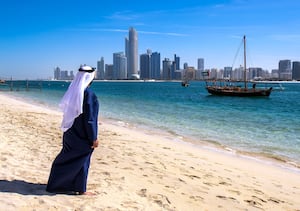
The total value of residential sales in the January to June period also surged to Dh268 billion ($73 billion), a 41 per cent increase compared to the same period last year. The market is poised to surpass the Dh367 billion in home sales reached last year, the consultancy said.
Residential prices grew by an average of 13.7 per cent annually in second quarter, with villa prices rising by 16 per cent year-on-year.
“The sustained growth in prices, now approaching five consecutive years since the current cycle began in November 2020, is a clear sign of a more stable and predictable market environment,” said Faisal Durrani, partner and head of research, Mena, at Knight Frank. “Knight Frank’s forecasts for 2025 remain unchanged, with 8 per cent growth expected in the mainstream market and 5 per cent in the prime segment.”
Dubai's property market has been booming in recent years, having benefited from government initiatives such as residency permits for retired and remote workers, expansion of the 10-year golden visa programme and overall growth in the UAE’s economy on diversification efforts.
This month, a new scheme was also launched to help Emiratis and UAE residents who do not own any freehold residential property in the emirate get on the property ladder.
In the first half of 2025, the volume and value of all real estate transactions in Dubai rose sharply amid the entry of more than 59,000 new investors into the booming market, the Dubai Media Office said on Sunday, quoting Dubai Land Department (DLD) data.
The number of transactions reached 125,538, up nearly 26 per cent from 99,947 during the first six months of last year, it said. The value of these transactions rose about 25 per cent to about Dh431 billion, “highlighting the strong growth momentum in the market”, the report said.
Luxury driving growth
The luxury segment recorded strong growth in the second quarter, with prime residential values across 10 key communities rising by 16 per cent over the past 12 months, according to Knight Frank. The average prime transacted price now stands at Dh3,850 per square foot.
Villas continued to outperform the broader market in the second quarter, with values climbing to Dh2,172 per square foot, marking a 4 per cent quarterly increase.
Prime residential areas such as Palm Jumeirah, Emirates Hills, Jumeirah Bay Island, and Dubai Hills Estate remained the most sought-after locations, particularly among international high-net-worth individuals, it said.
Sales of homes priced above $10 million reached Dh9.5 billion in second quarter of 2025, “the highest quarterly figure on record", according to the consultancy.
“The market is increasingly being shaped by genuine buyers rather than speculators, with resale activity within 12 months of purchase now at just 4–5 per cent, compared to 25 per cent in 2008,” said Will McKintosh, regional partner and head of residential, Mena, at Knight Frank.
“This shift toward end-user activity is a positive indicator of the market’s growing maturity and long-term sustainability.”
Knight Frank’s report also highlighted the emergence of "accidental millionaires" – homeowners whose properties have appreciated beyond $1 million due to market trends.
As of the second quarter, there are 110,000 such homes in Dubai, with 37,000 owned by individuals who originally purchased below the million-dollar threshold.

Tearful appearance
Chancellor Rachel Reeves set markets on edge as she appeared visibly distraught in parliament on Wednesday.
Legislative setbacks for the government have blown a new hole in the budgetary calculations at a time when the deficit is stubbornly large and the economy is struggling to grow.
She appeared with Keir Starmer on Thursday and the pair embraced, but he had failed to give her his backing as she cried a day earlier.
A spokesman said her upset demeanour was due to a personal matter.
LILO & STITCH
Starring: Sydney Elizebeth Agudong, Maia Kealoha, Chris Sanders
Director: Dean Fleischer Camp
Rating: 4.5/5
The specs
- Engine: 3.9-litre twin-turbo V8
- Power: 640hp
- Torque: 760nm
- On sale: 2026
- Price: Not announced yet
Ticket prices
General admission Dh295 (under-three free)
Buy a four-person Family & Friends ticket and pay for only three tickets, so the fourth family member is free
Buy tickets at: wbworldabudhabi.com/en/tickets
THE SPECS
Engine: 3.9-litre twin-turbo V8
Transmission: seven-speed dual clutch
Power: 710bhp
Torque: 770Nm
Speed: 0-100km/h 2.9 seconds
Top Speed: 340km/h
Price: Dh1,000,885
On sale: now
SPEC SHEET
Display: 10.9" Liquid Retina IPS, 2360 x 1640, 264ppi, wide colour, True Tone, Apple Pencil support
Chip: Apple M1, 8-core CPU, 8-core GPU, 16-core Neural Engine
Memory: 64/256GB storage; 8GB RAM
Main camera: 12MP wide, f/1.8, Smart HDR
Video: 4K @ 25/25/30/60fps, full HD @ 25/30/60fps, slo-mo @ 120/240fps
Front camera: 12MP ultra-wide, f/2.4, Smart HDR, Centre Stage; full HD @ 25/30/60fps
Audio: Stereo speakers
Biometrics: Touch ID
I/O: USB-C, smart connector (for folio/keyboard)
Battery: Up to 10 hours on Wi-Fi; up to 9 hours on cellular
Finish: Space grey, starlight, pink, purple, blue
Price: Wi-Fi – Dh2,499 (64GB) / Dh3,099 (256GB); cellular – Dh3,099 (64GB) / Dh3,699 (256GB)
Paris Can Wait
Dir: Eleanor Coppola
Starring: Alec Baldwin, Diane Lane, Arnaud Viard
Two stars
HIJRA
Starring: Lamar Faden, Khairiah Nathmy, Nawaf Al-Dhufairy
Director: Shahad Ameen
Rating: 3/5
More from Neighbourhood Watch
THE SPECS
Engine: 6.75-litre twin-turbocharged V12 petrol engine
Power: 420kW
Torque: 780Nm
Transmission: 8-speed automatic
Price: From Dh1,350,000
On sale: Available for preorder now
Uefa Nations League: How it works
The Uefa Nations League, introduced last year, has reached its final stage, to be played over five days in northern Portugal. The format of its closing tournament is compact, spread over two semi-finals, with the first, Portugal versus Switzerland in Porto on Wednesday evening, and the second, England against the Netherlands, in Guimaraes, on Thursday.
The winners of each semi will then meet at Porto’s Dragao stadium on Sunday, with the losing semi-finalists contesting a third-place play-off in Guimaraes earlier that day.
Qualifying for the final stage was via League A of the inaugural Nations League, in which the top 12 European countries according to Uefa's co-efficient seeding system were divided into four groups, the teams playing each other twice between September and November. Portugal, who finished above Italy and Poland, successfully bid to host the finals.
Common OCD symptoms and how they manifest
Checking: the obsession or thoughts focus on some harm coming from things not being as they should, which usually centre around the theme of safety. For example, the obsession is “the building will burn down”, therefore the compulsion is checking that the oven is switched off.
Contamination: the obsession is focused on the presence of germs, dirt or harmful bacteria and how this will impact the person and/or their loved ones. For example, the obsession is “the floor is dirty; me and my family will get sick and die”, the compulsion is repetitive cleaning.
Orderliness: the obsession is a fear of sitting with uncomfortable feelings, or to prevent harm coming to oneself or others. Objectively there appears to be no logical link between the obsession and compulsion. For example,” I won’t feel right if the jars aren’t lined up” or “harm will come to my family if I don’t line up all the jars”, so the compulsion is therefore lining up the jars.
Intrusive thoughts: the intrusive thought is usually highly distressing and repetitive. Common examples may include thoughts of perpetrating violence towards others, harming others, or questions over one’s character or deeds, usually in conflict with the person’s true values. An example would be: “I think I might hurt my family”, which in turn leads to the compulsion of avoiding social gatherings.
Hoarding: the intrusive thought is the overvaluing of objects or possessions, while the compulsion is stashing or hoarding these items and refusing to let them go. For example, “this newspaper may come in useful one day”, therefore, the compulsion is hoarding newspapers instead of discarding them the next day.
Source: Dr Robert Chandler, clinical psychologist at Lighthouse Arabia
COMPANY%20PROFILE
%3Cp%3E%3Cstrong%3EDate%20started%3A%3C%2Fstrong%3E%202020%3Cbr%3E%3Cstrong%3EFounders%3A%3C%2Fstrong%3E%20Khaldoon%20Bushnaq%20and%20Tariq%20Seksek%3Cbr%3E%3Cstrong%3EBased%3A%3C%2Fstrong%3E%20Abu%20Dhabi%20Global%20Market%3Cbr%3E%3Cstrong%3ESector%3A%3C%2Fstrong%3E%20HealthTech%3Cbr%3E%3Cstrong%3ENumber%20of%20staff%3A%3C%2Fstrong%3E%20100%3Cbr%3E%3Cstrong%3EFunding%20to%20date%3A%3C%2Fstrong%3E%20%2415%20million%3C%2Fp%3E%0A
