

A four-day working week is … working.
That is the message coming from the companies shifting to four-day working weeks in pilot programmes run by the non-profit 4 Day Week Global.
A survey out on Tuesday found that 78 per cent of leaders at the more than 70 UK companies that shifted to four-day schedules said their transition was good or “seamless”.
Only 2 per cent found it challenging. Most (88 per cent) said that four-day schedules are working well.
The idea of a four-day working week is no joke. California lawmakers recently considered, and then shelved, plans for a statewide four-day working week for some employees.
A survey by Gartner found a shorter week to be a favoured recruitment and retention strategy.
Six-month pilot programmes with more than 180 companies are currently under way in a half-dozen countries.
Employers typically transition to four-day, 32-hour schedules (with variations depending on role and industry), with no reduction in pay.
In the UK pilot, executives at companies with a total of 3,300 employees were surveyed at the halfway point.
The programme is operated in conjunction with the 4 Day Week Campaign and the think tank Autonomy, along with a data collection partnership of researchers at Boston College, Cambridge University and Oxford University.
Nearly all the participating UK organisations (86 per cent) said they would likely keep four-day schedules after the pilots finish in November. Almost half, 49 per cent, said that productivity had improved, while 46 per cent said it had remained stable.
“It’s extremely encouraging to see that,” said Joe O’Connor, chief executive of 4 Day Week Global, which had expected organisations to show steadier output.
“We would see it as a big productivity success if productivity stayed the same.”
Pilot studies are continuing in the UK, US, New Zealand, Australia, Ireland and Canada.
Not all the organisations that begin the trials complete them, Mr O’Connor said.
Roughly one in five employers drop out, more than half during the pre-planning stage.
Executives who have undertaken the pilot studies said they face the dual challenge of overcoming staff and industry five-day norms, alongside the tricky task of removing improving work processes to achieve the same output in four days.
When companies drop out in the planning phase, “the primary reason is the leadership overthinking it and getting cold feet”, Mr O’Connor said.
Top 20 global cities with best work-life balance - in pictures
-
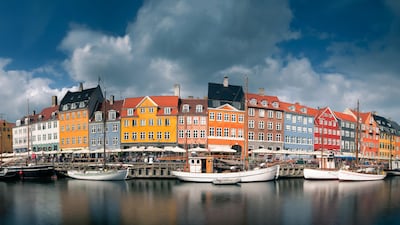
1. Copenhagen in Denmark is the best city to live in for work-life balance. Alamy -

2. Reykjavik, Iceland, ranks second, with a short commute time and plenty of paid holidays. Corbis -

3. Oslo is the most populous city in Norway and the third-best city in the world when it comes to work-life sway. -

4. Taking fourth position is Helsinki in Finland. One factor that the capital city stood out for was its happiness and well-being. -

5. Stockholm, Sweden, scored highly for the average number of holidays taken per capita. Getty Images -

6. Frankfurt is Germany's best city for work-life balance. AFP -

7. Linz in Austria ranks seventh. Getty Images -

8. Klagenfurt in Austria has an average of only nine minutes' commute time. Unsplash / Katie Archibald -

9. The Hague in The Netherlands records a happiness score of seven out of 10. Alamy -

10. The small Swiss town of Basel ranks 10th. Getty Images -

11. People in Austria's Graz get an average of seven hours and 22 minutes of shut-eye each night. Weinhaeupl / Osterreich Werbung -

12. Dresden, the capital of Saxony in Germany, is the 12th best city in the world for work-life balance. Getty Images -

13. Bern, Switzerland, has a happiness score of eight out of 10. Unsplash -

14. The average number of hours worked in Hannover, Germany, is 1,386. Unsplash -

15. Vienna in Austria ranks high for work-life balance. AFP -

16. Lausanne is one of four Swiss cities in the top 20. Photo: AllDetails / Regis Colombo -

17. Geneva, Switzerland, is the 17th best city in the world for a good work-life balance. Getty Images -

18. Rotterdam residents work an average of 1,440 hours per year. Photo: Rotterdam Partners -

19. Innsbruck in Austria, where residents work 1,611 hours per year. Getty Images -

20. The Netherlands' capital city is not the country's best for work-life balance, with Amsterdam outranked by The Hague. EPA


“They start trying to fix every possible problem before they actually run their trial, which is impossible, because a lot of the productivity gains and process improvements are ground up and led by teams.”
Mr O'Connor also reported difficulties among companies with cultures of mistrust between leaders and employees.
“They think they’ve got an open, bottom-up style of decision-making, but in practice, that might not be so,” he said.
Growing pains are part of the process.
“It wasn’t a walk in the park at the start, but no major change ever is,” said Nicci Russell, managing director of Waterwise, a non-profit focused on reducing water consumption.
“We have all had to work at it — things like annual leave can make it harder to fit everything in. But the team are pretty happy, and we certainly all love the extra day out of the office.”
Once on four-day schedules, the companies that struggle are often very small and in fields that necessitate five- or seven-day shift coverage. This requires precise scheduling among small numbers of staff.
The gift company Bookishly, for example, continues to tinker with staffing during busy times.
Organisations also abandon truncated schedule efforts when hit with unexpected changes, such as new leadership or financial changes.
The UK trial participants range across sectors, such as education, media, hospitality and health care. They include Charity Bank, the supply chain transparency company Everledger, the customer communication platform Secure Digital Exchange, and the Royal Society of Biology.
Mr O’Connor has learnt that when companies do not need him any longer, things are going well.

