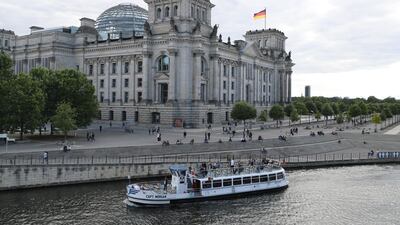
Germany’s economy plunged into a record slump in the second quarter, when virus restrictions slammed businesses and households across Europe, destroying jobs and prompting an unprecedented policy response.
Output fell 10.1 per cent, the most since the quarterly series began in 1970, with declines in exports, consumer spending and investment. While survey indicators signal a recent return to growth, higher unemployment remains a risk, which would threaten the recovery.
The pace of the rebound will rely in part on the effectiveness of the government’s €130 billion ($153bn/Dh560bn) stimulus approved in June and how fast can demand for German exports return to pre-pandemic levels. But with concerns over new outbreaks of the virus, the outlook is uncertain, even after an unprecedented European Union fiscal deal championed by Germany and France.
A similar picture is playing out across the euro-area, which may have suffered a 12 per cent contraction in the quarter. Governments across the region have stretched their budgets on health and welfare spending, and the European Central Bank launched an emergency bond-buying programme to get the economy through the crisis.
Job cuts remain a major risk for the outlook. Germany’s national airline Deutsche Lufthansa is slashing thousands of jobs, and car maker Daimler is reducing hours for some workers for a year. Figures due Friday may show even more severe slumps across Southern Europe. That partly reflects tougher lockdowns and damage to the crucial tourism sector in Italy and Spain.
The euro was little changed after the data, trading at 1.1757 per dollar as of 10:19am in Frankfurt (12.19pm in the UAE). German bonds held on to their gains, keeping the yield on 10-year securities down 2 basis points to minus 0.52 per cent.
Germany had less severe containment measures at the height of the health crisis, and was able to utilise long-established support measures that allowed companies to keep millions of staff on payrolls, and prevent a jump in joblessness.
“The labour market is still under pressure due to the coronavirus pandemic, even if the German economy is on a recovery path,” Daniel Terzenbach, regional board of the Federal Employment Agency, said in a separate release on Thursday.
The country’s fiscal situation was also stronger, allowing the government to mobilise trillions of euros in various rounds of stimulus to help struggling businesses and households with loan guarantees, equity injections, and additional liquidity.
A detailed breakdown of what drove the second-quarter slump is due on August 25. Inflation data is due later on Thursday, with prices forecast to have gained only 0.1 per cent in July from a year ago.

The specs
Engine: Two permanent-magnet synchronous AC motors
Transmission: two-speed
Power: 671hp
Torque: 849Nm
Range: 456km
Price: from Dh437,900
On sale: now
Tamkeen's offering
- Option 1: 70% in year 1, 50% in year 2, 30% in year 3
- Option 2: 50% across three years
- Option 3: 30% across five years
UAE currency: the story behind the money in your pockets
The story in numbers
18
This is how many recognised sects Lebanon is home to, along with about four million citizens
450,000
More than this many Palestinian refugees are registered with UNRWA in Lebanon, with about 45 per cent of them living in the country’s 12 refugee camps
1.5 million
There are just under 1 million Syrian refugees registered with the UN, although the government puts the figure upwards of 1.5m
73
The percentage of stateless people in Lebanon, who are not of Palestinian origin, born to a Lebanese mother, according to a 2012-2013 study by human rights organisation Frontiers Ruwad Association
18,000
The number of marriages recorded between Lebanese women and foreigners between the years 1995 and 2008, according to a 2009 study backed by the UN Development Programme
77,400
The number of people believed to be affected by the current nationality law, according to the 2009 UN study
4,926
This is how many Lebanese-Palestinian households there were in Lebanon in 2016, according to a census by the Lebanese-Palestinian dialogue committee
How to invest in gold
Investors can tap into the gold price by purchasing physical jewellery, coins and even gold bars, but these need to be stored safely and possibly insured.
A cheaper and more straightforward way to benefit from gold price growth is to buy an exchange-traded fund (ETF).
Most advisers suggest sticking to “physical” ETFs. These hold actual gold bullion, bars and coins in a vault on investors’ behalf. Others do not hold gold but use derivatives to track the price instead, adding an extra layer of risk. The two biggest physical gold ETFs are SPDR Gold Trust and iShares Gold Trust.
Another way to invest in gold’s success is to buy gold mining stocks, but Mr Gravier says this brings added risks and can be more volatile. “They have a serious downside potential should the price consolidate.”
Mr Kyprianou says gold and gold miners are two different asset classes. “One is a commodity and the other is a company stock, which means they behave differently.”
Mining companies are a business, susceptible to other market forces, such as worker availability, health and safety, strikes, debt levels, and so on. “These have nothing to do with gold at all. It means that some companies will survive, others won’t.”
By contrast, when gold is mined, it just sits in a vault. “It doesn’t even rust, which means it retains its value,” Mr Kyprianou says.
You may already have exposure to gold miners in your portfolio, say, through an international ETF or actively managed mutual fund.
You could spread this risk with an actively managed fund that invests in a spread of gold miners, with the best known being BlackRock Gold & General. It is up an incredible 55 per cent over the past year, and 240 per cent over five years. As always, past performance is no guide to the future.
BACK%20TO%20ALEXANDRIA
%3Cp%3E%3Cstrong%3EDirector%3A%20%3C%2Fstrong%3ETamer%20Ruggli%3C%2Fp%3E%0A%3Cp%3E%3Cstrong%3EStarring%3A%20%3C%2Fstrong%3ENadine%20Labaki%2C%20Fanny%20Ardant%3C%2Fp%3E%0A%3Cp%3E%3Cstrong%3ERating%3A%20%3C%2Fstrong%3E3.5%2F5%3C%2Fp%3E%0A
Our family matters legal consultant
Name: Hassan Mohsen Elhais
Position: legal consultant with Al Rowaad Advocates and Legal Consultants.
More from Neighbourhood Watch:
In numbers: PKK’s money network in Europe
Germany: PKK collectors typically bring in $18 million in cash a year – amount has trebled since 2010
Revolutionary tax: Investigators say about $2 million a year raised from ‘tax collection’ around Marseille
Extortion: Gunman convicted in 2023 of demanding $10,000 from Kurdish businessman in Stockholm
Drug trade: PKK income claimed by Turkish anti-drugs force in 2024 to be as high as $500 million a year
Denmark: PKK one of two terrorist groups along with Iranian separatists ASMLA to raise “two-digit million amounts”
Contributions: Hundreds of euros expected from typical Kurdish families and thousands from business owners
TV channel: Kurdish Roj TV accounts frozen and went bankrupt after Denmark fined it more than $1 million over PKK links in 2013
What is a calorie?
A food calorie, or kilocalorie, is a measure of nutritional energy generated from what is consumed.
One calorie, is the amount of heat needed to raise the temperature of 1 kilogram of water by 1°C.
A kilocalorie represents a 1,000 true calories of energy.
Energy density figures are often quoted as calories per serving, with one gram of fat in food containing nine calories, and a gram of protein or carbohydrate providing about four.
Alcohol contains about seven calories a gram.
Springsteen: Deliver Me from Nowhere
Director: Scott Cooper
Starring: Jeremy Allen White, Odessa Young, Jeremy Strong
Rating: 4/5
Profile Box
Company/date started: 2015
Founder/CEO: Mohammed Toraif
Based: Manama, Bahrain
Sector: Sales, Technology, Conservation
Size: (employees/revenue) 4/ 5,000 downloads
Stage: 1 ($100,000)
Investors: Two first-round investors including, 500 Startups, Fawaz Al Gosaibi Holding (Saudi Arabia)
COMPANY PROFILE
Name: Mamo
Year it started: 2019 Founders: Imad Gharazeddine, Asim Janjua
Based: Dubai, UAE
Number of employees: 28
Sector: Financial services
Investment: $9.5m
Funding stage: Pre-Series A Investors: Global Ventures, GFC, 4DX Ventures, AlRajhi Partners, Olive Tree Capital, and prominent Silicon Valley investors.
