When Israeli forces bombed a building housing international media outlets in Gaza earlier this month, we took notice because we need news, and it is these organisations – and others like them – that deliver it to us.
Besides news agencies, there are 'citizen journalists' who keep us informed. Thanks to social media and smartphones, there are plenty of citizen journalists, activists, influencers and celebrities on any platform.
This last month has brought up a debate: should influencers take a stand with regard to the news?
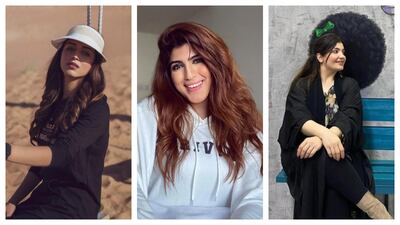
The violence in Palestine and Israel and the horrors Gazans faced over those 11 day led to marches across the world and also in part changed public opinion. But these events have also shed light on the relationship between influencers – including those whose platforms have little to do with current affairs or journalism – and their followers. Many influencers faced criticism, even abuse, from followers for not expressing their opinion about the conflict. Some were labelled "fakes", "sell-outs" and "puppets". Others were called "spineless", who were "in it only for the money".
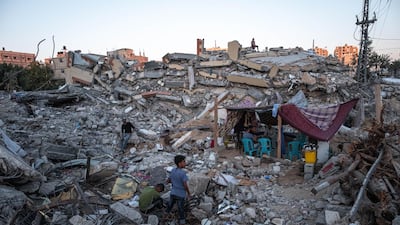
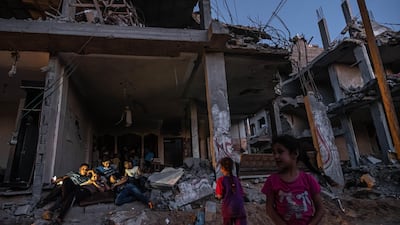
A boy rides his bicycle amid the rubble of destroyed homes in Beit Hanoun, Gaza. Getty
Life resumes amid the rubble of destroyed homes in Beit Hanoun, Gaza. Getty
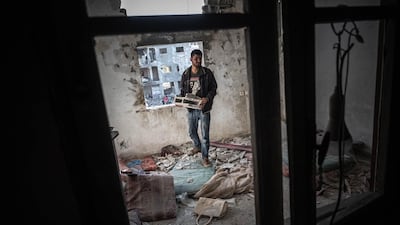
A Palestinian man tries to put his home back in order after Israeli air strikes on Beit Hanoun, Gaza. Getty
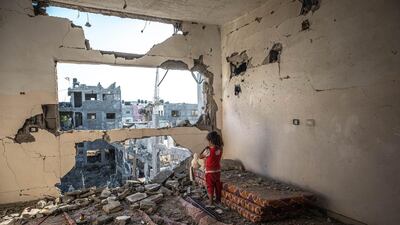
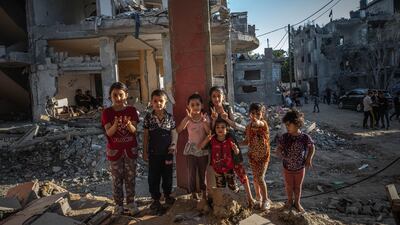
A Palestinian girl stands amid the rubble of her destroyed home in Beit Hanoun, Gaza. Getty
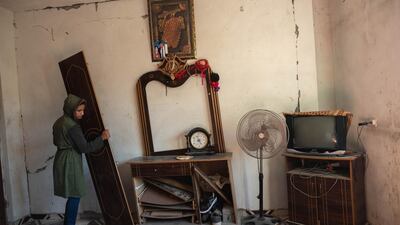
A Palestinian woman puts her house back in order after Israeli aerial raids over the past couple of weeks in Beit Hanoun, Gaza. Getty
Life resumes amid the rubble of destroyed homes in Beit Hanoun, Gaza. Getty
Palestinian children resume life amid the rubble of destroyed homes in Beit Hanoun, Gaza. Getty
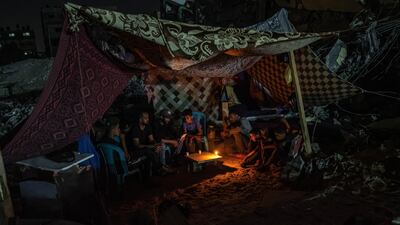
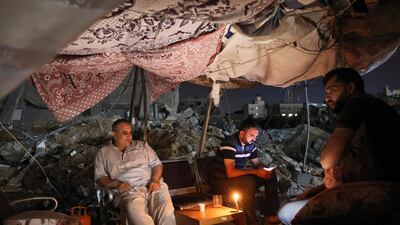
Palestinians in Gaza city sit in a tent set up on top of the ruins of a building destroyed in Israeli air strikes. Getty
Palestinians sit in a tent that has been set up on top of the ruins of a building destroyed in recent Israeli air strikes, in Gaza city. AFP
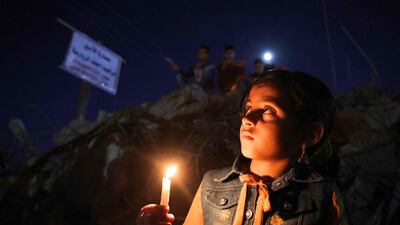
A Palestinian child attends a rally in Gaza city amid the ruins of houses destroyed by Israeli strikes. AFP
I can understand people getting angry and frustrated while watching the live coverage of the unfolding tragedy in Gaza. Our instinct is to redress the injustice, the indignity and the oppression of innocent civilians, including children. But in the process, some people misdirected their anger at influencers, for not wielding their influence by saying something.
But how fair is it for us to expect even those influencers who have made a name by baking cakes, providing beauty tutorials and starring in soap operas, to give us their take on the news? Should they have to be involved in activism and discuss politics? Just because we helped make them famous for their cooking, we can't now expect them to speak about unrelated matters.
Some influencers did speak out. But those who did not, are we really going to hold them guilty of omission?
Influencers are important to a degree because they can shape opinions. And they can certainly put pressure on politicians and decision-makers. But should we expect them to do so just because they have a sizeable following?
It is often pointless to try to force influencers to express an opinion if they don't care to. Our rage could even put them off the cause.
Imagine the affect the vitriol being sent by thousands, or in some cases, millions of followers can have on influencers' psyche when to most of us even one person's words can be hurtful.
Influencers have their reasons to not make a statement. First, there are many causes and no one can speak up for all of them. There is also the matter of personal security. Influencers are sometimes threatened and may choose not to speak up for fear of being harmed or even killed. Influencers, like the rest of us, are entitled to self-preservation.
Instead of getting angry at them, there are ways in which we can channel our energy more constructively to champion a cause we care about. We can lend support to those who choose to engage in activism, rather than rage against those who don’t. We can amplify those who speak up, by using our own social media channels. After all, that is exactly how one becomes an influencer – and instead of focusing on the power of influencers, we should focus on ours.
There is also a strategic element to all of this. Influencers gain influence only because we follow them. We essentially vote for them with our clicks and follows.
We can support those who engage in activism, rather than rage against those who don't
Whenever I ask fellow Muslim women, for example, who the most influential Muslim women in their lives are on social media, they mostly point to people in the beauty, fashion and lifestyle businesses. If they are the celebrities we elevate by following them, then why are we surprised that all they talk about is what beauty, fashion and lifestyle?
Our social media feeds and the people we follow reflect our priorities and give us an understanding of who we are.
Influencers rarely emerge overnight. So if we want influencers who address news issues, then we can start following them, so that they have the time to build their following.
To expect people to speak out and say the things we want them to say amounts to a misunderstanding of activism. Rather than directing our anger at influencers for not engaging with issues we care about, we could take up the cause and become activists ourselves.
Shelina Janmohamed is an author and a culture columnist for The National

Who's who in Yemen conflict
Houthis: Iran-backed rebels who occupy Sanaa and run unrecognised government
Yemeni government: Exiled government in Aden led by eight-member Presidential Leadership Council
Southern Transitional Council: Faction in Yemeni government that seeks autonomy for the south
Habrish 'rebels': Tribal-backed forces feuding with STC over control of oil in government territory
Uefa Nations League: How it Works
The Uefa Nations League, introduced last year, has reached its final stage, to be played over five days in northern Portugal. The format of its closing tournament is compact, spread over two semi-finals, with the first, Portugal versus Switzerland in Porto on Wednesday evening, and the second, England against the Netherlands, in Guimaraes, on Thursday.
The winners of each semi will then meet at Porto’s Dragao stadium on Sunday, with the losing semi-finalists contesting a third-place play-off in Guimaraes earlier that day.
Qualifying for the final stage was via League A of the inaugural Nations League, in which the top 12 European countries according to Uefa's co-efficient seeding system were divided into four groups, the teams playing each other twice between September and November. Portugal, who finished above Italy and Poland, successfully bid to host the finals.
Disclaimer
Director: Alfonso Cuaron
Stars: Cate Blanchett, Kevin Kline, Lesley Manville
Rating: 4/5
Tree of Hell
Starring: Raed Zeno, Hadi Awada, Dr Mohammad Abdalla
Director: Raed Zeno
Rating: 4/5
The President's Cake
Director: Hasan Hadi
Starring: Baneen Ahmad Nayyef, Waheed Thabet Khreibat, Sajad Mohamad Qasem
Rating: 4/5
Islamophobia definition
A widely accepted definition was made by the All Party Parliamentary Group on British Muslims in 2019: “Islamophobia is rooted in racism and is a type of racism that targets expressions of Muslimness or perceived Muslimness.” It further defines it as “inciting hatred or violence against Muslims”.
Our family matters legal consultant
Name: Hassan Mohsen Elhais
Position: legal consultant with Al Rowaad Advocates and Legal Consultants.
Ziina users can donate to relief efforts in Beirut
Ziina users will be able to use the app to help relief efforts in Beirut, which has been left reeling after an August blast caused an estimated $15 billion in damage and left thousands homeless. Ziina has partnered with the United Nations High Commissioner for Refugees to raise money for the Lebanese capital, co-founder Faisal Toukan says. “As of October 1, the UNHCR has the first certified badge on Ziina and is automatically part of user's top friends' list during this campaign. Users can now donate any amount to the Beirut relief with two clicks. The money raised will go towards rebuilding houses for the families that were impacted by the explosion.”
Countdown to Zero exhibition will show how disease can be beaten
Countdown to Zero: Defeating Disease, an international multimedia exhibition created by the American Museum of National History in collaboration with The Carter Center, will open in Abu Dhabi a month before Reaching the Last Mile.
Opening on October 15 and running until November 15, the free exhibition opens at The Galleria mall on Al Maryah Island, and has already been seen at the Jimmy Carter Presidential Library and Museum in Atlanta, the American Museum of Natural History in New York, and the London School of Hygiene and Tropical Medicine.
You can donate to several registered charities through a “donation catalogue”. The use of the donation is quite specific, such as buying a fan for a poor family in Niger for Dh130.
The site has an e-donation service accepting debit card, credit card or e-Dirham, an electronic payment tool developed by the Ministry of Finance and First Abu Dhabi Bank.
You can donate online or order Smiles n’ Stuff products handcrafted by Al Noor students. The centre publishes a wish list of extras needed, starting at Dh500.
Beit Al Khair Society has the motto “From – and to – the UAE,” with donations going towards the neediest in the country. Its website has a list of physical donation sites, but people can also contribute money by SMS, bank transfer and through the hotline 800-22554.
Dar Al Ber Society, which has charity projects in 39 countries, accept cash payments, money transfers or SMS donations. Its donation hotline is 800-79.
Dubai Cares provides several options for individuals and companies to donate, including online, through banks, at retail outlets, via phone and by purchasing Dubai Cares branded merchandise. It is currently running a campaign called Bookings 2030, which allows people to help change the future of six underprivileged children and young people.
Those who travel on Emirates have undoubtedly seen the little donation envelopes in the seat pockets. But the foundation also accepts donations online and in the form of Skywards Miles. Donated miles are used to sponsor travel for doctors, surgeons, engineers and other professionals volunteering on humanitarian missions around the world.
On the Emirates Red Crescent website you can choose between 35 different purposes for your donation, such as providing food for fasters, supporting debtors and contributing to a refugee women fund. It also has a list of bank accounts for each donation type.
Gulf for Good raises funds for partner charity projects through challenges, like climbing Kilimanjaro and cycling through Thailand. This year’s projects are in partnership with Street Child Nepal, Larchfield Kids, the Foundation for African Empowerment and SOS Children's Villages. Since 2001, the organisation has raised more than $3.5 million (Dh12.8m) in support of over 50 children’s charities.
Sheikh Mohammed bin Rashid Al Maktoum launched the Noor Dubai Foundation a decade ago with the aim of eliminating all forms of preventable blindness globally. You can donate Dh50 to support mobile eye camps by texting the word “Noor” to 4565 (Etisalat) or 4849 (du).
Conflict, drought, famine
Estimates of the number of deaths caused by the famine range from 400,000 to 1 million, according to a document prepared for the UK House of Lords in 2024. It has been claimed that the policies of the Ethiopian government, which took control after deposing Emperor Haile Selassie in a military-led revolution in 1974, contributed to the scale of the famine. Dr Miriam Bradley, senior lecturer in humanitarian studies at the University of Manchester, has argued that, by the early 1980s, “several government policies combined to cause, rather than prevent, a famine which lasted from 1983 to 1985. Mengistu’s government imposed Stalinist-model agricultural policies involving forced collectivisation and villagisation [relocation of communities into planned villages]. The West became aware of the catastrophe through a series of BBC News reports by journalist Michael Buerk in October 1984 describing a “biblical famine” and containing graphic images of thousands of people, including children, facing starvation.
Band Aid
Bob Geldof, singer with the Irish rock group The Boomtown Rats, formed Band Aid in response to the horrific images shown in the news broadcasts. With Midge Ure of the band Ultravox, he wrote the hit charity single Do They Know it’s Christmas in December 1984, featuring a string of high-profile musicians. Following the single’s success, the idea to stage a rock concert evolved. Live Aid was a series of simultaneous concerts that took place at Wembley Stadium in London, John F Kennedy Stadium in Philadelphia, the US, and at various other venues across the world. The combined event was broadcast to an estimated worldwide audience of 1.5 billion.
Milestones on the road to union
1970
October 26: Bahrain withdraws from a proposal to create a federation of nine with the seven Trucial States and Qatar.
December: Ahmed Al Suwaidi visits New York to discuss potential UN membership.
1971
March 1: Alex Douglas Hume, Conservative foreign secretary confirms that Britain will leave the Gulf and “strongly supports” the creation of a Union of Arab Emirates.
July 12: Historic meeting at which Sheikh Zayed and Sheikh Rashid make a binding agreement to create what will become the UAE.
July 18: It is announced that the UAE will be formed from six emirates, with a proposed constitution signed. RAK is not yet part of the agreement.
August 6: The fifth anniversary of Sheikh Zayed becoming Ruler of Abu Dhabi, with official celebrations deferred until later in the year.
August 15: Bahrain becomes independent.
September 3: Qatar becomes independent.
November 23-25: Meeting with Sheikh Zayed and Sheikh Rashid and senior British officials to fix December 2 as date of creation of the UAE.
November 29: At 5.30pm Iranian forces seize the Greater and Lesser Tunbs by force.
November 30: Despite a power sharing agreement, Tehran takes full control of Abu Musa.
November 31: UK officials visit all six participating Emirates to formally end the Trucial States treaties
December 2: 11am, Dubai. New Supreme Council formally elects Sheikh Zayed as President. Treaty of Friendship signed with the UK. 11.30am. Flag raising ceremony at Union House and Al Manhal Palace in Abu Dhabi witnessed by Sheikh Khalifa, then Crown Prince of Abu Dhabi.
December 6: Arab League formally admits the UAE. The first British Ambassador presents his credentials to Sheikh Zayed.
5pm: Maiden (Purebred Arabians); Dh80,000; 1,400m. 5.30pm: Maiden (PA); Dh80,00; 1,400m. 6pm: Sheikh Zayed bin Sultan Al Nahyan National Day Cup (PA); Group 3; Dh500,000; 1,600m. 6.30pm: Sheikh Zayed bin Sultan Al Nahyan National Day Cup (Thoroughbred); Listed; Dh380,000; 1,600m 7pm: Wathba Stallions Cup for Private Owners Handicap (PA); Dh70,000; 1,400m. 7.30pm: Handicap (PA); Dh80,000; 1,600m
The specs
AT4 Ultimate, as tested
Engine: 6.2-litre V8
Power: 420hp
Torque: 623Nm
Transmission: 10-speed automatic
Price: From Dh330,800 (Elevation: Dh236,400; AT4: Dh286,800; Denali: Dh345,800)