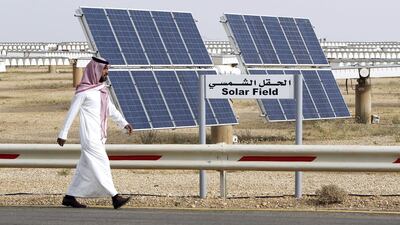
A field of solar panels at Saudi Arabia's King Abdulaziz City of Sciences and Technology. The kingdom plans to generate 50% of its power from renewables by 2030. Reuters

Saudi Arabia to add renewable and gas capacity equal to 1 million bpd by 2030


Jennifer Gnana
  • English
  • Arabic

Saudi Arabia, the world's largest exporter of oil, plans to add gas and renewables capacity equating to one million barrels of oil per day by 2030, according to the kingdom's Crown Prince Mohammed bin Salman.

The kingdom is looking to green its power mix and export more barrels of oil. It is also committing to lowering emissions and the energy impact of fossil fuels as part of its diversification strategy for 2030.

"We aim to have the share of each gas and renewable energy in this mix at 50 per cent by 2030,” Prince Mohammed Bin Salman said in comments reported by the Saudi Press Agency. Growth in the use of renewables and gas could replace about one billion barrels of oil per day used for electricity and water desalination, he added.

The Crown Prince was speaking at the signing of seven power purchase agreements for new solar photovoltaic plants in Saudi Arabia following the inauguration of the Sakaka plant.

The 300 megawatt Sakaka power plant is the kingdom's first-ever solar utility-scale project. It has been built at a cost of 1.2bn Saudi riyals ($320m) and is part of the kingdom's plan to add 27.3 gigawatts of clean energy to its grid by 2024.

Prince Mohammed also said the kingdom's first wind energy project, the 400MW Dumat Al Jandal farm, will be completed soon. The utility-scale wind project is being developed by France’s EDF and Abu Dhabi’s Masdar.

The kingdom plans to account for almost half of the region's wind capacity additions by 2028.

“The output capacity of these projects, in addition to the projects of Sakaka and Dumat Al Jandal, will amount to more than 3,600MW," Prince Mohammed said.

The projects will have the capacity to power more than 600,000 households and offset greenhouse gas emissions by more than 7 million tonnes, he added.

Among the power purchase agreements signed on Thursday, was a 3.4bn Saudi riyal contract for the 1.5 gigawatt Sudair solar PV plant.

The project, which is backed by the sovereign Public Investment Fund, will be built within Sudair Industrial City and will power 185,000 homes, offsetting 2.9 million tonnes of carbon dioxide.

It is being developed by two PIF-backed entities – Acwa Power and the Water and Electricity Holding Company, Badeel.

The PIF holds a 50 per cent stake in Acwa Power, one of the most prolific developers of conventional and renewable energy projects in the kingdom.

The consortium signed the 25-year power purchase agreement with the Saudi Power Procurement Company.

The project is set for commissioning in the second half of 2022 and will become the largest of its kind in the kingdom.

"The renewable energy sector is a critical sector that provides sustainable solutions against the challenges of climate change, through developing projects aimed at reducing carbon emissions," said PIF governor Yasir Al-Rumayyan.

The PIF has been given the mandate to develop nearly 70 per cent of renewable projects in Saudi Arabia. Utilities and renewables are among the 13 sectors identified by the fund as part of its Vision 2030 strategy.


Semi-final fixtures

Portugal v Chile, 7pm, today

Germany v Mexico, 7pm, tomorrow

Sly%20Cooper%20and%20the%20Thievius%20Raccoonus
%3Cp%3E%3Cstrong%3EDeveloper%3A%3C%2Fstrong%3E%20Sucker%20Punch%20Productions%3Cbr%3E%3Cstrong%3EPublisher%3A%3C%2Fstrong%3E%20Sony%20Computer%20Entertainment%3Cbr%3E%3Cstrong%3EConsole%3A%3C%2Fstrong%3E%20PlayStation%202%20to%205%3Cbr%3E%3Cstrong%3ERating%3A%3C%2Fstrong%3E%205%2F5%3C%2Fp%3E%0A
Barbie
%3Cp%3E%3Cstrong%3EDirector%3A%3C%2Fstrong%3E%20Greta%20Gerwig%3Cbr%3E%3Cstrong%3EStars%3A%3C%2Fstrong%3E%20Margot%20Robbie%2C%20Ryan%20Gosling%2C%20Will%20Ferrell%2C%20America%20Ferrera%3Cbr%3E%3Cstrong%3ERating%3A%3C%2Fstrong%3E%204%2F5%3Cbr%3E%3C%2Fp%3E%0A
Company%20Profile
%3Cp%3E%3Cstrong%3ECompany%20name%3A%20%3C%2Fstrong%3ENamara%0D%3Cbr%3E%3Cstrong%3EStarted%3A%20%3C%2Fstrong%3EJune%202022%0D%3Cbr%3E%3Cstrong%3EFounder%3A%20%3C%2Fstrong%3EMohammed%20Alnamara%0D%3Cbr%3E%3Cstrong%3EBased%3A%20%3C%2Fstrong%3EDubai%20%0D%3Cbr%3E%3Cstrong%3ESector%3A%20%3C%2Fstrong%3EMicrofinance%0D%3Cbr%3E%3Cstrong%3ECurrent%20number%20of%20staff%3A%20%3C%2Fstrong%3E16%0D%3Cbr%3E%3Cstrong%3EInvestment%20stage%3A%20%3C%2Fstrong%3ESeries%20A%0D%3Cbr%3E%3Cstrong%3EInvestors%3A%20%3C%2Fstrong%3EFamily%20offices%0D%3Cbr%3E%3C%2Fp%3E%0A
Related
The Sand Castle

Director: Matty Brown

Stars: Nadine Labaki, Ziad Bakri, Zain Al Rafeea, Riman Al Rafeea

Rating: 2.5/5

World record transfers

1. Kylian Mbappe - to Real Madrid in 2017/18 - €180 million (Dh770.4m - if a deal goes through)
2. Paul Pogba - to Manchester United in 2016/17 - €105m
3. Gareth Bale - to Real Madrid in 2013/14 - €101m
4. Cristiano Ronaldo - to Real Madrid in 2009/10 - €94m
5. Gonzalo Higuain - to Juventus in 2016/17 - €90m
6. Neymar - to Barcelona in 2013/14 - €88.2m
7. Romelu Lukaku - to Manchester United in 2017/18 - €84.7m
8. Luis Suarez - to Barcelona in 2014/15 - €81.72m
9. Angel di Maria - to Manchester United in 2014/15 - €75m
10. James Rodriguez - to Real Madrid in 2014/15 - €75m

%20Ramez%20Gab%20Min%20El%20Akher
%3Cp%3E%3Cstrong%3ECreator%3A%3C%2Fstrong%3E%20Ramez%20Galal%3C%2Fp%3E%0A%3Cp%3E%3Cstrong%3EStarring%3A%3C%2Fstrong%3E%20Ramez%20Galal%3C%2Fp%3E%0A%3Cp%3E%3Cstrong%3EStreaming%20on%3A%20%3C%2Fstrong%3EMBC%20Shahid%3C%2Fp%3E%0A%3Cp%3E%3Cstrong%3ERating%3A%20%3C%2Fstrong%3E2.5%2F5%3C%2Fp%3E%0A
Top%2010%20most%20competitive%20economies
%3Cp%3E1.%20Singapore%0D%3Cbr%3E2.%20Switzerland%0D%3Cbr%3E3.%20Denmark%0D%3Cbr%3E4.%20Ireland%0D%3Cbr%3E5.%20Hong%20Kong%0D%3Cbr%3E6.%20Sweden%0D%3Cbr%3E7.%20UAE%0D%3Cbr%3E8.%20Taiwan%0D%3Cbr%3E9.%20Netherlands%0D%3Cbr%3E10.%20Norway%0D%3Cbr%3E%3C%2Fp%3E%0A
Victims%20of%20the%202018%20Parkland%20school%20shooting
%3Cp%3EAlyssa%20Alhadeff%2C%2014%3C%2Fp%3E%0A%3Cp%3EScott%20Beigel%2C%2035%0D%3C%2Fp%3E%0A%3Cp%3EMartin%20Duque%2C%2014%3C%2Fp%3E%0A%3Cp%3ENicholas%20Dworet%2C%2017%3C%2Fp%3E%0A%3Cp%3EAaron%20Feis%2C%2037%3C%2Fp%3E%0A%3Cp%3EJaime%20Guttenberg%2C%2014%0D%3C%2Fp%3E%0A%3Cp%3EChris%20Hixon%2C%2049%0D%3C%2Fp%3E%0A%3Cp%3ELuke%20Hoyer%2C%2015%3C%2Fp%3E%0A%3Cp%3ECara%20Loughran%2C%2014%0D%3C%2Fp%3E%0A%3Cp%3EGina%20Montalto%2C%2014%0D%3C%2Fp%3E%0A%3Cp%3EJoaquin%20Oliver%2C%2017%0D%3C%2Fp%3E%0A%3Cp%3EAlaina%20Petty%2C%2014%0D%3C%2Fp%3E%0A%3Cp%3EMeadow%20Pollack%2C%2018%3C%2Fp%3E%0A%3Cp%3EHelena%20Ramsay%2C%2017%0D%3Cbr%3E%0D%3C%2Fp%3E%0A%3Cp%3EAlex%20Schachter%2C%2014%0D%3C%2Fp%3E%0A%3Cp%3ECarmen%20Schentrup%2C%2016%0D%3C%2Fp%3E%0A%3Cp%3EPeter%20Wang%2C%2015%3Cbr%3E%3C%2Fp%3E%0A

Mercer, the investment consulting arm of US services company Marsh & McLennan, expects its wealth division to at least double its assets under management (AUM) in the Middle East as wealth in the region continues to grow despite economic headwinds, a company official said.

Mercer Wealth, which globally has $160 billion in AUM, plans to boost its AUM in the region to $2-$3bn in the next 2-3 years from the present $1bn, said Yasir AbuShaban, a Dubai-based principal with Mercer Wealth.

Within the next two to three years, we are looking at reaching $2 to $3 billion as a conservative estimate and we do see an opportunity to do so,” said Mr AbuShaban.

Mercer does not directly make investments, but allocates clients’ money they have discretion to, to professional asset managers. They also provide advice to clients.

“We have buying power. We can negotiate on their (client’s) behalf with asset managers to provide them lower fees than they otherwise would have to get on their own,” he added.

Mercer Wealth’s clients include sovereign wealth funds, family offices, and insurance companies among others.

From its office in Dubai, Mercer also looks after Africa, India and Turkey, where they also see opportunity for growth.

Wealth creation in Middle East and Africa (MEA) grew 8.5 per cent to $8.1 trillion last year from $7.5tn in 2015, higher than last year’s global average of 6 per cent and the second-highest growth in a region after Asia-Pacific which grew 9.9 per cent, according to consultancy Boston Consulting Group (BCG). In the region, where wealth grew just 1.9 per cent in 2015 compared with 2014, a pickup in oil prices has helped in wealth generation.

BCG is forecasting MEA wealth will rise to $12tn by 2021, growing at an annual average of 8 per cent.

Drivers of wealth generation in the region will be split evenly between new wealth creation and growth of performance of existing assets, according to BCG.

Another general trend in the region is clients’ looking for a comprehensive approach to investing, according to Mr AbuShaban.

“Institutional investors or some of the families are seeing a slowdown in the available capital they have to invest and in that sense they are looking at optimizing the way they manage their portfolios and making sure they are not investing haphazardly and different parts of their investment are working together,” said Mr AbuShaban.

Some clients also have a higher appetite for risk, given the low interest-rate environment that does not provide enough yield for some institutional investors. These clients are keen to invest in illiquid assets, such as private equity and infrastructure.

“What we have seen is a desire for higher returns in what has been a low-return environment specifically in various fixed income or bonds,” he said.

“In this environment, we have seen a de facto increase in the risk that clients are taking in things like illiquid investments, private equity investments, infrastructure and private debt, those kind of investments were higher illiquidity results in incrementally higher returns.”

The Abu Dhabi Investment Authority, one of the largest sovereign wealth funds, said in its 2016 report that has gradually increased its exposure in direct private equity and private credit transactions, mainly in Asian markets and especially in China and India. The authority’s private equity department focused on structured equities owing to “their defensive characteristics.”