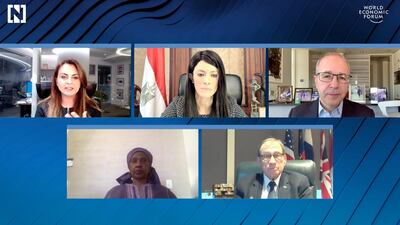
The panel at the Placing Gender Parity at the Heart of the Recovery session at the virtual World Economic Forum event. Panellists included Rania Al-Mashat, minister of international cooperation of Egypt; Phumzile Mlambo-Ngcuka, unndersecretary- general and executive director at UN WOMEN, Michael Neidorff, chairman, president and chief executive at Centene, Kevin Sneader, global managing partner at McKinsey & Company, while the moderator was Mina Al-Oraibi, editor-in-chief, The National. Courtesy WEF
The panel at the Placing Gender Parity at the Heart of the Recovery session at the virtual World Economic Forum event. Panellists included Rania Al-Mashat, minister of international cooperation of Egy
Women should be at the heart of the global post-pandemic recovery
With Covid-19 having disproportionately affected women, policy makers need to pay more attention to gender parity to help build a more equitable society
It will take years to fully assess the impact of Covid-19 on global health systems, societies, economies and governments. However, in a number of areas, the devastation brought about by the pandemic is already clear. In addition to the death of over 2 million people because of the novel coronavirus, and the immense loss that their families will have to contend with, there are societal ramifications that must be recognised and addressed. Around the world, women are witnessing tangible regression in the areas of hard-won progress they made over the past few years.
From bearing the larger burden of home-schooling to facing elevated levels of job losses, women have suffered throughout the past year. And the facts are evident. While women represent 39 per cent of global employment, they have accounted for 54 per cent of overall job losses during the pandemic, according to the management consulting firm McKinsey. The World Economic Forum says that many women are working a “double-double shift”, taking on at least an extra 20 hours of work each week to juggle the demands made real by Covid-19. Mothers have been spending an average of 1.7 hours more per day on housework than fathers and provide 70 per cent of child care during business hours, according to the Forum. The international organisation has been measuring gender disparity for years in its annual “Global Gender Gap” report. In its 2020 report, it predicted that the world would need 99.5 years to reach gender parity. This was before the pandemic hit.
There is no doubt that the vast majority of women find great joy and satisfaction if they can help their families. UN Women, the UN’s agency for women’s advancement, estimates that women’s unpaid contributions to health care are equal to 2.35 per cent of global GDP, or almost $1.5 trillion. And while money and percentages are a good way of measuring how significant this contribution is, no amount of remuneration can equal the love of a mother, a wife, a sister or a daughter when providing care to their families. That is provided unconditionally. However, the reality is that the long-term consequences of this care could lead to career regression, increased psychological pressure and a greater financial burden.
James Laurie, aged 8, is assisted in his online work by his mother Laurette as he continues home-schooling in London. From bearing the larger burden of home-schooling to facing elevated levels of job losses, women have suffered throughout the past year. Getty Images
Oxfam has called Covid-19 the "inequality virus", saying that the world's poor have been disproportionately affected by this pandemic. This is true for both men and women. However, given that women are more likely to be in low-paying jobs and on flexible contracts, they are more adversely impacted. In its 2020 report on employment, the International Labour Organisation said that losses in income were larger for young workers, women, the self-employed and low and medium-skilled workers.
Moreover, while the world is witnessing a digital revolution with more aspects of people’s lives moving online, a proportion of men and women are being left out as they do not have access to the internet. Women have 17 per cent less access to the internet globally. One of the reasons that women are particularly hurt is that they make up a large proportion of the informal work sector, with 760 million of them in informal employment. Informal workers experienced a 60 per cent fall in income in the first month of the pandemic and much of that income has not recovered.
In her comments during a session I moderated during this week's "Davos Agenda", Egypt's Minister of International Co-operation Rania Al-Mashat stressed the importance of governments taking tangible measures to support women at this time, including legislation that helps mothers care for children under 12 years during this period. Undersecretary-General and Executive Director of UN Women Phumzile Mlambo-Ngcuka echoed that sentiment, stressing the need for tangible measures to solidify women's gains in the workforce and mitigate against the fallout from Covid-19.
We must keep in mind the toll that the pandemic will have on health workers for years to come. According to UN Women, 70 per cent of health workers and first responders around the world are women. And the gender pay gap in the health sector is estimated to be at 28 per cent – meaning that women are bearing a heightened financial, emotional and health burden.
Reena Jani, a health worker, gets ready to travel to receive the AstraZeneca vaccine in Koraput, India. According to UN Women, 70 per cent of health workers and first responders around the world are women. Reuters
Women are witnessing tangible regression in the areas of hard-won progress they made over the years
The issue of women in the workforce was discussed in a number of sessions during the Forum’s annual ”Davos Agenda” meeting, which has been held in its entirety virtually. However, the competing demands on policy makers may mean that women’s rights do not get the attention they deserve. They must.
Much has been said of the need to plan for a more equitable society with the emergence from the pandemic, and in order to do so, women have to be at the heart of that planning. Three priorities should be set towards that end. Firstly, providing the infrastructure needed for mothers to progress in the work place, which includes flexible hours to allow for family care and providing childcare facilities. Secondly, a continued effort to tackle gender inequality in pay across the board and securing all workers rights. Thirdly, and perhaps most importantly, protecting women in society and challenging those who seek to use conditions created by the pandemic as a tool of control to hold women back. That is the one fallout from this health crisis that should not be allowed.
Mina Al-Oraibi is editor-in-chief of The National

PROVISIONAL FIXTURE LIST
Premier League
Wednesday, June 17 (Kick-offs uae times) Aston Villa v Sheffield United 9pm; Manchester City v Arsenal 11pm
Friday, June 19 Norwich v Southampton 9pm; Tottenham v Manchester United 11pm
Saturday, June 20 Watford v Leicester 3.30pm; Brighton v Arsenal 6pm; West Ham v Wolves 8.30pm; Bournemouth v Crystal Palace 10.45pm
Sunday, June 21 Newcastle v Sheffield United 2pm; Aston Villa v Chelsea 7.30pm; Everton v Liverpool 10pm
Monday, June 22 Manchester City v Burnley 11pm (Sky)
Tuesday, June 23 Southampton v Arsenal 9pm; Tottenham v West Ham 11.15pm
Wednesday, June 24 Manchester United v Sheffield United 9pm; Newcastle v Aston Villa 9pm; Norwich v Everton 9pm; Liverpool v Crystal Palace 11.15pm
Thursday, June 25 Burnley v Watford 9pm; Leicester v Brighton 9pm; Chelsea v Manchester City 11.15pm; Wolves v Bournemouth 11.15pm
Sunday June 28 Aston Villa vs Wolves 3pm; Watford vs Southampton 7.30pm
Monday June 29 Crystal Palace vs Burnley 11pm
Tuesday June 30 Brighton vs Manchester United 9pm; Sheffield United vs Tottenham 11.15pm
Wednesday July 1 Bournemouth vs Newcastle 9pm; Everton vs Leicester 9pm; West Ham vs Chelsea 11.15pm
Thursday July 2 Arsenal vs Norwich 9pm; Manchester City vs Liverpool 11.15pm
Bob Honey Who Just Do Stuff
By Sean Penn
Simon & Schuster
Centre Court - from 4pm (UAE time)
Angelique Kerber (1) v Irina Falconi
Martin Klizan v Novak Djokovic (2)
Alexandr Dolgopolov v Roger Federer (3)
Court One - from 4pm
Milos Raonic (6) v Jan-Lennard Struff
Karolina Pliskova (3) v Evgeniya Rodina
Dominic Thiem (8) v Vasek Pospisil
Court Two - from 2.30pm
Juan Martin Del Potro (29) v Thanasi Kokkinakis
Agnieszka Radwanska (9) v Jelena Jankovic
Jeremy Chardy v Tomas Berdych (11)
Ons Jabeur v Svetlana Kuznetsova (7)
Stormy seas
Weather warnings show that Storm Eunice is soon to make landfall. The videographer and I are scrambling to return to the other side of the Channel before it does. As we race to the port of Calais, I see miles of wire fencing topped with barbed wire all around it, a silent ‘Keep Out’ sign for those who, unlike us, aren’t lucky enough to have the right to move freely and safely across borders.
We set sail on a giant ferry whose length dwarfs the dinghies migrants use by nearly a 100 times. Despite the windy rain lashing at the portholes, we arrive safely in Dover; grateful but acutely aware of the miserable conditions the people we’ve left behind are in and of the privilege of choice.
Emirates and Etihad fly to Johannesburg or Cape Town daily. Flights cost from about Dh3,325, with a flying time of 8hours and 15 minutes. From there, fly South African Airlines or Air Namibia to Namibia’s Windhoek Hosea Kutako International Airport, for about Dh850. Flying time is 2 hours.
The stay
Wilderness Little Kulala offers stays from £460 (Dh2,135) per person, per night. It is one of seven Wilderness Safari lodges in Namibia; www.wilderness-safaris.com.
Skeleton Coast Safaris’ four-day adventure involves joining a very small group in a private plane, flying to some of the remotest areas in the world, with each night spent at a different camp. It costs from US$8,335.30 (Dh30,611); www.skeletoncoastsafaris.com
Timeline
2012-2015
The company offers payments/bribes to win key contracts in the Middle East
May 2017
The UK SFO officially opens investigation into Petrofac’s use of agents, corruption, and potential bribery to secure contracts
September 2021
Petrofac pleads guilty to seven counts of failing to prevent bribery under the UK Bribery Act
October 2021
Court fines Petrofac £77 million for bribery. Former executive receives a two-year suspended sentence
December 2024
Petrofac enters into comprehensive restructuring to strengthen the financial position of the group
May 2025
The High Court of England and Wales approves the company’s restructuring plan
July 2025
The Court of Appeal issues a judgment challenging parts of the restructuring plan
August 2025
Petrofac issues a business update to execute the restructuring and confirms it will appeal the Court of Appeal decision
October 2025
Petrofac loses a major TenneT offshore wind contract worth €13 billion. Holding company files for administration in the UK. Petrofac delisted from the London Stock Exchange
