
The coronavirus pandemic has accelerated the transition to greener and more environmentally friendly policies, with countries around the world looking at a record fall in emissions as a benchmark to set future sustainability targets.
A similar dynamic is unfolding in Dubai, where the emirate is studying the reduction in emissions from mobility restrictions put in place earlier this year to contain the pandemic.
Dubai saw a 22 per cent decline in carbon emissions last year and discussions about driving the growth of the renewables sector will take place at the annual Wetex and Dubai Solar Show, that runs for three days starting October 26.
Organised by the Dubai Electricity and Water Authority (Dewa), the event is taking place online this year. Some 168 solar companies from more than 1,000 businesses are participating in the virtual conference and exhibition.
The Middle East is home to some of the world's most ambitious planned solar schemes. Here are five of the biggest.
Mohammed bin Rashid Solar Park
Dubai aims to generate 25 per cent of its energy requirements from renewable sources by 2030 and 75 per cent by 2050 as part of its clean energy drive.
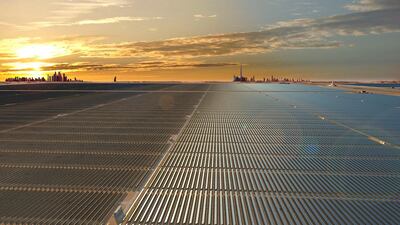
Dewa is building the world’s largest solar energy park in an effort to reduce reliance on natural gas and diversify its power sources.
The Mohammed bin Rashid Solar Park is expected to generate 5,000 Megawatt of electricity by 2030 and is estimated to drive up to Dh50 billion ($13.6bn) in investment.
The fifth phase of the project is currently being implemented through Shuaa Energy 3, a firm in which Dewa holds a 60 per cent stake, with the remainder held by a consortium including Acwa Power and Gulf Investment Corporation.
-
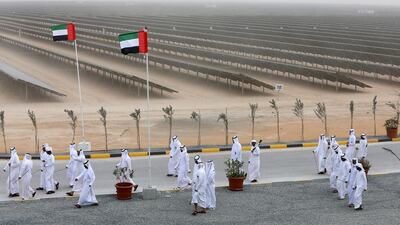
The Mohammed bin Rashid Al Maktoum Solar Park. Dewa is building the world’s largest solar energy park in the Dubai desert in an effort to reduce reliance on natural gas and diversify its power sources. Pawan Singh / The National -
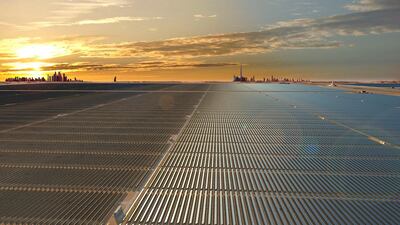
The Mohammed bin Rashid Solar Park is expected to generate 5000MW of electricity by 2030 and is expected to drive up to Dh50 billion in investments. Image courtesy of Masdar -
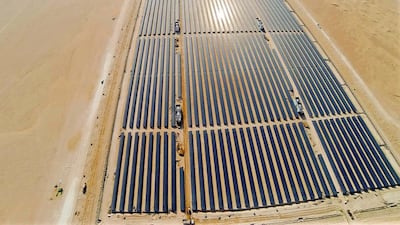
The fifth phase of the MBR solar scheme is currently being implemented through the Shuaa Energy 3 company in which Dewa holds a 60% stake, with the remainder held by a consortium including Acwa Power and Gulf Investment Corporation. Courtesy Dewa -
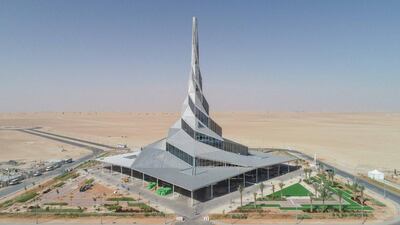
The solar park is the largest single-site solar park in the world based on the Independent Power Producer (IPP) model, with a capacity of 5,000MW by 2030 and total investments worth Dh50 billion. Courtesy Dubai Media Office -

The Mohammed bin Rashid Al Maktoum Solar Park in Dubai. Investors are now looking towards investments that align with their sustainability preferences and values. Reuters -
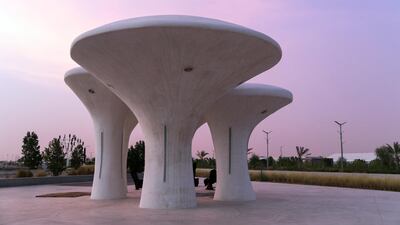
The solar park by Al Qudra’s Innovation Centre. Reem Mohammed/The National -
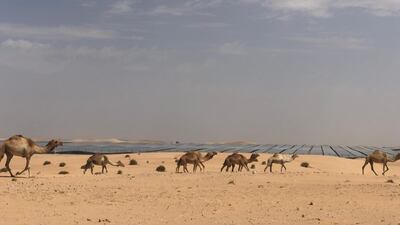
A herd of camels graze close to the sprawling solar park in Sweihan. Courtesy: Noor Abu Dhabi -
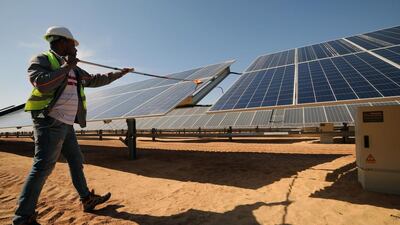
A man cleans solar panels at the Benban Solar Park in Aswan, Egypt. EPA -
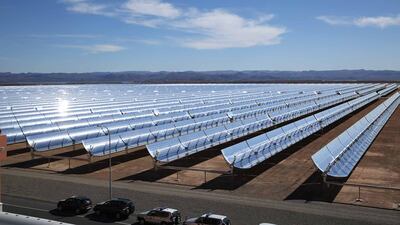
The Noor Power Station 1 in Ouarzazate, Morocco, which was established by Acwa Power -
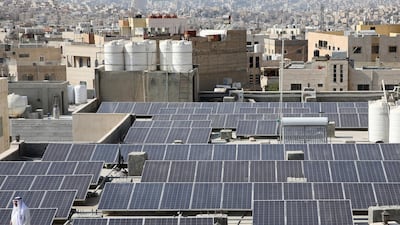
A picture shows on September 6, 2018 a view of the Hamdan Al Qara mosque in southern Amman, equipped with 140 solar panels on its roof. - Jordan imports nearly 98% of its energy supply, and has long relied on gas, heavy fuel oil and diesel to run its power plants. But a government plan to make clean energy 20% of the kingdom's overall power consumption by 2020 has seen alternative energy projects skyrocket in recent years. AFP -
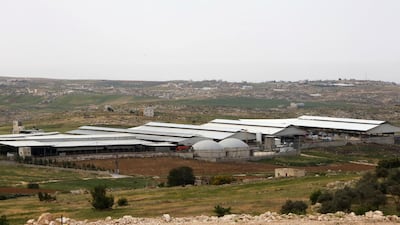
A picture taken on April 10, 2017 shows a general view of the Jebrini dairy farm in the West Bank town of Hebron, where cow dung is used to produce electricity as an alternative power source. - Power comes in many forms, but Palestinian cattle farmer Kamal al-Jebrini's family looked to where others may fear to tread for a new source of it: cow dung. The family has begun recycling waste from its cows to produce electricity for one of the largest Palestinian dairy plants and even to provide power to some houses. The project in the occupied West Bank is the first of its kind in the Palestinian territories, where renewable energy usually means solar panels. AFP


Al Dhafra Solar Park
Abu Dhabi intends to generate half of its power requirements from clean energy sources by 2030.
The planned 2 Gigawatt Al Dhafra photovoltaic project comes after the start up of the 1.7GW Noor Abu Dhabi plant in June. Noor Abu Dhabi, built at a cost of Dh3.2bn, is a joint venture between Abu Dhabi National Energy Company (Taqa), Japan's Marubeni and China's Jinko Solar.
The tariff received on the Dhafra scheme, during the middle of the pandemic, is 44 per cent lower than that of the Noor Abu Dhabi project, the emirate's first solar PV scheme.

Ouarzazate Solar Power Station
The plant in Morocco, which is also known as the Noor solar power project, is a concentrated solar power scheme.
At 510MW, it is one of the biggest such schemes across the globe, with additional PV units expected to boost capacity to 582 MW. The $2.5bn project uses molten salt to store solar energy to produce electricity at night. The North African state is targeting 52 per cent of renewables in its energy mix by 2030.
Benban Solar Complex
Egypt's array of 41 solar power plants being developed in Aswan, home to Africa's second largest dam, is one of the biggest such PV schemes in the region.
The project has a nominal power capacity of 1,650MW at peak hour, making it the fourth largest such solar scheme in the world.
The Arab world's most populous nation is faced with rapidly growing demand for both industrial and residential power use. The country meets more than half of its power needs from gas at 53 per cent, with oil accounting for 43 per cent of its requirements.
The government is prioritising adding renewables to the mix, with plans to raise capacity from clean sources to 20 per cent by 2022.
Sakaka Solar PV Plant
The 300MW PV plant in Saudi Arabia’s northern Al Jouf region is the first of its kind for the world’s largest oil exporter.
The Sakaka plant, built at a cost of 1.2 billion Saudi riyals ($320 million) is part of the kingdom's plan to add 27.3GW of clean energy to grid by 2024. Saudi Arabia is also set to become the Middle East's biggest wind power market in the next decade.
The kingdom aims to account for almost half of the region's wind capacity additions by 2028. About 70 per cent of renewable schemes in the country will be backed by the sovereign investment fund, the Public Investment Fund, while the remainder will be awarded through the Renewable Energy Project Development Office within the Saudi energy ministry.

