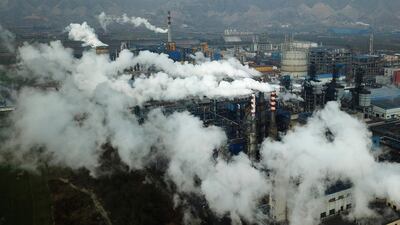
The International Monetary Fund said the right mix of economic policy tools can still pave the road toward net zero emissions by 2050, as it warned of "catastrophic" consequences of climate change.
"Without further action to reduce greenhouse gas emissions, the planet is on course to reach temperatures not seen in millions of years, with potentially catastrophic implications," the Washington-based lender said in a chapter of its forthcoming World Economic Outlook to be released in full next week.
Global temperatures are on the trend to rise by 2-5 degrees Celsius by the end of the century if carbon emissions are not brought down to net zero by 2050, the IMF said.
Global temperatures could reach levels "not seen in millions of years, imposing growing physical and economic damage, and increasing the risk of catastrophic outcomes across the planet", the fund said.
In the first 15 years of climate change mitigation policy, gross domestic product is expected to rise by about 0.7 per cent on average, with the transition helping provide jobs to 12 million people.
The fund said taxing expensive fossil fuels is one way to de-incentivise the use of polluting fuels such as crude and shift their consumer consumption towards greener fuels. Total energy consumption falls too because, overall, energy is more expensive, it said.
However, subsidising green energy as a whole could prove to be a double-edged sword, leading to an overall increase in energy usage.
"Pairing carbon taxes with policies that cushion the impact on consumers’ energy costs can deliver rapid emissions reductions without major negative impacts on output and employment," IMF staff said in a separate blog post.
Energy transition, while likely to offer an initial boost to economic activity, is likely to still drag global GDP down by around 0.7 per cent on average every year between 2037-50 and by 1.1 per cent in 2050 relative to unchanged policies.
"Countries should initially opt for a green investment stimulus—investments in clean public transportation, smart electricity grids to incorporate renewables into power generation, and retrofitting buildings to make them more energy efficient,” the fund said.
The pivot to such policies will help boost both global GDP and employment in the initial years of recovery from the Covid-19 pandemic. Investment in green infrastructure will also improve productivity in low carbon sectors, incentivising the private sector to invest in them and making them easier to adapt to higher prices.
"As the recovery takes hold, preannounced and gradually rising carbon prices will become a powerful tool to deliver the needed reduction in carbon emissions,” the IMF said.
Other organisations such as the International Renewable Energy Agency have also called for accelerating efforts to decarbonise.
In May, the Abu Dhabi-based Irena said renewable energy carriers and building zero-carbon supply chains represent a $500 billion opportunity as economies continue to decarbonise.
The agency, which is headquartered in Masdar City, said decarbonisation of the global energy system away from fossil fuels to renewables could generate $98 trillion in cumulative growth between now and 2050, adding an extra 2.4 per cent to GDP.
A deep overhaul of fossil fuel-wired economies to function on cleaner energy sources could require as much as $130tn in spending, according to Irena.
The Covid-19 pandemic has proved an unlikely push for green transition amid falling emissions from halted air and ground travel.
However, with prices and demand for fossil fuels remaining weak, global investment in the energy sector as a whole is expected to decline by a fifth or nearly $400bn this year due to the impact of the pandemic on the industry, the International Energy Agency said earlier this year.

RACE CARD
5pm: Handicap (PA) Dh70,000 1,400m
5.30pm: Handicap (TB) Dh70,000 1,000m
6pm: Maiden (PA) Dh70,000 2,000m
6.30pm: Handicap (PA) Dh70,000 2,000m
7pm: Maiden (PA) Dh70,000 1,600m
7.30pm: Al Ain Mile Group 3 (PA) Dh350,000 1,600m
8pm: Handicap (PA) Dh70,000 1,600m
Amith's selections:
5pm: AF Sail
5.30pm: Dahawi
6pm: Taajer
6.30pm: Pharitz Oubai
7pm: Winked
7.30pm: Shahm
8pm: Raniah
COMPANY%20PROFILE
%3Cp%3E%3Cstrong%3EName%3A%20%3C%2Fstrong%3ESmartCrowd%0D%3Cbr%3E%3Cstrong%3EStarted%3A%20%3C%2Fstrong%3E2018%0D%3Cbr%3E%3Cstrong%3EFounder%3A%20%3C%2Fstrong%3ESiddiq%20Farid%20and%20Musfique%20Ahmed%0D%3Cbr%3E%3Cstrong%3EBased%3A%20%3C%2Fstrong%3EDubai%0D%3Cbr%3E%3Cstrong%3ESector%3A%20%3C%2Fstrong%3EFinTech%20%2F%20PropTech%0D%3Cbr%3E%3Cstrong%3EInitial%20investment%3A%20%3C%2Fstrong%3E%24650%2C000%0D%3Cbr%3E%3Cstrong%3ECurrent%20number%20of%20staff%3A%3C%2Fstrong%3E%2035%0D%3Cbr%3E%3Cstrong%3EInvestment%20stage%3A%20%3C%2Fstrong%3ESeries%20A%0D%3Cbr%3E%3Cstrong%3EInvestors%3A%20%3C%2Fstrong%3EVarious%20institutional%20investors%20and%20notable%20angel%20investors%20(500%20MENA%2C%20Shurooq%2C%20Mada%2C%20Seedstar%2C%20Tricap)%3C%2Fp%3E%0A
RACE CARD
6.30pm Maiden Dh165,000 (Dirt) 1,200
7.05pm Handicap Dh165,000 (D) 1,600m
7.40pm Maiden Dh165,000 (D) 1,600m
8.15pm Handicap Dh190,000 (D) 1,600m
8.50pm Handicap Dh175,000 (D) 1,400m
9.25pm Handicap Dh175,000 (D) 2,000m
The National selections:
6.30pm Underwriter
7.05pm Rayig
7.40pm Torno Subito
8.15pm Talento Puma
8.50pm Etisalat
9.25pm Gundogdu
UAE tour of Zimbabwe
All matches in Bulawayo
Friday, Sept 26 – UAE won by 36 runs
Sunday, Sept 28 – Second ODI
Tuesday, Sept 30 – Third ODI
Thursday, Oct 2 – Fourth ODI
Sunday, Oct 5 – First T20I
Monday, Oct 6 – Second T20I
German intelligence warnings
- 2002: "Hezbollah supporters feared becoming a target of security services because of the effects of [9/11] ... discussions on Hezbollah policy moved from mosques into smaller circles in private homes." Supporters in Germany: 800
- 2013: "Financial and logistical support from Germany for Hezbollah in Lebanon supports the armed struggle against Israel ... Hezbollah supporters in Germany hold back from actions that would gain publicity." Supporters in Germany: 950
- 2023: "It must be reckoned with that Hezbollah will continue to plan terrorist actions outside the Middle East against Israel or Israeli interests." Supporters in Germany: 1,250
Source: Federal Office for the Protection of the Constitution
RESULTS
5pm: Maiden (PA) Dh80,000 1,200m
Winner: Ferdous, Szczepan Mazur (jockey), Ibrahim Al Hadhrami (trainer)
5.30pm: Arabian Triple Crown Round-3 Group 3 (PA) Dh300,000 2,400m
Winner: Basmah, Fabrice Veron, Eric Lemartinel
6pm: UAE Arabian Derby Prestige (PA) Dh150,000 2,200m
Winner: Ihtesham, Szczepan Mazur, Ibrahim Al Hadhrami
6.30pm: Emirates Championship Group 1 (PA) Dh1,000,000 2,200m
Winner: Somoud, Patrick Cosgrave, Ahmed Al Mehairbi
7pm: Abu Dhabi Championship Group 3 (TB) Dh380,000 2,200m
Winner: GM Hopkins, Patrick Cosgrave, Jaber Ramadhan
7.30pm: Wathba Stallions Cup Conditions (PA) Dh70,000 1,600m
Winner: AF Al Bairaq, Tadhg O’Shea, Ernst Oertel
MATCH INFO
World Cup qualifier
Thailand 2 (Dangda 26', Panya 51')
UAE 1 (Mabkhout 45 2')
Iran's dirty tricks to dodge sanctions
There’s increased scrutiny on the tricks being used to keep commodities flowing to and from blacklisted countries. Here’s a description of how some work.
1 Going Dark
A common method to transport Iranian oil with stealth is to turn off the Automatic Identification System, an electronic device that pinpoints a ship’s location. Known as going dark, a vessel flicks the switch before berthing and typically reappears days later, masking the location of its load or discharge port.
2. Ship-to-Ship Transfers
A first vessel will take its clandestine cargo away from the country in question before transferring it to a waiting ship, all of this happening out of sight. The vessels will then sail in different directions. For about a third of Iranian exports, more than one tanker typically handles a load before it’s delivered to its final destination, analysts say.
3. Fake Destinations
Signaling the wrong destination to load or unload is another technique. Ships that intend to take cargo from Iran may indicate their loading ports in sanction-free places like Iraq. Ships can keep changing their destinations and end up not berthing at any of them.
4. Rebranded Barrels
Iranian barrels can also be rebranded as oil from a nation free from sanctions such as Iraq. The countries share fields along their border and the crude has similar characteristics. Oil from these deposits can be trucked out to another port and documents forged to hide Iran as the origin.
* Bloomberg
