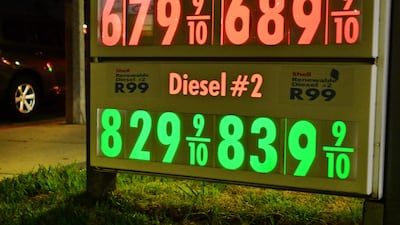

A car crash has a strange fascination – it is hard to look away, even when you fear seeing the awful result. In a similar way, a US ban on diesel exports would be a disastrous policy. But energy analysts and economists would still be curious to see what precisely happens.
The US has just woken up to the diesel problem. Pump prices in California have risen so high – more than $10 per gallon – that the four-digit displays cannot show the correct per gallon prices. The average retail price has scurried up to about $6.30 per gallon, the equivalent of $265 per barrel.
This is particularly infuriating for truckers and other users of the fuel when crude oil prices are barely $100 per barrel. UAE prices for this month, meanwhile, are Dh4.30 per litre ($1.17 per litre, or about $4.43 per gallon).

US President Donald Trump has assigned blame. “[The] world’s diesel price rise is mostly caused by the Russia/Ukraine War, not Iran,” he said.
John Thune, the US Senate majority leader, said on Tuesday that he was “open to exploring” the idea of a ban on exports.
The true reasons for the surge are mixed, but the US’s war against Iran, which led to the effective closure of the Strait of Hormuz, is the main one. Extremely high refining margins – the profit from processing a barrel of crude oil into products – come on top of elevated crude prices.
What's really behind the price surge?
The products from the large Gulf refineries cannot escape at all, or only with considerable risk. The Houthi rebels in Yemen have attacked and damaged pipelines and refineries in western Saudi Arabia that are key suppliers of diesel and aviation fuel to Europe and East Africa.
Even worse, the lost crude from the Middle East is mostly of medium gravity, ideal for making diesel. Its partial replacements from the US and strategic reserves are mostly light crudes with higher yields of petrol and petrochemical feedstocks.
Ukraine’s successful campaign of destruction against Russia’s refineries is the second main contributor. Russia used to export about 1 million barrels per day of diesel.
On Thursday, Ukraine’s drones hit the large Yaroslavl refinery north-east of Moscow and put it out of action. Virtually every Russian refinery has been struck, with the exception of a few in the far east. The Kremlin has decided to extend its own ban on diesel exports until the end of October, having already forbidden petrol exports until January.
China, meanwhile, restricted its exports of refined oil products from March, early in the war. That prohibition has been relaxed; about 140,000 barrels per day of diesel are expected to be shipped this month. As China’s inventories decline, Beijing may reintroduce the curbs.
The global economy has kept going remarkably well despite the conflict in the Gulf, but it is showing signs of flagging, with rising inflation and interest rates. Diesel is a core input for trucking, shipping, industrial engines and mining. The shortage will rev up costs through the value chain.
The squeeze comes at a bad time. Autumn is the harvest season, when diesel-driven farm machinery across the US, Canada, Russia and China cranks into gear. China’s traditional Mid-Autumn Festival for harvest this year falls on September 25.
Into the Northern Hemisphere winter, the US will consume up to 390,000 barrels per day of heating oil, which is very similar to diesel. The holiday season will bring rising air travel, and again jet fuel is a close cousin of diesel. Three major US airlines, American, United and Southwest, have announced they are cutting back flights as some have become unprofitable.
US refineries have been running at maximum rates to capture high margins, but this cannot go on forever. At some point, and probably soon, they will have to throttle back for maintenance, or risk breakdowns.
Snowball of bans
The US sent abroad about 1.8 million barrels per day of diesel and similar products last month, and another 440,000 bpd of jet fuel. Given these figures, it is not surprising that politicians – keen to be seen to be doing something, anything, to fix high prices – are considering an export ban.
What would happen? First, refiners, having no outlet for their surplus diesel, would shift production towards other products as far as possible. Refineries have a certain amount of flexibility in the exact mix of their outputs. They would make more jet fuel and petrol, and export them instead. Prices for those fuels would rise, and petrol in particular is a more visible and sensitive issue for the average American than diesel.
There would be calls for exemptions. No doubt politically favoured companies or states would get special treatment. Refinery run rates would drop, and they would probably take the chance to do some overdue maintenance. North-eastern states, which normally buy diesel from abroad, would seek waivers from the Jones Act, an archaic law that would otherwise require American ships to bring the fuel to and from domestic ports. The feast of resulting lobbying will be popular in the halls of Washington, but not elsewhere.
Meanwhile the price of diesel outside the US would surge, intensifying the economic pain. Mexico in particular, which relies heavily on the US as its own refineries are insufficient, would suffer. Canada, though, which sells diesel to its southern neighbour, might consider a ban of its own. Ottawa feels stung by Washington’s unfriendly trade policies.
The US would then have to move to banning other product exports, to close loopholes. As refining runs drop, it would ship more crude oil abroad, and there would then be calls to prohibit that too. The country, while a net exporter, still imports from 7-8 million barrels per day of crude oil, mostly heavier varieties, to blend with its own light oil and boost diesel yields. The general chaos of a ban might disrupt those imports too.
Fuel price protests are already spreading around the world: from Portugal and France to Syria, Kenya and Guatemala. Such outrage and hardship have often been enough to topple governments, further spreading geopolitical turmoil.
The US’s reputation as a reliable energy exporter would be torn to shreds. The White House’s “energy dominance” has sought to make petroleum and gas exports a tool of economic diplomacy. A ban would convince Europe, Latin America and East Asia that they should not rely on Washington any more than on Moscow.
In the current crisis, politicians around the world have mostly managed to avoid outright counterproductive meddling with the physical oil market. That is one of the key lessons of the 1970s – the shocks then were made much worse by price controls and trade restrictions.
Now the political pressure for a US ban is growing as November’s mid-term elections approach. The temptation may be irresistible. But it would cause a crash that all participants would rue.

