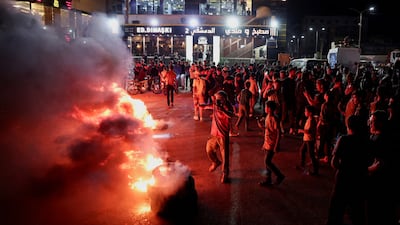
Syrians took to the streets for a second day on Monday to demonstrate against a shock government decision to raise fuel prices. Angry crowds started fires and blocked major roads in protest.
Cities and towns across northern Syria – Hama, Khan Sheikhoun and Maarat Al Numan, among others – have played host to some of the angriest protests against the move that was announced without warning overnight on Saturday into Sunday.
“We went to sleep and woke up to this,” said a resident of Idlib who witnessed the protests. “It was a shock, because this is not just about fuel, it will affect the cost of living.”
The government's decision to temporarily raise fuel prices – by up to 40 per cent for diesel and 28 per cent for petrol – came as a surprise to Syrians, many of whom are already struggling with economic hardship. About 90 per cent of the population lives below the poverty line, UN figures show.
Syria's government said the temporary increases were caused by a global rise in the cost of securing fuel due to disruption in the Strait of Hormuz and other shipping routes, as well as higher transport and insurance costs caused by the US-Iran war.
The protests came after Mohammed Al Bashir, Syria's Energy Minister, announced the “increase was needed to bridge a temporary gap between the cost of securing petroleum products and their domestic selling prices”, the state-run Syrian Arab News Agency reported.
Although Syria is itself an oil and gas producer, its reliance on imports has increased because of continuing rehabilitation work at the Baniyas oil refinery in Tartus governorate, according to a government source.
“During the maintenance period, domestic refining capacity is temporarily reduced, requiring additional imports of finished petroleum products,” the source added. “The broader pressure comes from the higher international cost of refined products, shipping, insurance and supply.”
Syria produces about 102,000 barrels of oil per day but requires around 325,000 bpd for domestic consumption, leaving it reliant on imports to make up the shortfall, Mr Al Bashir said.
Fuel supplies are crucial for Syria as the country seeks to rebuild and recover economically after being devastated by nearly 14 years of civil war.

