

The Opec+ group of oil producers is set to meet this week amid heightened geopolitical tensions due to the escalation of the Russia-Ukraine crisis that propelled crude prices above $100 a barrel.
The situation for the super group that has been shepherding oil prices since 2016 could not be more sensitive as energy ministers of the bloc prepare to convene virtually this Wednesday. Russia is one of the top crude producers in the world.
Despite rising concerns about a possible disruption to global energy flows in an already tight market, the group is expected to stay the course and bring another 400,000 barrels per day of crude to the market in April.
“We expect that Opec+ will endorse its plan to increase production for April by 400,000 barrels a day, in line with its strategy of returning all production taken out of the market during the peak of the Covid-19 pandemic,” said Edward Bell, senior director of market economics at Emirates NBD.
“In terms of oil market balances, conditions now are essentially the same as they were a few weeks ago. Balances are tight, helping to keep spot prices high and supporting a wide backwardation in the futures curve.”
Brent, the global benchmark for two thirds of the world's oil, was 5.37 per cent higher at $103.23 per barrel at 4.21am UAE time on Tuesday. West Texas Intermediate, the gauge that tracks US crude, was up 4.57 per cent trading at $100.09 a barrel.
-
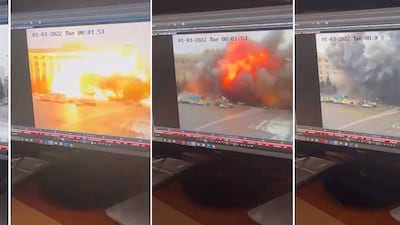
A monitor displays a projectile striking the regional state administration building in Kharkiv, as the Russian invasion continues. Reuters -
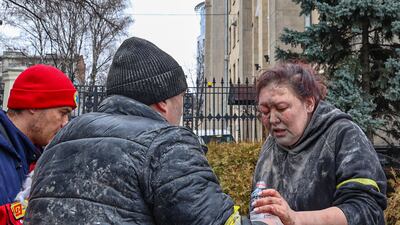
People help a wounded woman in the aftermath of Russian shelling in Kharkiv. EPA -

Ukrainian emergency service personnel carry the body of a victim following shelling in Kharkiv. AP -
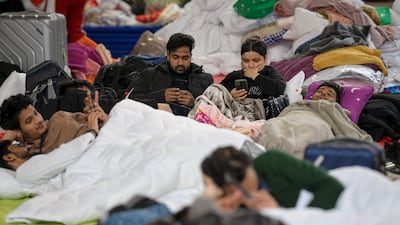
Students who fled the conflict rest in a refugee camp in Voluntari, Romania. AP -
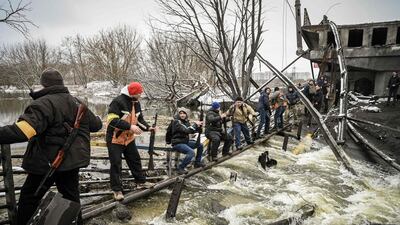
Members of an Ukrainian civil defence unit pass new assault rifles to the opposite side of a blown-up bridge on Kiev’s northern front. AFP -
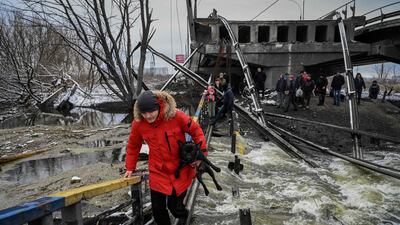
Civilians cross a river on Kiev's northern front. AFP -
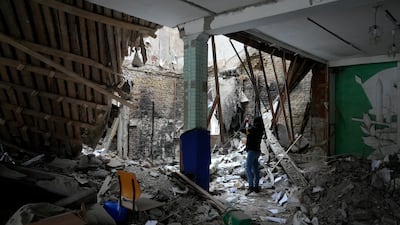
A woman takes photos of a destroyed accommodation building near a checkpoint in Brovary, outside Kiev. AP -
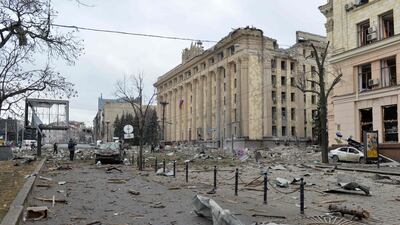
The city hall of Kharkiv, damaged by Russian shelling. AFP -
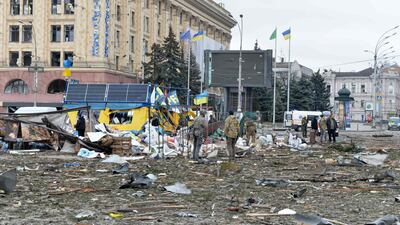
Debris litters the square outside the damaged Kharkiv city hall. AFP -

A Ukrainian woman sleeps on the floor of the railway station in Zahonyi close to the Hungary/Ukraine border. AFP -

A medical worker attends to wounded man at a hospital in Brovary, outside Kiev. AP -
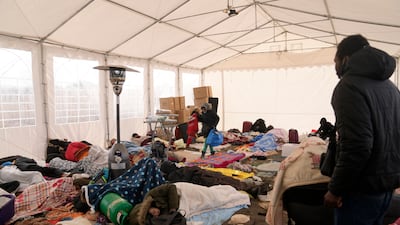
Refugees from Ukraine in a tent at the Medyka border crossing, Poland. AP -
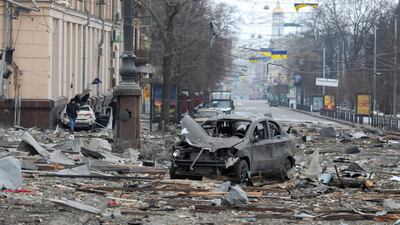
Debris outside the regional administration building, which city officials said was hit by a missile, in Kharkiv. Reuters -

A student evacuated from Ukraine is embraced by her family after arriving at Tunis-Carthage International Airport in Tunisia. AFP -
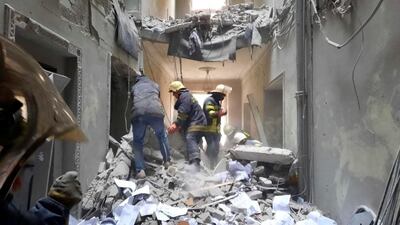
Rescuers in a building damaged by a missile in central Kharkiv. Reuters -
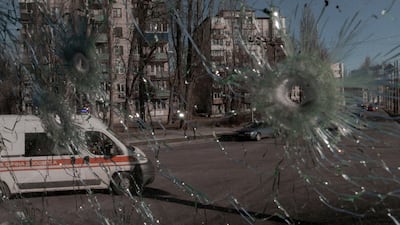
An ambulance is visible through the damaged window of a vehicle hit by bullets in Kiev, Ukraine. Reuters -

Territorial defence members prepare to head out on patrol in Kiev. EPA -
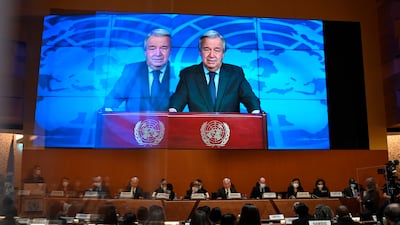
UN Secretary General Antonio Guterres delivers a speech on screen during the opening of the 49th session of the UN Human Rights Council in Geneva, Switzerland. AP -
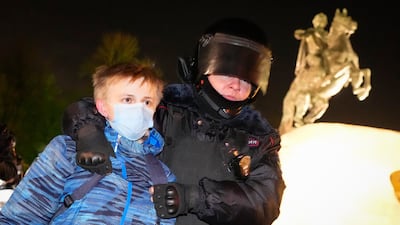
A policeman detains a young demonstrator during a protest against Russia's attack on Ukraine in St Petersburg, Russia. AP -
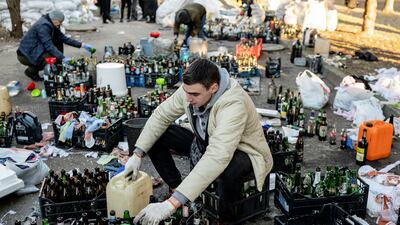
Local residents in Zhytomyr, Ukraine, prepare Molotov cocktails. Reuters -

Residents clean a bomb shelter under an out-of-service cinema in central Zhytomyr. Reuters -
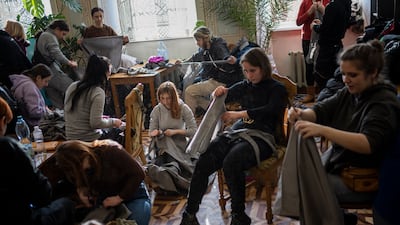
Ukrainian volunteers tear cloth into strips to make camouflage nets in Lviv, western Ukraine. AP -
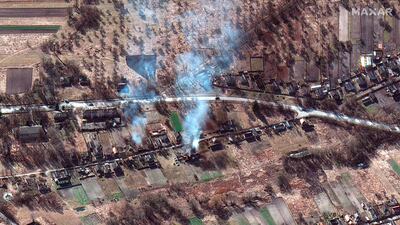
Part of the military convoy north-west of Invankiv, Ukraine. AP -

Mark Goncharuk, a young boy from Kiev, leaves his father behind as he travels with the rest of his family towards the border. Reuters -

People hold an anti-war protest outside the Russian Embassy in Mexico City, Mexico. Reuters -
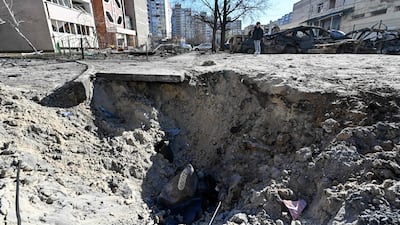
A crater caused by shelling on the outskirts of Kiev. AFP -
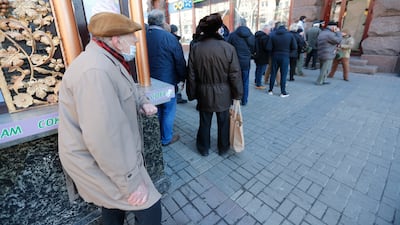
People queue outside a grocery store in the Ukrainian capital. EPA -

Ukrainian soldiers stand at Maidan Nezalezhnosti, or Independence Square, in Kiev. EPA -
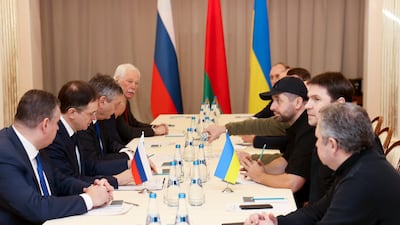
Vladimir Medinsky, the head of the Russian delegation, second left, and Davyd Arakhamia, faction leader of the Servant of the People party in the Ukrainian Parliament, third right, attend the peace talks in the Gomel region of Belarus. AP -
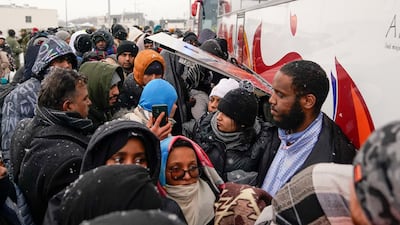
People who have fled the Russian invasion in Ukraine, clamour to board a bus bound for a refugee centre established in Przemysl, Poland. Reuters -
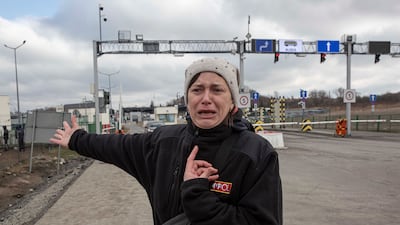
Hanna Pavlovna Lukasz, from Mirhord, Ukraine, said her sons, aged 12 and 8, and her 66-year-old mother had been waiting on the Ukrainian side of the border crossing with Medyka, Poland, for four days. AP -

A volunteer from Kiev prepares a rear post with trenches in the city. AFP -

A child being treated for cancer rests in the bomb shelter of the oncology ward at a hospital in Kiev. Getty -

Police officers check occupants of a suspicious car in Kiev, as Russia's invasion of Ukraine continues. Reuters -

A woman from Ukraine uses a phone to listen to a speech by President Volodymyr Zelenskyy at a refugee shelter in Beregsurany, Hungary. Reuters -

Shelves empty of bread after a curfew was lifted as Russia's invasion of Ukraine continues, in Kiev. Reuters -

Ukrainian Defence Minister Oleksii Reznikov, left, and President Zelenskyy. AFP -
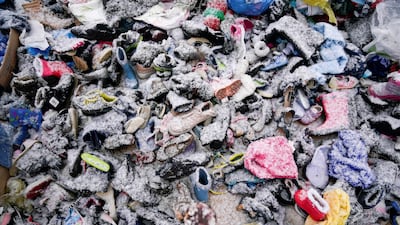
Snow-covered shoes donated for those fleeing the Russian invasion of Ukraine at the border crossing in Medyka, Poland. Reuters -
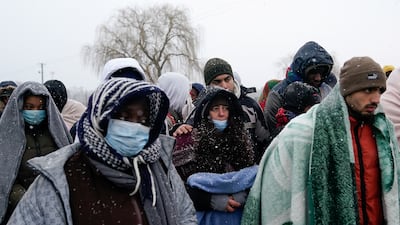
People who have fled Ukraine wait for a bus to transport them away from the border crossing in Medyka. Reuters -
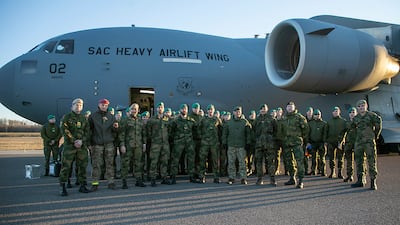
Norwegian soldiers of the Nato-enhanced forward presence battalion pose at a military plane as they arrive at an airport in Kaunas, Lithuania. AP -

A person fleeing Ukraine sits during snowfall at a temporary camp in Przemysl, Poland. Reuters -
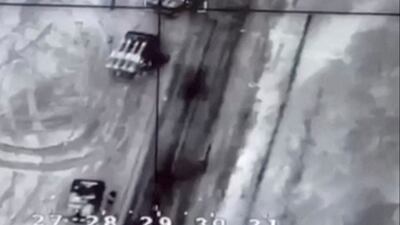
Footage reportedly of Russian Buk missile system vehicles on a road before a drone strike near Malyn, Ukraine. Reuters -
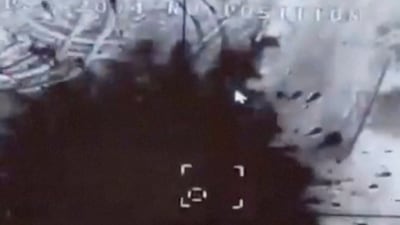
An explosion after what are said to be Russian Buk missile system vehicles on a road are struck by a drone. Reuters -
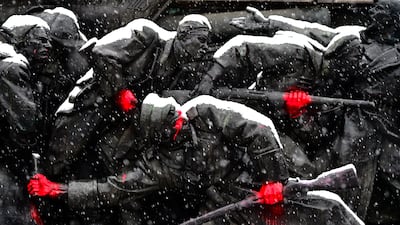
The monument to Russian troops from the Second World War, after the figures’ hands were painted red, at the Red Army memorial in Sofia, Bulgaria. EPA -
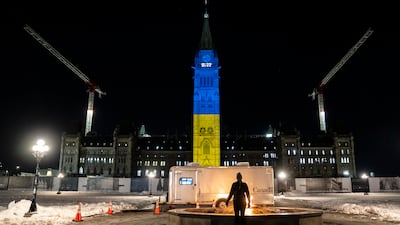
The Peace Tower on Parliament Hill in Ottawa, Canada, is lit up with the colours of Ukraine’s national flag in a show of support. AP -
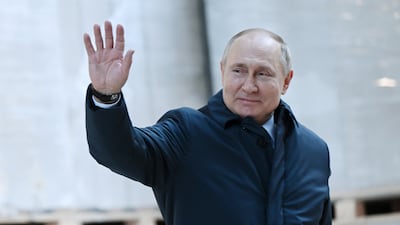
Russian President Vladimir Putin visits the construction site of the National Space Agency on the premises of the Khrunichev State Research and Production Space Centre, in Moscow. EPA -

A man looks out from a train, at the railway station in Lviv, Ukraine. The UN has estimated the conflict could produce as many as four million refugees. AP -
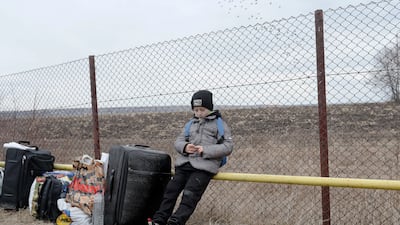
A Ukrainian boy waits for his mother after passing the border crossing point in Siret, northern Romania. EPA -

Russian policemen detain a demonstrator in St Petersburg, during a protest against the country's military actions in Ukraine. EPA -
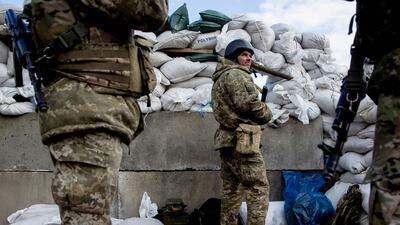
Ukrainian soldiers at a check point in the city of Zhytomyr. Reuters -
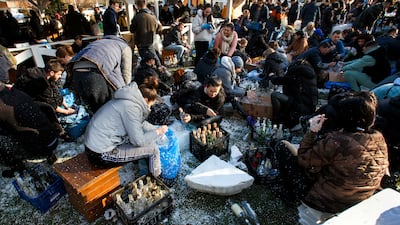
Residents prepare petrol bombs to defend the city, in Uzhhorod, Ukraine. Reuters -
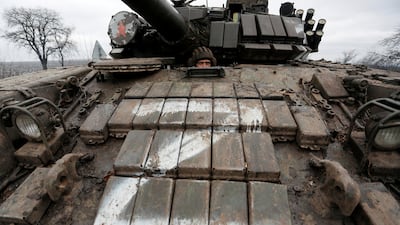
A pro-Russian fighter sits inside a tank in the separatist self-proclaimed Luhansk People's Republic, in the Luhansk region, Ukraine. Reuters -
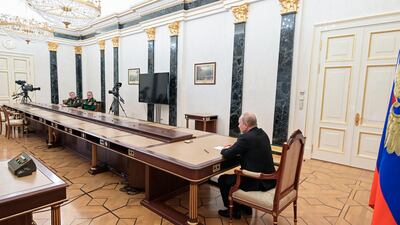
Russian President Vladimir Putin, right, speaks to Defence Minister Sergei Shoigu, second left, and Head of the General Staff of the Armed Forces and First Deputy Defence Minister Valery Gerasimov, left, during their meeting in Moscow. AP -
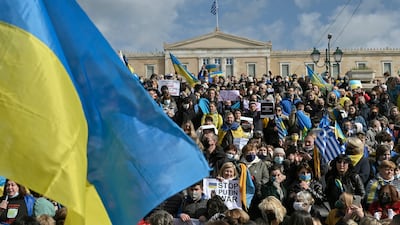
Ukrainians and supporters gather during a demonstration in front of the Greek Parliament in Athens against the Russian military's operation in Ukraine. AFP -
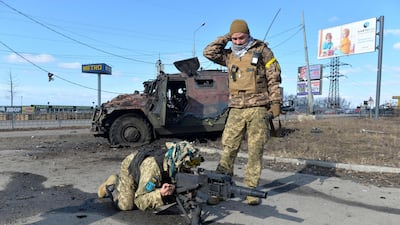
Ukrainian Territorial Defence fighters test an automatic grenade launcher taken from a destroyed Russian infantry mobility vehicla after a battle in Kharkiv. AFP


Crude, which surged to more than $105 per barrel last week, has stayed buoyant in the past few months as the global economy continued to recover from the pandemic-driven slowdown, despite the emergence of new Covid-19 variants last year. That has largely been a reflection of a faster than expected economic recovery, high demand and limited production capacity due to years of underinvestment in the energy industry.
The Russia-Ukraine crisis has exacerbated the upward trajectory.
The US and EU allies have levied a slew of sanctions against Russia for its military offensive in Ukraine. The measures include limiting Moscow's ability to do business in dollars, euros, pounds and yen as well as the freezing of Russian assets, barring a number of lenders from the Swift payments network and limiting the ability to raise funding in European financial markets.
Due to Russia's clout as a global energy player and its economy being closely intertwined with European countries the US and EU have so far stopped short of imposing sanctions on Russia’s oil and gas industries.
In 2020, Russia produced about 10.2 million barrels per day of crude oil and natural gas condensate, placing it second after the US, with Saudi Arabia in third, the 2021 BP Statistical Review of World Energy reported. It is also the second-largest producer of natural gas in the world and a major source of other commodities including nickel, aluminium, palladium, cobalt, copper, wheat and barley.
Although, Russia’s energy sector has escaped the sanctions net, analysts say oil prices could hit $130 a barrel by June if the Ukrainian conflict disrupts Russian crude flows and even surge beyond that if the crisis escalates.
Demand destruction is the only thing that can stop oil shooting higher, said Goldman Sachs, which has raised its one-month forecast for Brent to $115 a barrel from $95, with significant upside risks on further escalation or longer disruption.
Hurdles created for payments systems following sanctions should exacerbate the already visible commodity supply shock, Goldman Sachs analysts Damien Courvalin and Jeff Currie said.
“Commodity markets need to reflect not only these difficulties in paying for Russia’s exports but, with little left to sanction, the risk that Russian commodities eventually fall under western restrictions,” they said. They added it is an outcome which the US is no longer ruling out.
Energy Aspects, a research consultancy considered an authority on the energy industry, has raised its forecast on Brent to an average of $101 per barrel in 2022 and does not expect sanctions to target Russia's energy industry.
Despite rising concerns about supply disruptions as Europe relies heavily on Russian oil and gas, Opec+ ministers pushed back last week against the idea of increasing output at a faster pace.
Looking ahead, alliance will need to factor Iranian barrels coming to the market if Tehran strikes a nuclear deal with the US and its allies. Iran has been exempt from the production cuts under the Opec+ agreement because its crude oil production remains limited by US sanctions.
Iran, among larger Opec producers, will be able to boost exports by about a million barrels per day within a matter of months once sanctions are lifted. The US Energy Information Administration estimates Iran’s production could return to full capacity, at 3.8 million barrels per day, if Washington lifts the sanctions.
Despite the fluid situation that has developed Monica Malik, head of research at Abu Dhabi Commercial Bank, said that Opec+ is unlikely to waver from the course.
“We expect the group to continue with its agreement to increase output for April … we do not expect any change in its stance at this point, despite increasing supply-side uncertainty,” Ms Malik said.
“The Saudi energy minister … recently highlighted the importance of Opec+ group cohesion for the long-term stability of the oil market. We see this as an indication that Opec is looking to continue with its oil supply-related partnership with Russia.”
senior director of market economics at Emirates NBD
Oil prices have risen more than 67 per cent in the past year, partly driven by oil supply shortfall from Opec+ countries. The market could tighten further and push prices higher as producers continue to struggle to meet their supply quotas, the International Energy Agency said.
The bloc’s prolonged underperformance has effectively taken 300 million barrels, or 800,000 barrels per day, off the market since the start of 2021, the Paris-based agency said in its monthly market report.
“That shortfall is expected to deepen as some Opec+ members struggle with production constraints, exacerbating market tightness,” it said.
Spare capacity is almost entirely held by two producers — Saudi Arabia and the UAE, the IEA report said.
Opec+ had shown no inclination last week to increase production, primarily due to the fact many producers were already struggling to reach their production targets "while Russia, if allowed, is likely to hit its production limit within months”, Ole Hansen, head of commodities strategy at Saxo Bank, said in a note last week.
Brent is expected to “overshoot” $125 a barrel this year and $150 a barrel in 2023, given that Opec's spare capacity is below market expectations and impedes its ability to respond to high oil prices, JP Morgan said in December.
In a research note, Japan's largest lender MUFG said its “bull case for commodities rests not on the current geopolitical tensions, but rather on the structural underinvestment thesis centred on the lack of investments in commodity supply capacity”.

