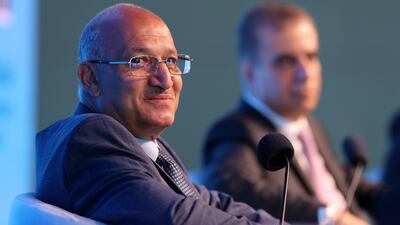
Roshdy Zakaria, chairman and chief executive of Egyptair, at the Arab Aviation Summit in Ras Al Khaimah. Chris Whiteoak / The National

Egyptair seeks government support as it presses ahead with Africa growth plans


Deena Kamel
  • English
  • Arabic

Egyptair, one of the Middle East’s oldest airlines, plans to ask for a government loan worth 5 billion to 7bn Egyptian pounds ($317 million to $447m) this year to help it weather the Covid-19 crisis.

The funds will be used to pay salaries, foreign loans and aircraft leasing fees, said chairman and chief executive Roshdy Zakaria on the sidelines of the Arab Aviation Summit in Ras Al Khaimah on Monday.

The loan will also bolster Egyptair’s cash reserves for the year after it spent 500m pounds a month during the pandemic.

“We are dealing with it and trying to keep surviving and this is with support of our government so that we can still continue our operations,” said Mr Zakaria.

“It is the worst catastrophe we have had in the last few years and I do not think we will have any other stronger catastrophe as this.”

Governments around the world have extended aid to their national airlines to help them survive the pandemic. Direct cash infusions and other measures such as tax relief and loan guarantees are valued at more than $225bn, according to the International Air Transport Association.

Egyptair received 5bn Egyptian pounds in direct government assistance and state-guaranteed loans last year. As a result, the airline did not cut salaries or jobs.

Mr Zakaria said he is optimistic about continued government support this year.

The airline is pressing ahead with plans to expand across Africa through partnerships with other operators and governments.

“To spread in Africa, this is our main goal,” he said.

The airline signed a joint venture agreement with Ghana to form a new airline, which will likely be called Air Ghana, that will start operations in the “next couple of months”, he said.

Egyptair, which will hold a 75 per cent stake in the venture, will provide four Boeing 737-800s to set up the fleet of the new airline.

The two parties are currently finalising financial and legal arrangements.

“There is a need for an airline in Ghana ... this will give Egyptair a hub in the middle of Africa so we can add more destinations which we don’t fly to,” he said.

Egyptair is also in talks with Sudan Airways over a potential joint venture. However, the airlines have yet to finalise the nature of the partnership.

It is also considering taking over flights to Israel – routes that are currently serviced by Air Sinai, he said.

The airline is optimistic about a rebound in passenger traffic this year. Passenger numbers currently stand at about 45 per cent to 50 per cent of 2019 levels. Egyptair plans to raise the figure to 75 per cent of pre-pandemic levels this year as more people are vaccinated around the world, said Mr Zakaria.

However, governments must ease restrictions, eliminate quarantine measures and collaborate on common standards for travel to resume safely, he said.

“The biggest worry is the continuation of the pandemic after the end of this year,” said Mr Zakaria.

Egyptair has no plans to shrink the size of its fleet and will take delivery of six Airbus A321neos and two Boeing 787 Dreamliners in March 2022.


ENGLAND SQUAD

Team: 15 Mike Brown, 14 Anthony Watson, 13 Ben Te'o, 12 Owen Farrell, 11 Jonny May, 10 George Ford, 9 Ben Youngs, 1 Mako Vunipola, 2 Dylan Hartley, 3 Dan Cole, 4 Joe Launchbury, 5 Maro Itoje, 6 Courtney Lawes, 7 Chris Robshaw, 8 Sam Simmonds

Replacements 16 Jamie George, 17 Alec Hepburn, 18 Harry Williams, 19 George Kruis, 20 Sam Underhill, 21 Danny Care, 22 Jonathan Joseph, 23 Jack Nowell

Analysis

Members of Syria's Alawite minority community face threat in their heartland after one of the deadliest days in country’s recent history. Read more

Key facilities
  • Olympic-size swimming pool with a split bulkhead for multi-use configurations, including water polo and 50m/25m training lanes
  • Premier League-standard football pitch
  • 400m Olympic running track
  • NBA-spec basketball court with auditorium
  • 600-seat auditorium
  • Spaces for historical and cultural exploration
  • An elevated football field that doubles as a helipad
  • Specialist robotics and science laboratories
  • AR and VR-enabled learning centres
  • Disruption Lab and Research Centre for developing entrepreneurial skills
Living in...

This article is part of a guide on where to live in the UAE. Our reporters will profile some of the country’s most desirable districts, provide an estimate of rental prices and introduce you to some of the residents who call each area home. 

Meydan card

6.30pm: Al Maktoum Challenge Round-1 (PA) Group 1 US$65,000 (Dirt) 1,600m
7.05pm: Conditions (TB) $100,000 (Turf) 1,400m
7.40pm: UAE 2000 Guineas Trial (TB) $100,000 (D) 1,600m
8.15pm: Handicap (TB) $175,000 (T) 1,200m
8.50pm: Al Maktoum Challenge Round-1 (TB) Group 2 $350,000 (D) 1,600m
9.25pm: Handicap (TB) $175,000 (D) 1,900m
10pm: Handicap (TB) $135,000 (T) 1,600m

Tips for SMEs to cope
  • Adapt your business model. Make changes that are future-proof to the new normal
  • Make sure you have an online presence
  • Open communication with suppliers, especially if they are international. Look for local suppliers to avoid delivery delays
  • Open communication with customers to see how they are coping and be flexible about extending terms, etc
    Courtesy: Craig Moore, founder and CEO of Beehive, which provides term finance and working capital finance to SMEs. Only SMEs that have been trading for two years are eligible for funding from Beehive.
The Bio

Ram Buxani earned a salary of 125 rupees per month in 1959

Indian currency was then legal tender in the Trucial States.

He received the wages plus food, accommodation, a haircut and cinema ticket twice a month and actuals for shaving and laundry expenses

Buxani followed in his father’s footsteps when he applied for a job overseas

His father Jivat Ram worked in general merchandize store in Gibraltar and the Canary Islands in the early 1930s

Buxani grew the UAE business over several sectors from retail to financial services but is attached to the original textile business

He talks in detail about natural fibres, the texture of cloth, mirrorwork and embroidery 

Buxani lives by a simple philosophy – do good to all

Notable salonnières of the Middle East through history

Al Khasan (Okaz, Saudi Arabia)

Tamadir bint Amr Al Harith, known simply as Al Khasan, was a poet from Najd famed for elegies, earning great renown for the eulogy of her brothers Mu’awiyah and Sakhr, both killed in tribal wars. Although not a salonnière, this prestigious 7th century poet fostered a culture of literary criticism and could be found standing in the souq of Okaz and reciting her poetry, publicly pronouncing her views and inviting others to join in the debate on scholarship. She later converted to Islam.


Maryana Marrash (Aleppo)

A poet and writer, Marrash helped revive the tradition of the salon and was an active part of the Nadha movement, or Arab Renaissance. Born to an established family in Aleppo in Ottoman Syria in 1848, Marrash was educated at missionary schools in Aleppo and Beirut at a time when many women did not receive an education. After touring Europe, she began to host salons where writers played chess and cards, competed in the art of poetry, and discussed literature and politics. An accomplished singer and canon player, music and dancing were a part of these evenings.


Princess Nazil Fadil (Cairo)

Princess Nazil Fadil gathered religious, literary and political elite together at her Cairo palace, although she stopped short of inviting women. The princess, a niece of Khedive Ismail, believed that Egypt’s situation could only be solved through education and she donated her own property to help fund the first modern Egyptian University in Cairo.


Mayy Ziyadah (Cairo)

Ziyadah was the first to entertain both men and women at her Cairo salon, founded in 1913. The writer, poet, public speaker and critic, her writing explored language, religious identity, language, nationalism and hierarchy. Born in Nazareth, Palestine, to a Lebanese father and Palestinian mother, her salon was open to different social classes and earned comparisons with souq of where Al Khansa herself once recited.

Ponti

Sharlene Teo, Pan Macmillan