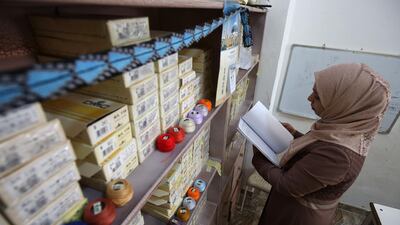
The Covid-19 pandemic has worsened the plight of vulnerable groups such as refugees and informal workers, according to the ILO. AFP.

Pandemic deepens plight of refugees, informal workers and youth in Arab countries, ILO says


Deena Kamel
  • English
  • Arabic

The Covid-19 pandemic has deepened the plight of informal workers, refugees, youth and women who were already among the most vulnerable groups in Arab states' labour markets, a regional International Labour Organisation official said.

The health crisis has worsened pre-existing inequalities, aggravated the suffering of vulnerable groups and highlighted the need for further economic diversification, Tariq Haq, the ILO's senior employment policy specialist, told The National.

"When you look at labour markets, the region is full of segmentation. Countries in conflict were extremely vulnerable before the crisis and the pandemic is compounding their suffering and economic pressures, making the situation even worse and less sustainable than ever before," he said.

The ILO projected that Arab countries will end this year with the equivalent of one million fewer full-time jobs, or a reduction in working hours of 2.9 per cent, compared to pre-crisis levels, according to its latest global update. In 2020, the total estimated decline in working hours in 2020 was 9 per cent, or the equivalent of 5 million full-time jobs.

Under the United Nations agency's most optimistic assumptions, Arab states will still see a 1.3 per cent decline in working hours in 2021. In a pessimistic scenario, working hours will decline by 3.8 per cent or the equivalent to 2 million full-time jobs.

The region's wealthier nations with stable social protections, access to Covid-19 vaccines and resources to handle infection flare-ups without imposing stringent restrictions, will most likely veer towards the baseline and optimistic scenarios, Mr Haq said.

Countries embroiled in conflict or where healthcare systems fail to keep up with the rates of infection could move towards stricter lockdowns and therefore see greater losses in working hours compared to wealthier nations or those better equipped to manage the number of cases, he said.

"Lebanon is a case in point," the ILO official said. The country has been roiled by a financial and political crisis, and is reeling from the aftermath of Beirut port explosion, lockdown measures and a labour market that was already in shambles prior to the pandemic.

Overall, it is difficult to predict which of the outcomes from the three labour scenarios will materialise in 2021 given the high uncertainty due to the new virus mutations and rate of vaccine distribution.

"This is a heterogenous region, we have the least developed countries in conflict to some of the highest-income countries in the world," Mr Haq said. "The reality is you will see a big mix."

Among groups made even more vulnerable by the pandemic are workers engaged in informal employment, without contracts or social protection, as they have less access to formal support schemes during the crisis, Mr Haq said.

The pandemic has also negatively impacted the region's youth, who have been struggling with high unemployment rates.

"Pre-Covid our youth unemployment rate was amongst the highest in the world," he said. "Young people have struggled to find jobs in our region for a long time."

Refugees also face a potentially greater proliferation of the virus and lack of adherence to social distancing or other safety measures in crowded spaces.

The ILO official said that as the region emerges from the Covid-19 crisis, policymakers should seek newer models where macro-economics, trade and investment are geared towards developing high-productivity and high value-add sectors that can absorb the region's young people.

"What this region suffered prior to the pandemic was a lack of diversification within economies: it was consumption-oriented, there was a lack of structural transformation and labour demand was relatively low," Mr Haq said. "What this crisis has brought to bear is the fault lines in existing structures, which will not be sustainable."

Expansion of social protection systems across the region and more social dialogue between workers and businesses is critical, he said.

Last week, the ILO said a global recovery in working hours and incomes this year will be slow, uneven and uncertain.

The tentative signs of a labour market recovery come after the pandemic shut workplaces, forced many to work from home, hit incomes, led to job losses and pushed millions into poverty.

“Covid-19 has resulted in the most severe crisis for the world of work since the Great Depression of the 1930s,” the UN agency said.


Ten tax points to be aware of in 2026

1. Domestic VAT refund amendments: request your refund within five years

If a business does not apply for the refund on time, they lose their credit.

2. E-invoicing in the UAE

Businesses should continue preparing for the implementation of e-invoicing in the UAE, with 2026 a preparation and transition period ahead of phased mandatory adoption. 

3. More tax audits

Tax authorities are increasingly using data already available across multiple filings to identify audit risks. 

4. More beneficial VAT and excise tax penalty regime

Tax disputes are expected to become more frequent and more structured, with clearer administrative objection and appeal processes. The UAE has adopted a new penalty regime for VAT and excise disputes, which now mirrors the penalty regime for corporate tax.

5. Greater emphasis on statutory audit

There is a greater need for the accuracy of financial statements. The International Financial Reporting Standards standards need to be strictly adhered to and, as a result, the quality of the audits will need to increase.

6. Further transfer pricing enforcement

Transfer pricing enforcement, which refers to the practice of establishing prices for internal transactions between related entities, is expected to broaden in scope. The UAE will shortly open the possibility to negotiate advance pricing agreements, or essentially rulings for transfer pricing purposes. 

7. Limited time periods for audits

Recent amendments also introduce a default five-year limitation period for tax audits and assessments, subject to specific statutory exceptions. While the standard audit and assessment period is five years, this may be extended to up to 15 years in cases involving fraud or tax evasion. 

8. Pillar 2 implementation 

Many multinational groups will begin to feel the practical effect of the Domestic Minimum Top-Up Tax (DMTT), the UAE's implementation of the OECD’s global minimum tax under Pillar 2. While the rules apply for financial years starting on or after January 1, 2025, it is 2026 that marks the transition to an operational phase.

9. Reduced compliance obligations for imported goods and services

Businesses that apply the reverse-charge mechanism for VAT purposes in the UAE may benefit from reduced compliance obligations. 

10. Substance and CbC reporting focus

Tax authorities are expected to continue strengthening the enforcement of economic substance and Country-by-Country (CbC) reporting frameworks. In the UAE, these regimes are increasingly being used as risk-assessment tools, providing tax authorities with a comprehensive view of multinational groups’ global footprints and enabling them to assess whether profits are aligned with real economic activity. 

Contributed by Thomas Vanhee and Hend Rashwan, Aurifer

How The Debt Panel's advice helped readers in 2019

December 11: 'My husband died, so what happens to the Dh240,000 he owes in the UAE?'

JL, a housewife from India, wrote to us about her husband, who died earlier this month. He left behind an outstanding loan of Dh240,000 and she was hoping to pay it off with an insurance policy he had taken out. She also wanted to recover some of her husband’s end-of-service liabilities to help support her and her son.

“I have no words to thank you for helping me out,” she wrote to The Debt Panel after receiving the panellists' comments. “The advice has given me an idea of the present status of the loan and how to take it up further. I will draft a letter and send it to the email ID on the bank’s website along with the death certificate. I hope and pray to find a way out of this.”

November 26:  ‘I owe Dh100,000 because my employer has not paid me for a year’

SL, a financial services employee from India, left the UAE in June after quitting his job because his employer had not paid him since November 2018. He owes Dh103,800 on four debts and was told by the panellists he may be able to use the insolvency law to solve his issue. 

SL thanked the panellists for their efforts. "Indeed, I have some clarity on the consequence of the case and the next steps to take regarding my situation," he says. "Hopefully, I will be able to provide a positive testimony soon."

October 15: 'I lost my job and left the UAE owing Dh71,000. Can I return?'

MS, an energy sector employee from South Africa, left the UAE in August after losing his Dh12,000 job. He was struggling to meet the repayments while securing a new position in the UAE and feared he would be detained if he returned. He has now secured a new job and will return to the Emirates this month.

“The insolvency law is indeed a relief to hear,” he says. "I will not apply for insolvency at this stage. I have been able to pay something towards my loan and credit card. As it stands, I only have a one-month deficit, which I will be able to recover by the end of December." 

The specs: 2018 Ducati SuperSport S

Price, base / as tested: Dh74,900 / Dh85,900

Engine: 937cc

Transmission: Six-speed gearbox

Power: 110hp @ 9,000rpm

Torque: 93Nm @ 6,500rpm

Fuel economy, combined: 5.9L / 100km

Company%20Profile
%3Cp%3E%3Cstrong%3ECompany%20name%3A%3C%2Fstrong%3E%20Cargoz%3Cbr%3E%3Cstrong%3EDate%20started%3A%3C%2Fstrong%3E%20January%202022%3Cbr%3E%3Cstrong%3EFounders%3A%3C%2Fstrong%3E%20Premlal%20Pullisserry%20and%20Lijo%20Antony%3Cbr%3E%3Cstrong%3EBased%3A%3C%2Fstrong%3E%20Dubai%3Cbr%3E%3Cstrong%3ENumber%20of%20staff%3A%3C%2Fstrong%3E%2030%3Cbr%3E%3Cstrong%3EInvestment%20stage%3A%3C%2Fstrong%3E%20Seed%3C%2Fp%3E%0A
England squad

Moeen Ali, James Anderson, Jofra Archer, Jonny Bairstow, Dominic Bess, James Bracey, Stuart Broad, Rory Burns, Jos Buttler, Zak Crawley, Sam Curran, Joe Denly, Ben Foakes, Lewis Gregory, Keaton Jennings, Dan Lawrence, Jack Leach, Saqib Mahmood, Craig Overton, Jamie Overton, Matthew Parkinson, Ollie Pope, Ollie Robinson, Joe Root, Dom Sibley, Ben Stokes, Olly Stone, Amar Virdi, Chris Woakes, Mark Wood

Company%20profile
%3Cp%3E%3Cstrong%3EName%3A%3C%2Fstrong%3E%20Belong%3Cbr%3E%3Cstrong%3EBased%3A%3C%2Fstrong%3E%20Dubai%3Cbr%3E%3Cstrong%3EFounders%3A%3C%2Fstrong%3E%20Michael%20Askew%20and%20Matthew%20Gaziano%3Cbr%3E%3Cstrong%3ESector%3A%3C%2Fstrong%3E%20Technology%3Cbr%3E%3Cstrong%3ETotal%20funding%3A%3C%2Fstrong%3E%20%243.5%20million%20from%20crowd%20funding%20and%20angel%20investors%3Cstrong%3E%3Cbr%3ENumber%20of%20employees%3A%3C%2Fstrong%3E%2012%3C%2Fp%3E%0A
LIVING IN...

This article is part of a guide on where to live in the UAE. Our reporters will profile some of the country’s most desirable districts, provide an estimate of rental prices and introduce you to some of the residents who call each area home.

Key facilities
  • Olympic-size swimming pool with a split bulkhead for multi-use configurations, including water polo and 50m/25m training lanes
  • Premier League-standard football pitch
  • 400m Olympic running track
  • NBA-spec basketball court with auditorium
  • 600-seat auditorium
  • Spaces for historical and cultural exploration
  • An elevated football field that doubles as a helipad
  • Specialist robotics and science laboratories
  • AR and VR-enabled learning centres
  • Disruption Lab and Research Centre for developing entrepreneurial skills
The specs

Engine: 4.0-litre V8

Power: 503hp at 6,000rpm

Torque: 685Nm at 2,000rpm

Transmission: 8-speed auto

Price: from Dh850,000

On sale: now