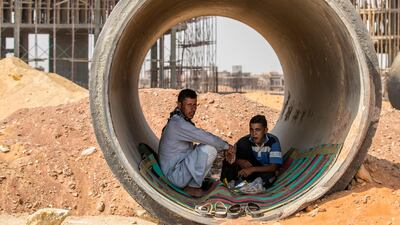

Hisham, 48, sleeps in a cabin in the desert near Ain Sokhna, 200km from his home, guarding a construction site. He earns 10,000 Egyptian pounds ($186) a month, and did so long before the government's latest wage decision.
The job is dangerous, he told The National. “They should be paying me much more just because of the amount of snakes I have had to kill on the job.”
His pay reflects risk, not fair wage by decree. The same holds for much of Egypt's private sector, where pay often follows its own logic: risk, scarcity of skills and competition from informal work are bigger determinants of pay than government mandates.
On Sunday, the National Wages Council, chaired by Prime Minister Mostafa Madbouly, approved a raise in the private-sector minimum wage to 8,500 pounds ($158) a month from January 1, up from 7,000 pounds since March 2025.
Unaccounted labour
The decision is binding on all of Egypt's about four million private establishments, which employ about 26.5 million people, cabinet spokesman Mohamed Adel said. The private sector accounts for 82.8 per cent of the employed.
The Labour Ministry said inspectors would strictly enforce the 2025 labour law, which sets fines of 5,000 pounds to 50,000 pounds that multiply with the number of workers affected, and pointedly warned employers in a statement on Monday against deviating from it.
But the state's reach is limited. More than 60 per cent of jobs in Egypt are informal, outside contracts and social insurance, according to International Labour Organisation estimates.
In fact, a private-sector minimum was only introduced in 2022, when more than 3,000 companies and 22 sectors applied for exemptions.
Labour Ministry inspections of 26,486 private establishments between March 2025 and March 2026 found 6,591 in violation, about one in four, according to a review of the figures by the fact-checking platform Saheeh Masr.
For Egypt's biggest employers, the new floor is already out of date. Businessman Naguib Sawiris said earlier this week that none of his companies' staff earn less than 10,000 pounds.
Ahmed, 42, has worked as a porter at El Sewedy Electric for five years. He earns 11,000 pounds, about 30 per cent above the new minimum, and gets a raise every year without waiting for a government order.
Furthermore, skilled workers are leaving factory jobs “to drive tuk-tuks”, Industry Minister Khaled Hashem said during a seminar last month.
He described a labour market where factories must outbid the informal economy for workers, rather than simply meeting a legal minimum wage.
A tuk-tuk driver answers to no employer, pays no social insurance and keeps his day's earnings in cash.
Workers without that leverage have little say over their pay. A teacher at a private school in Cairo told Saheeh Masr he earns 4,500 pounds after eight years. He said he would not ask for more because the management “excludes any teacher who asks for better pay and replaces them with new ones on lower salaries”.
A security guard in Cairo's Heliopolis district told The National on Tuesday that his pay has stayed at 6,000 pounds since 2021, and nobody has told him it will rise.
A 31-year-old woman who runs a two-year-old service business in Heliopolis said she would probably not raise the 6,000 pounds a month she pays each of her two Sudanese workers, employed by verbal agreement. Stretched by higher taxes and tougher enforcement, she hired Sudanese workers because they accept less than Egyptians.
The owner of a small supermarket chain in Nasr City said he had replaced most of his Egyptian delivery staff with Sudanese men because “they work harder, give me less trouble and they accept lower wages than Egyptians”.
Others see signs this time may be different.
Yasser, 39, who packs vegetables at a wholesale warehouse in New Cairo, has been earning 6,000 pounds and was told he would receive 8,500 starting next month. He received no increase in pay after the last order, so he thinks the government is serious now. He had accepted the low pay because his employer provides transport, saving him about 2,000 pounds a month.
“We hope the National Wages Council states that the decision means a net income of 8,500 pounds, and not gross, otherwise we are fooling people,” read one widely shared post online.
Eroded by inflation
Alaa El Sokky, an employers' representative on the council, said the figure is gross and that workers would take home 7,000 pounds to 7,500 pounds after social insurance and tax. The National's calculation, based on current tax brackets and the employee's 11 per cent insurance contribution, puts it at about 7,200 pounds.
Mr El Sokky said the increase of more than 20 per cent outpaced inflation, which slowed to 12.7 per cent in cities in October. Since the last rise in March 2025, prices nationwide have climbed about 18 per cent, based on official index figures.
But that leaves out the earlier economic shock.
The pound traded at about 15.7 to the dollar until March 2022 and is now near 54, after a series of devaluations and a float in March 2024. Urban inflation peaked at a record 38 per cent in September 2023.
The government has also cut subsidies to ease pressure on its budget, a central part of its International Monetary Fund programme.
The increase places the cost of higher wages on private employers rather than the state, which is seeking to contain spending under its IMF programme. Talks on the programme's latest review have ended without an agreement, delaying a potential $2.3 billion disbursement.
Egypt quadrupled the price of subsidised bread in June 2024, the first increase since 1988. It also raised electricity tariffs by about 45 per cent, and in March this year raised fuel prices by 14 to 17 per cent. In October, transport inflation stood at 25.8 per cent and housing and utilities at 24.5 per cent.
Rent alone can take half the current minimum with the median in Cairo's El Marg district being 3,500 pounds, according to Saheeh Masr.
In dollar terms, the floor has barely moved.
The first private-sector minimum of 2,400 pounds was worth about $154 in 2022. The new one is worth about $158. So workers have absorbed four years of price rises and subsidy cuts with little change to their purchasing power.