
Egypt has signed a $1 billion financing agreement with the World Bank, the latest foreign funding for an economy buffeted by regional war, a sliding currency and rising prices.
The deal, signed by Foreign Minister Badr Abdelatty on Sunday, is the second of three concessional development policy operations. Approved by the bank's board in May, it includes a $200 million British credit guarantee and is tied to reforms of state-owned enterprises, competition rules, tax collection and the cost of government borrowing.
The bank said at the time that Egypt had endured “two years of successive external shocks”. Those pressures have since deepened. The US-Israeli war on Iran has raised oil, shipping and insurance costs for a country reliant on imports.

Prime Minister Mostafa Madbouly told the Egypt Forum in late October that oil was trading around $110 a barrel, against $75 assumed in the budget. He considered passing costs to citizens, borrowing to absorb them, or risking power cuts of six to eight hours a day. The government chose to absorb them “at this stage”, he said.
President Abdel Fattah El Sisi told the same forum that fuel and electricity prices were “completely uneconomic” and sold below cost, and that limited resources often forced the state to borrow to keep supplies flowing.
Finance Minister Ahmed Kouchouk put subsidies at 840 billion Egyptian pounds ($15 billion) this fiscal year, with borrowing costs adding about 20 per cent to bring the real bill near EGP 1 trillion ($17.9 billion).
The strain has since reached the local currency. The dollar rose by almost 8 per cent, from about EGP 52 at the start of October to break a record above EGP 56 on October 26.
It is estimated that about $4 billion of foreign money left Egyptian government debt between October 15 and 26 as markets prepared for further turmoil in the region.

Central Bank Governor Hassan Abdalla told the same forum that a flexible exchange rate was the “first line of defence” against external shocks. “The most important thing for us is unifying the exchange rate, not the exchange rate itself,” he said.
For import-dependent Egypt, the priority is keeping dollars flowing through banks rather than into the black market, even at the cost of a weaker pound, Mr Abdallah said.
Before the March 2024 currency float, a wide gap between official and parallel rates diverted remittances away from banks and left businesses struggling to secure foreign currency to pay for imports.
On Thursday, the bank raised rates by 100 basis points to 20 per cent, citing “challenging external conditions”. It was the first increase since March 2024 and reversed an easing cycle that had cut 825 basis points from April 2025 before pausing when the war began. The bank also pushed back its inflation target to late 2027.
On the stock exchange, trading was halted for 30 minutes on October 25, the first suspension since 2021, after the EGX100 index fell 10 per cent.
Egypt's other dollar earners offer only partial cover from the war-related pressures. Remittances hit a record $33.9 billion in the first eight months of the year, but tourism revenue grew 1.7 per cent over the same period, compared with 16.3 per cent growth in the fiscal year ending June 2025.
Suez Canal income, near $10 billion a year before Red Sea attacks began, has recovered only to about $4.4 billion, and the canal's chief has warned that renewed tension at Bab Al Mandeb strait greatly threatens that recovery.
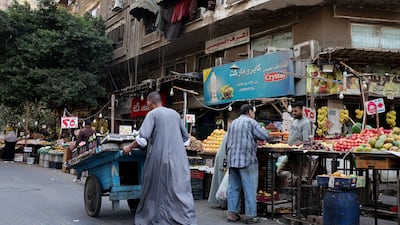
In the shops, the effect is immediate. Shoppers in Cairo told The National on Monday that they were shocked by the increases in some food items over the past couple of months.
Cooking oil, more than 95 per cent of which is imported, has risen from EGP 75 ($1.34) to EGP90 ($1.61) per bottle in a month, meat rose by EGP 100 ($1.79) a kilo in five months and a bar of soap from EGP 20 ($0.36) to EGP 35 ($0.63) since the summer.
Traders blame more expensive imported milk powder for cheese price rises, animal feed for meat increases, and imported chemicals for rising soap prices.
The squeeze comes on top of a heavy debt load. External debt reached $166.45 billion at the end of June, according to World Bank data, and Egypt owes about $60.9 billion in repayments and interest between July this year and June 2027. That includes some $19.1 billion in central bank deposits, mostly from Gulf states.
The acute hardship has been acknowledged by leaders. Mr El Sisi said he had convened the Egypt Forum amid discontent over rising prices and the difficulty of paying electricity bills, conceding that “electricity is indeed expensive” and that energy feeds into the price of everything.
Closing the event, he said the cost of reform “has borne heavily upon the Egyptian citizen” and urged officials to prioritise “alleviating cost-of-living burdens”. For households, that relief has yet to arrive.
Official data has yet to capture October. Urban inflation eased to 13.9 per cent in September, though food inflation picked up. After household electricity tariffs rose an average of 12 per cent in August, the cabinet's spokesman said there would be no fuel or power price rises “at this stage”.
An IMF mission is in Cairo for the final review of Egypt's loan programme, which could release about $2.3 billion before it ends on December 15. The government has signalled it will not seek a successor deal.