
Syria and the World Bank have agreed to set up a multi-donor trust fund for the country's recovery and reconstruction, the two sides announced in a joint statement on Sunday.
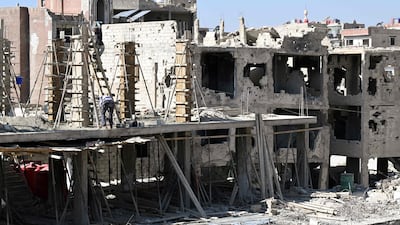
Damascus is continuing to rebuild after a civil war that lasted for more than a decade and had destroyed the country's infrastructure.

The Syria Recovery and Reconstruction Trust Fund – or “Start” – is a multi-donor fund that aims to provide concessional financing, investment guarantees and technical assistance, and build trust, the statement said.
The agreement comes after Syria took part in the International and World Bank annual meetings in Bangkok, Thailand. The gatherings were the latest to be attended by Syrian officials since the fall of president Bashar Al Assad's regime in December 2024.
Syrian Finance Minister Yisr Barnieh said the agreement helps to set the foundation for a new phase of co-operation with Damascus's international partners. Partners in the US, Europe and Middle East expressed their support for the initiative, the statement said.
“An important milestone in Syria’s recovery and reconstruction journey,” Mr Barnieh wrote in a post on X.
The World Bank in 2025 estimated Syria's reconstruction would cost about $216 billion, making it one of the most expensive rebuilding efforts in history. The World Bank classified this as its best “conservative” estimate.
The World Bank said infrastructure accounted for 48 per cent, or $52 billion, of total damage from the civil war, followed by residential buildings at $33 billion and non-residential buildings at $33 billion.
It said the multi-donor trust fund will help to support the delivery of basic services, strengthen institutional capacities and expand economic opportunities.
“We look forward to working with all partners to support a comprehensive and sustainable recovery path,” said Ousmane Dione, World Bank vice president for the Middle East, North Africa, Afghanistan and Pakistan.
Syria's transitional government has been racing to secure investment commitments to help rebuild the country's infrastructure. Some of those pledges have recently gone to the implementation phase, including DP World's $800 million towards Tartus Port.
The country has secured deals with its other Gulf partners, including a $2 billion Saudi Arabian investment package to develop two airports in Aleppo, as well as other projects involving energy, real estate and telecommunications.
At this week's gatherings in Thailand, Mr Barnieh also held discussions with Qatari Finance Minister Ali Al Kuwari on supporting recovery and development work, the state-run news agency Sana reported. Norway also expressed interest in contributing to the trust fund, Sana reported.
Qatar has also offered financing for projects to rehabilitate Syria's electricity grids, water networks, public services and the Damascus International Airport.
Baker Hughes, Caterpillar and Visa were among a delegation of about 50 US companies that visited Syria last month to explore and deepen economic ties, which came weeks after the US delisted Syria as a state sponsor of terrorism.
Syria will also return to the Arab group at the International Monetary Fund beginning on November 1, leaving the Russian-led group it joined in 2012, the Finance Ministry said in a post on Telegram.
The IMF restarted communications with Syria in 2025. The fund said in August it had agreed on a technical assistance programme for the country after a staff-level visit in July.
The IMF has not had an Article IV consultation with Syria since 2009.

