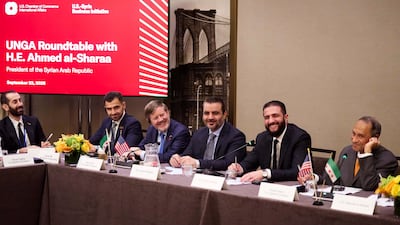

US investors see an opportunity to invest early in Syria as the transitional government races to establish a pro-business environment and attract foreign capital.
“We see that the door is open, and we're coming early,” Steve Lutes, vice president of Middle East Affairs at the US Chamber of Commerce, said in an interview.
“I think US companies made it very clear across a different range of sectors that they're looking to be strategically engaged, to be a long-term partner in helping Syria get back up on its feet and excel economically.”

Mr Lutes spoke to The National after the Chamber of Commerce hosted a round-table with Syrian President Ahmad Al Shara and Foreign Minister Asaad Al Shibani on the sidelines of the UN General Assembly last month. He also recently led a delegation of more than 50 American businesses and 80 delegates to Damascus.
The delegation – which included Baker Hughes, Caterpillar, Visa and dozens of other US firms – marked a significant step in re-establishing Washington's economic relationship with Syria after the 13-year civil war. It also came shortly after the US lifted its state sponsor of terrorism designation on Syria, which had been a prominent roadblock to the country’s reintegration into the international financial system.
Syria’s government has moved quickly to attract investment since the fall of Bashar Al Assad's regime in 2024. The World Bank estimates it will cost $216 billion to rebuild the country.
Some investment pledges from the Gulf have already moved towards implementation, including DP World's $800 million investment commitment to Tartus Port. At the same time, Syria has also courted foreign investors from Silicon Valley to Riyadh.
“They're really pressing on the accelerator to try to move things forward,” Mr Lutes said.
He added that the Chamber of Commerce was turning significant attention towards Syria's banking sector, which has undergone a rapid transformation under the current government. Mr Al Shara carried out the country’s first international Visa transaction in August.
“It's so foundational to everything else,” Mr Lutes said.
QNB and Mastercard issued the first internationally accepted payment card in Syria. The World Bank has also approved a $100 million grant to help establish a digitally enabled financial sector.
Last Sunday, Central Bank of Syria Governor Mohammed Raslan told official news agency Sana that the government expected foreign investment in establishing new banks to surpass $1 billion in the coming period.
The US Treasury Department on Thursday held a round-table in New York to support the country's financial sector and reconnection to the global financial system. Finance Minister Yisr Barnieh said in a LinkedIn post that discussions had focused on advancing anti-money laundering and counter-terrorism financing standards, among other reforms. Treasury Assistant Secretary for Terrorist Financing and Financial Crimes Jonathan Burke also stressed financial connectivity remains a vital component to combatting illicit finance and supporting Syria's reintegration into the global financial system, according to a readout.
Public spending in Syria for first six months of the year totalled roughly $3.7 billion, compared to a public revenue of $2.7 billion, according to the finance ministry's first-half 2026 budget report. That leaves a fiscal deficit of about $1 billion.
“The biggest challenge at the end of the day are the budgetary constraints and how are they going to finance and pay for it all,” Mr Lutes said.
Damascus said it was implementing new measures to control public spending, including reviewing investment projects. Mr Barnieh wrote in a social media post on Monday that the measures would not affect salaries, wages or spending on essential needs such as health, education, water, energy, security, public safety and necessary operational maintenance.
Gulf partnerships
While the state sponsor of terrorism delisting removed the final pillar in the US sanctions architecture, investing in Syria continues to carry reputational risks. It remains on the Financial Action Task Force's grey list, and parties may have previous links to sanctioned actors.
Mr Lutes described the Chamber of Commerce’s delegation to Damascus as an “exploratory” one to give US companies the chance to identify sectors for investment and re-establish trust with Syrian officials.
Several US companies have already signed memorandums of understanding and other agreements with Syria including ConocoPhillips, Chevron, Baker Hughes, Hunt Energy and Ardent LNG.
Gulf partners have joined some of these projects including Qatar's UCC Holding, which signed an agreement with Chevron and Syria's state-run petroleum company to develop the country's first offshore oil and gasfield.
Mr Lutes anticipates more US companies could go down similar routes with Emirati, Saudi or Qatari partners who already have relationships with the country. Doing so could mitigate some risks and increase US investor confidence.
He added that he hopes the delegation will become an annual occurrence. He also said the chamber is engaging with the Syrian government on addressing policy regulatory issues.
“We're not going out of business any time soon. There's a lot of work for the chamber to support US companies that are interested in doing business in Syria, so we're going to be at this … for many years to come,” Mr Lutes said.

