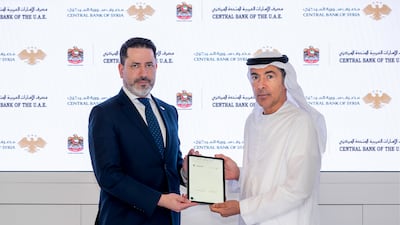

The Central Bank of the UAE has agreed to deepen bilateral co-operation with regulators in Syria and Morocco, focusing on key areas to boost financial stability and technology.
The preliminary agreement with the Central Bank of Syria includes a framework for building technical expertise for payment systems, monetary policy, cash management and financial technology, the CBUAE said in a statement on Friday.
It will also cover climate risk management, sustainable finance, financial inclusion, financial literacy and awareness, credit information systems, and reporting and risk management frameworks, it added.
The agreement was signed by the UAE central bank governor Khaled Balama and his Syrian counterpart Mohammad Raslan.
On Saturday, the CBUAE said it had signed two preliminary agreements with Bank Al Maghrib, the central bank of Morocco, centred on regulatory frameworks and the possibility of interlinking payment systems to facilitate cross-border transactions.
The UAE-Syria deal reflects the two countries' shared interest in “advancing co-operation in financial and regulatory areas … to support the resilience of the financial system, enhance the efficiency of the financial infrastructure and keep pace with developments in the financial technology sector”, Mr Balama said.
That agreement is expected to boost Syria's plans for its economy, which continues to open up following the toppling of Bashar Al Assad's regime in December 2024 and the removal of western sanctions last year. Gulf states and other regional countries are moving quickly to invest in Syria’s future, launching diplomatic, financial and infrastructure support.
Syria also plans to build or rehabilitate two million homes by 2035 to address housing shortages and boost its economy. Investors including UAE-based developer Arada and Emaar founder Mohamed Alabbar have revealed plans to invest in the country's property sector.
The agreement “represents an important step … serving as a foundation for practical and sustainable avenues of co-operation between the two central banks, contributing to more efficient banking services, supporting monetary and banking stability”, Mr Raslan added.
The CBUAE said the two deals with Morocco's central bank cover Islamic finance, financial messaging systems and exploring the development of retail and wholesale central bank digital currencies.
The agreements were signed by Mr Balama and Bank Al Maghrib governor Abdellatif Jouahri.

“We look forward to exchanging supervisory expertise, developing Islamic finance solutions and exploring opportunities to strengthen links between payment systems, contributing to a more efficient and innovative financial sector and supporting economic and trade relations between the two countries,” Mr Al Balama said.
Authorities in Morocco, Africa's fifth-biggest economy, have leaned heavily on their economic strategy. Already one of Africa’s most diversified and industrialised economies, Morocco’s growth targets are ambitious.
The country’s New Development Model, a national economic plan launched about five years ago, aims to double gross domestic product per capita by 2035. The country has seen billions pour into sectors such as deepwater ports, phosphates, green energy and railway lines.
“The signing of the two [agreements] marks an important step … contributing to greater efficiency in financial transactions and stronger co-operation between the two institutions,” Mr Jouahri said.
Earlier this week, the CBUAE agreed to renew its Dh5 billion ($1.36 billion) currency swap agreement with Egypt. The refreshed deal is valid for five years and is aimed at enhancing trade relations and financial co-operation between the countries.

