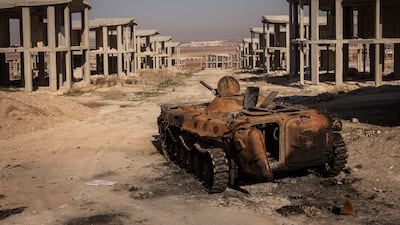

Syria faces a “multi-decade” recovery from the destruction of its civil war, even as returning families show striking optimism about rebuilding their lives, the head of a major international aid organisation has told The National.
Tjada McKenna, chief executive of Prosper Global, formerly Mercy Corps, said international assistance reaching Syria remains “woefully insufficient” for the scale of reconstruction required.
In an interview in New York on the sidelines of the UN General Assembly high-level debate week, she thought the rebuild would be a "multi-decade" process. “We have a longer road ahead for just the complete rehabilitation,” she added.
Ms McKenna spoke a few weeks after travelling across Syria from Aleppo through Idlib and on to Damascus, where she saw widespread destruction of homes and essential infrastructure despite growing optimism among Syrians about rebuilding their lives.
The World Bank has estimated the cost of Syria's reconstruction at about $216 billion, almost 10 times the size of the country's 2024 economy. Millions of Syrians also remain displaced despite increasing numbers returning home since the fall of Bashar Al Assad in December 2024.
Ms McKenna said restoring water and electricity networks, roads, hospitals and schools were among the immediate priorities, alongside creating jobs and livelihoods that would allow people to return home.
But Syria is beginning its recovery at a particularly difficult moment for the international humanitarian system. “I think this is the most extraordinarily challenging time we've had in the world,” she explained, pointing to the number of simultaneous conflicts and other emergencies.
“It's just like an unprecedented level of need in the world. At the same time, it feels like an unprecedented level of apathy, with all of the aid cuts happening at the same time.”

Ms McKenna pointed to Gaza as an example of how humanitarian needs persist and evolve during prolonged conflicts, particularly when basic infrastructure has been destroyed.
Sewage systems and water quality remain major concerns amid heavy Israeli restrictions and continued strikes, while many Palestinians continue to live in tents. “People still don't have access to good shelter,” she said. “People are still living in tents. They're very subject to weather.”
Prosper Global is continuing to provide immediate assistance in Gaza, including bringing clean water into communities by lorry and providing cash support. But Ms McKenna said humanitarian organisations were also trying to help Palestinians maintain livelihoods during the crisis.
Her organisation also operates in Sudan, Yemen, Ukraine and the Democratic Republic of Congo, among other countries.
Sudan is facing one of the world's most severe humanitarian emergencies as the war between the Sudanese Armed Forces and Rapid Support Forces continues, while years of conflict and economic deterioration have left millions in Yemen requiring assistance, needs that have been exacerbated by the Houthis' recent takeover of the western coast.

The simultaneous crises are unfolding as international aid budgets are being reduced, forcing humanitarian organisations to respond to greater needs with fewer resources.
For Syria, Ms McKenna said that squeeze could have significant consequences. She added that the country might have received a much larger international response if its war had ended several years earlier, before the current pressure on global aid budgets.
Prosper Global continues to provide emergency assistance to displaced Syrians, including cash support, but is increasingly focusing on longer-term recovery through restoring water infrastructure and supporting agriculture and livelihoods. “People in Syria are excited. They don't want handouts,” Ms McKenna said. “They want to work. They want markets open to them.”
The lifting of Western sanctions has raised hopes of greater foreign investment in Syria, and Ms McKenna said the changes could expand the number of companies, suppliers and other partners able to operate there. But the scale of reconstruction, combined with competing emergencies around the world, means the country's transition from humanitarian relief to economic recovery will take time.
Those delivering the aid also feel the pressure. “I worry about my team,” Ms McKenna said. About 90 per cent of her organisation's staff live and work in the communities they serve, she added. “Their resilience and their strength really give me the support and energy I need to persist.”

