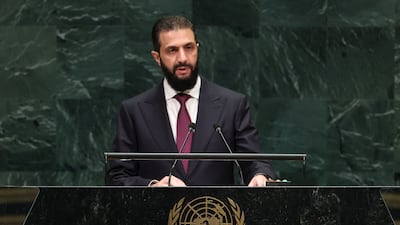

Syrian President Ahmad Al Shara on Wednesday accused Israel of carrying out hundreds of air strikes and incursions on Syrian territory that he said were undermining his country's rise.
“The world is rejoicing about our return, but Israel is launching attacks against Syria,” Mr Al Shara told the UN General Assembly in New York. He said there had been 500 air strikes, more than 1,200 incursions and 300 detentions, describing the actions as a threat to regional peace and security.
Israeli troops entered a UN-patrolled buffer zone after the collapse of Bashar Al Assad's government in Damascus in December 2024, in what Israel described as a temporary move to secure its border.
However, Israel has since carried out hundreds of strikes on Syrian military infrastructure and seized new positions deeper into the country. The Syrian government and the UN have said the deployment violates Syrian sovereignty and a 1974 disengagement agreement that followed the 1973 Middle East war.
In his speech, Mr Al Shara reaffirmed Syria’s commitment to a 1974 disengagement agreement with Israel and called for Israeli forces to withdraw to their pre-2024 lines He also said the Golan Heights would remain Syrian territory.
Mr Al Shara said the Israeli actions undermined peace and security and rejected what he called attempts to impose a fait accompli on Syria.
“We call for the withdrawal of Israeli forces to the lines of 8 December 2024. We reject Israeli attempts to impose a fait accompli. We reject their aggressions, which undermines peace and security,” he said.
He said that Syria wanted “just peace” that preserved the rights of all parties. “The urgency for peace and security is available to those who wish to live in peace, in just peace that maintains the rights of all.”
Turning to Syria’s recovery from 13 years of civil war, Mr Al Shara said Damascus had ended the bloodshed, restored state institutions, brought weapons under state control and begun reconstruction.
He said sanctions had been lifted, Syria had resumed production and agricultural output had increased, while Damascus had stepped up efforts to combat drug trafficking, organised crime and human smuggling.
He said more than 3.5 million refugees and internally displaced people had returned to Syria and announced an initiative called “Syria without refugee camps” aimed at ending displacement. Universities and schools were being rebuilt to restore education services, he said.
Mr Al Shara said Syria had also restored diplomatic ties with the international community, with more than 100 states communicating with Damascus and more than 60 diplomatic missions operating in the capital. He said Syria was co-operating with international organisations including the Organisation for the Prohibition of Chemical Weapons and the International Atomic Energy Agency.
“Syria turned from a crisis to an opportunity for many countries,” he said, warning that regional development plans that ignored Syria would be flawed.
Mr Al Shara said the repeal of US sanctions had opened the way for wider international co-operation, including with the European Union. Syria has also been removed from a US list of state sponsors of terrorism.
He concluded by pledging to continue rebuilding Syria and restoring its dignity, saying the country had reappeared at the General Assembly at its 80th session to announce its return and was now presenting its achievements at the 81st.
“At the 82nd session, we will come together again to gain the fruits of strategic partnerships,” Mr Al Shara said.

