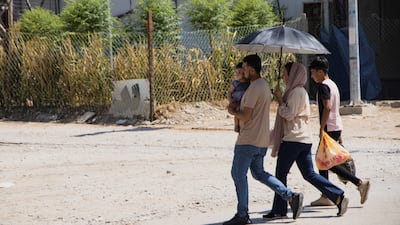

Reconstruction work in Syria must extend to Kurdish areas in the north-east if refugees are to return home, the UN refugee agency’s representative in Iraq has told The National.
Toby Harward said the lack of economic opportunities and security in the region remained a major obstacle.
“We see a lot of MoUs [memorandums of understanding] signed in Syria, we see a lot of agreements being signed, plans for reinvestment, reconstruction,” Mr Harward said. But these plans have to extend to the Kurdish areas to create an appetite for Syrian refugees in Iraq to return, he added.

Iraq hosts more than 300,000 Syrian refugees, according to UNHCR data. Eighty-five per cent of them are in the autonomous Kurdistan Region, and the majority are Syrian Kurds, Mr Harward said.
Refugees began returning from Iraq to Syria in the immediate aftermath of the fall of the Assad regime in late 2024, but this has slowed, he said. “It has not just slowed from Iraq, but also from Jordan, from Lebanon and from Turkey.
“When I talk to the refugees, the number one reason for not returning is the continuing frictions and tensions. We have seen demonstrations in Hasakah over the last … several days,” he said. He was referring to the uncertain security situation in north-east Syria following the integration deal between the Damascus government and the Kurdish-led Syrian Democratic Forces, which assumed control of the area during the country's 2011-2024 civil war.
Mr Harward said refugees had told him that until there was “a reduction in tensions” between the “Arab and Kurdish components, [until] there is more of social cohesion, peaceful coexistence between them, they feel that there is no future for younger people going back”.
“I am optimistic. But then the power of one revenge kidnapping and killing on social media will destroy all of the positive developments at one level,” he added.
However, the slowing of returns is not just due to the economic and security uncertainty in Syria. Some refugees have established livelihoods in their host community.
“I would argue that there is more opportunity in Iraq. Kurdistan's progressive policies – allowing access to services, allowing access to livelihoods – mean that they have a lot better situation than refugees in many other parts of the world,” Mr Harward said.

He praised efforts by the Iraqi and Kurdish governments to provide Syrian refugees with opportunities to work and live. Many Kurdish officials have an “emotional and empathetic attachment” towards refugees, having been in these positions before, he said.
He noted that the UN High Commissioner for Refugees, Barham Salih, is an Iraqi Kurd and a former refugee.
“But on the other side, they will admit that it is a burden,” he said, of the reliance on the government to provide electricity, water and other basic needs to refugees.
To counter this, one of the UNHCR's main priorities in Iraq is to generate employment opportunities that allow refugees to become more independent in their host country, he said.
Mr Harward noted that the rate of return of Syrian refugees from federal Iraq was higher than from the Kurdistan Region. “The number of refugees returning from central-south, from federal Iraq, has been higher than the numbers here. And that is primarily because they are Arabs.”
A drop in job opportunities and the economic situation in federal Iraq was another factor in their decision to return, he said.
Mr Harward said the UNHCR was also working with Iraqi families returned from Al Hol camp in Syria, where the SDF held relatives of suspected ISIS militants.
"What I understand is that on return to the areas of origin, there are still prejudices, they are still facing stigma, negative stigma, and this is something that I think UN agencies, working obviously with the government in the lead, need to do more to ensure that they are properly able to integrate,” he said.
Iraq also has nearly one million internally displaced people, including more than 100,000 living in camps in the Kurdistan Region, according to figures from the UN and the International Organisation for Migration. Most of them fled their homes after ISIS seized large areas of northern and western Iraq in 2014.
Mr Harward said there were still 18 camps, mainly in Duhok and Zakho, hosting members of the Yazidi community, who follow an ancient monotheistic religion and live in the mountains of north-west Iraq.
ISIS extremists captured Sinjar, the ancestral homeland of Yazidis, and surrounding villages in August 2014, taking thousands captive and slaughtering thousands of others. Some Yazidis fled to Mount Sinjar, where many were flown to safety by the US-backed Iraqi forces.
“I feel a deep sense of shame that the people who suffered from brutal human rights violations and what many governments have called genocide are still living in camps 12 years after 2014,” he said.
He said “durable solutions” should be found for not just the Yazidis but all internally displaced communities to return to their areas of origin and reintegrate into those areas.
In October 2020, nearly three years after ISIS was defeated in Iraq, the Baghdad and Kurdistan Region governments signed the Sinjar Agreement to restore state authority in Sinjar and facilitate the return of internally displaced people, particularly Yazidis, with UN support. However, its implementation has largely stalled amid disputes over who should control the area and appoint a mayor.
The Popular Mobilisation Forces, an umbrella group of Iraqi militias that fought ISIS, including factions aligned with Iran, Yazidi armed groups and the Kurdistan Workers’ Party (PKK) remain in Sinjar.
Mr Harward said he hoped Turkey's decision to withdraw its troops from the Bashiqa base in northern Iraq, the peace process between Ankara and the PKK, and Iraq's efforts to bring armed groups under state control would alleviate the security situation.

