

Abu Dhabi's International Holding Company, the UAE’s largest company by market capitalisation, has teamed up with the US International Development Finance Corporation (DFC) to co-invest in key sectors, in what the latter says is a “crucial step” in President Donald Trump's foreign policy.
The agreement involves co-operation in industries including energy, mining, logistics, maritime operations, food security, agriculture and technologies including data centres, IHC said on Thursday in a filing to the Abu Dhabi Securities Exchange, where its shares trade.
Under the framework agreement both firms will deploy capital at scale, while building supply chains and allowing investment to and from both regions, it said.

The agreement was signed in Abu Dhabi in the presence of Sheikh Tahnoon bin Zayed, chairman of IHC, Deputy Ruler of Abu Dhabi and National Security Adviser, IHC chief executive Syed Shueb and DFC chief executive Ben Black.
The DFC – the US government's international investment arm – sees the “work with IHC [as] a crucial step in executing President Trump’s foreign policy vision and deepens the US-UAE bilateral relationship”, Mr Black said.
Both sides will focus on investments that “strengthen and expand economic opportunity and advance shared US-UAE strategic goals – all while making a return for the US taxpayer”, he said.
The UAE and the US are advancing their economic and bilateral relationships, with the primary focus on technology in the artificial intelligence-led boom.
America is the world's top economy and the UAE, the Arab world's second-largest, is its key partner in the Middle East. Mr Trump embarked on a high-profile tour of the Gulf last May in which trillions of dollars worth of investment deals were forged.
-
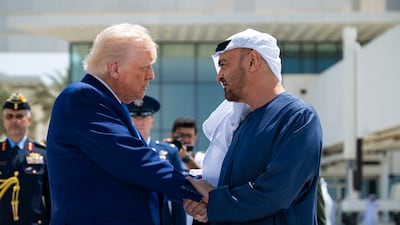
President Sheikh Mohamed bids farewell to US President Donald Trump. Abdulla Al Neyadi / UAE Presidential Court -
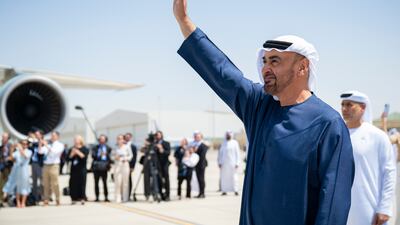
Sheikh Mohamed waves as Mr Trump's aircraft leaves the Presidential Airport. Abdulla Al Neyadi / UAE Presidential -
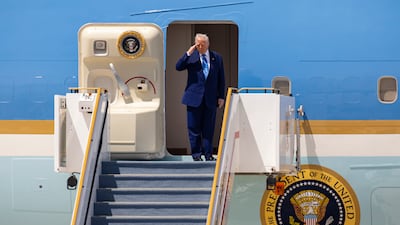
Mr Trump aboard Air Force One. Ismaeel Al Zaher / UAE Presidential Court -
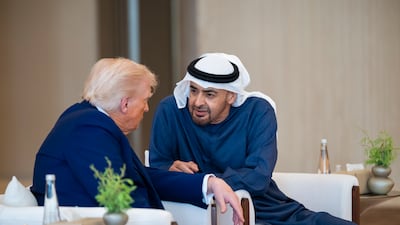
Sheikh Mohamed and Mr Trump. Abdulla Al Neyadi / UAE Presidential Court -
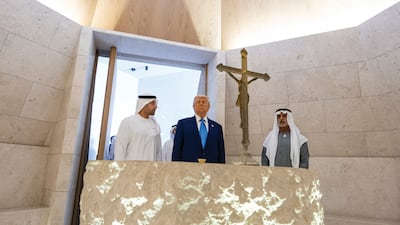
Mr Trump and senior officials visit the Abrahamic Family House in Abu Dhabi. Photo: Abu Dhabi Media Office -
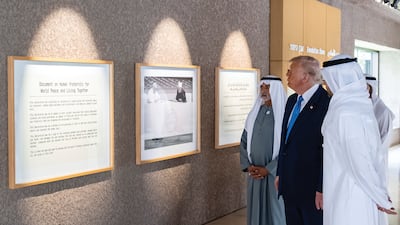
Mr Trump at the Abrahamic Family House. Photo: Abu Dhabi Media Office -
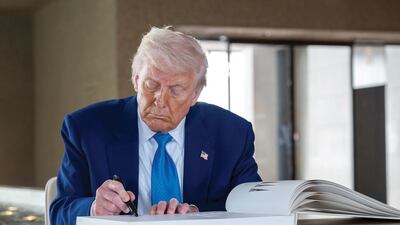
Mr Trump at the Abrahamic Family House. Photo: Abu Dhabi Media Office -
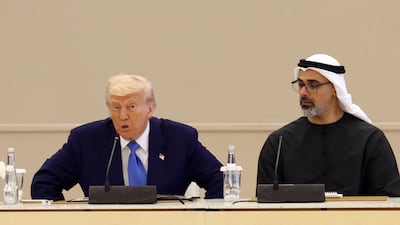
Mr Trump attends the UAE-US Business Dialogue alongside Sheikh Khaled bin Mohamed, Crown Prince of Abu Dhabi, at Qasr Al Watan. Chris Whiteoak / The National -
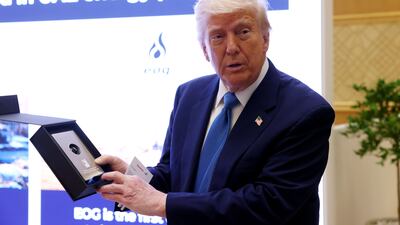
Mr Trump receives a small bottle of the UAE's Murban crude oil at Qasr Al Watan in Abu Dhabi. Chris Whiteoak / The National -
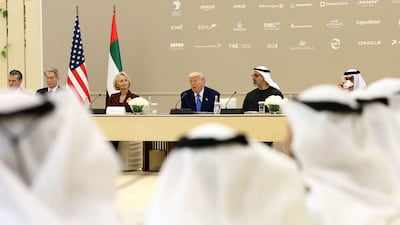
Mr Trump and Sheikh Khaled at the UAE-US Business Dialogue. Chris Whiteoak / The National -
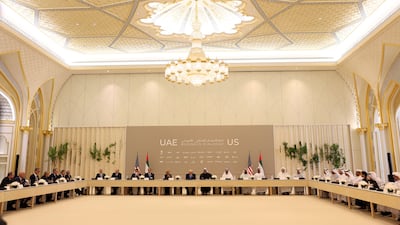
The UAE-US Business Dialogue. Chris Whiteoak / The National -
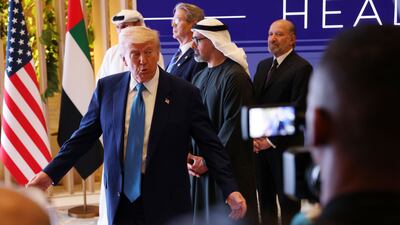
Mr Trump at the UAE-US Business Dialogue. Chris Whiteoak / The National -

Mr Trump and Sheikh Khaled at Qasr Al Watan. Chris Whiteoak / The National -
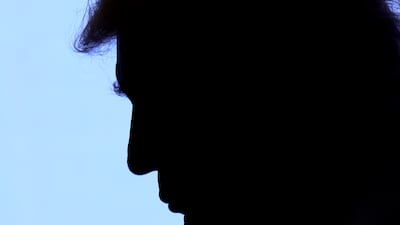
President of the United States of America Donald Trump attends the UAE-US Business Dialogue at Qasr Al Watan in Abu Dhabi during his tour of the Middle East. Chris Whiteoak / The National -
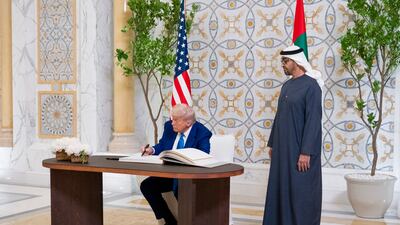
UAE President Sheikh Mohamed watches as US President Donald Trump signs the guest book at Qasr Al Watan, in Abu Dhabi. UAE Presidential Court -
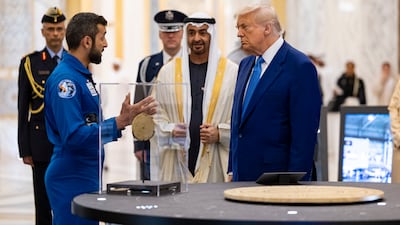
Sheikh Mohamed and Mr Trump are given a tour by Sultan Al Neyadi, UAE astronaut and Minister of State for Youth Affairs, of an exhibition titled Guided by the Stars at the presidential palace. UAE Presidential Court -
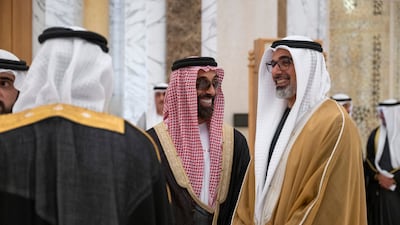
Sheikh Khaled and Sheikh Tahnoon bin Zayed, Deputy Ruler of Abu Dhabi and UAE National Security Adviser, attend the reception for Mr Trump at Qasr Al Watan. UAE Presidential Court -
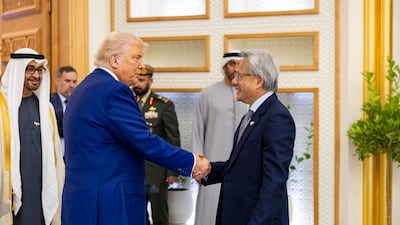
Mr Trump greets Jensen Huang, president and chief executive of Nvidia, at Qasr Al Watan as Sheikh Mohamed watches. Photo: UAE Presidential Court -
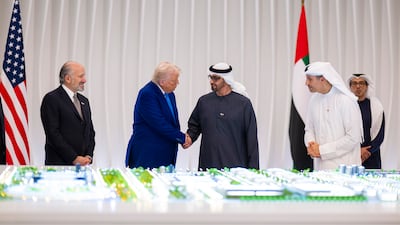
Sheikh Mohamed and Mr Trump view a model of the UAE-US AI Cluster, during the launch ceremony at Qasr Al Watan. Photo: UAE Presidential Court -

Sheikh Mohamed presents the Order of Zayed to Mr Trump during the state reception at Qasr Al Watan. Hamad Al Kaabi / UAE Presidential Court -
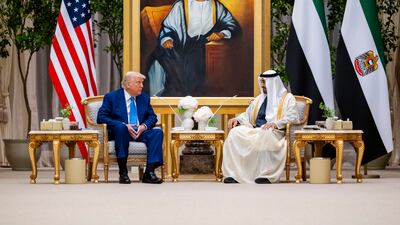
Sheikh Mohamed speaks with Mr Trump at Qasr Al Watan. Hamad Al Kaabi / UAE Presidential Court -
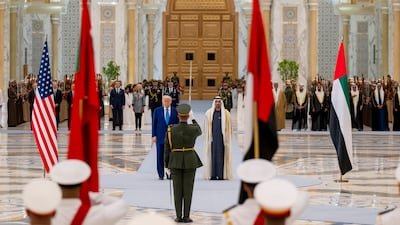
Sheikh Mohamed and Mr Trump stand for the national anthems at Qasr Al Watan. Abdulla Al Neyadi / UAE Presidential Court -
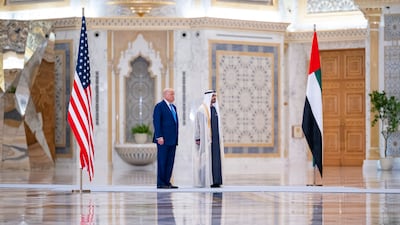
Sheikh Mohamed and Mr Trump stand for the national anthems. Hamad Al Kaabi / UAE Presidential Court -
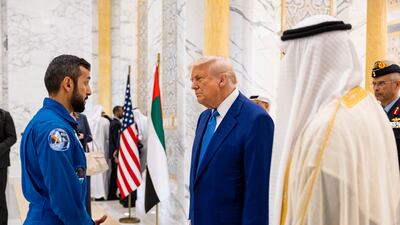
Sheikh Mohamed and Mr Trump view an exhibition titled ‘Guided By the Stars’ at Qasr Al Watan, and speak with UAE astronaut and Minister of State for Youth Affairs, Dr Sultan Al Neyadi. Ryan Carter / UAE Presidential Court -
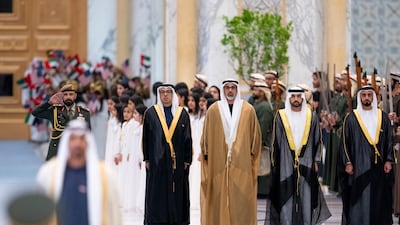
The ceremony at Qasr Al Watan is attended by Sheikh Mansour bin Zayed, Vice President, Deputy Prime Minister and Chairman of the Presidential Court; Sheikh Khaled bin Mohamed, Crown Prince of Abu Dhabi; Sheikh Hamdan bin Mohammed, Crown Prince of Dubai, Deputy Prime Minister and Minister of Defence; and Sheikh Saif bin Zayed, Deputy Prime Minister and Minister of Interior. Abdulla Al Neyadi / UAE Presidential Court -
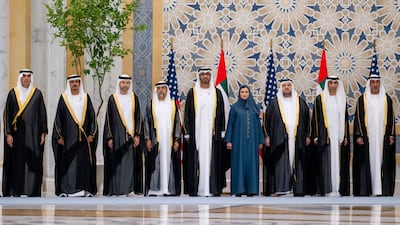
Also standing for the national anthems at Qasr Al Watan are Mohamed Al Mazrouei, Minister of State for Defence Affairs; Dr Thani Al Zeyoudi, Minister of State for Foreign Trade; Mohamed Al Suwaidi, Minister of Investment; Sarah Al Amiri, Minister of Education; Dr Sultan Al Jaber, Minister of Industry and Advanced Technology, and managing director and group chief executive of Adnoc; Suhail Al Mazrouei, Minister of Energy and Infrastructure; Mohamed Al Hussaini, Minister of State for Financial Affairs; Ali Al Shamsi, Secretary General of the Supreme Council for National Security; and Khaldoon Al Mubarak, chairman of the Executive Affairs Authority and managing director and group chief executive of Mubadala Investment Company. Abdulla Al Neyadi / UAE Presidential Court -
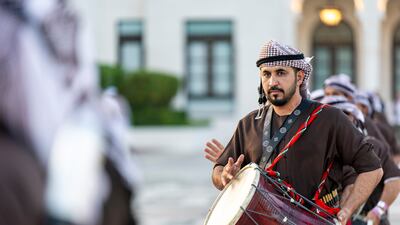
Heritage band musicians perform as Mr Trump arrives at Qasr Al Watan. Ryan Carter / UAE Presidential Court -
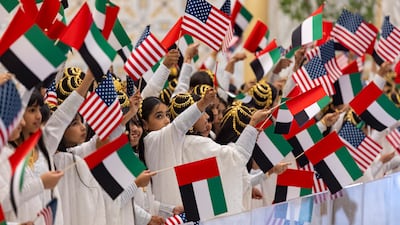
Children wave UAE and US flags at Qasr Al Watan. Ryan Carter / UAE Presidential Court -

President Sheikh Mohamed and Mr Trump arrive at Qasr Al Watan. Chris Whiteoak / The National -
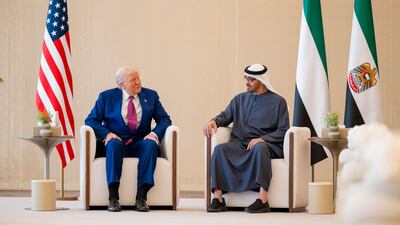
Sheikh Mohamed meets Mr Trump after his arrival at the Presidential Airport in Abu Dhabi. Abdulla Al Neyadi / UAE Presidential Court -
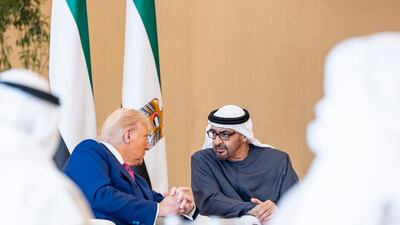
Sheikh Mohamed and Mr Trump in discussion at the Presidential Airport. Ryan Carter / UAE Presidential Court -
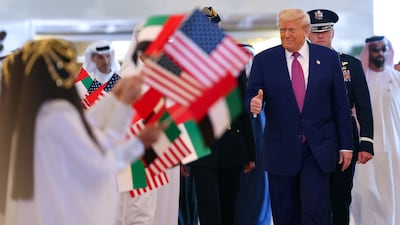
Mr Trump arrives in Abu Dhabi. Chris Whiteoak / The National -

Mr Trump arrives in Abu Dhabi. Chris Whiteoak / The National -

Traditional drummers greet the US President on his arrival. Chris Whiteoak / The National -
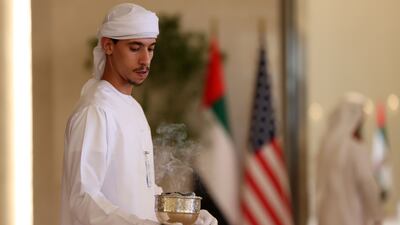
A participant in the ceremony welcoming Mr Trump to Abu Dhabi. Chris Whiteoak / The National -
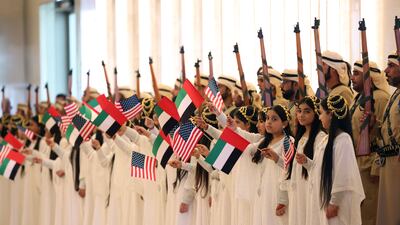
Participants in the welcoming ceremony for Mr Trump. Chris Whiteoak / The National -
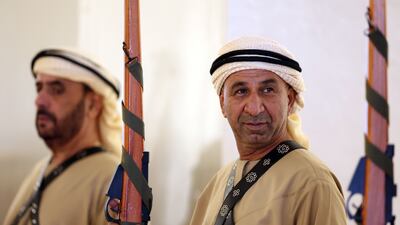
Participants help to welcome Mr Trump to Abu Dhabi. Chris Whiteoak / The National -
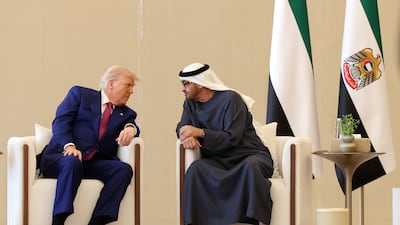
Sheikh Mohamed with Mr Trump. Chris Whiteoak / The National -
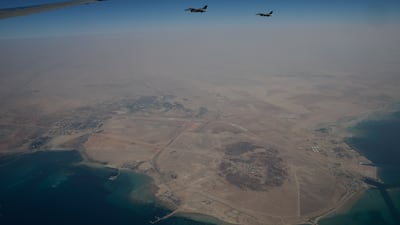
UAE Air Force fighter jets accompany Air Force One, carrying Mr Trump, as it approaches Abu Dhabi. Reuters


The latest technology-focused collaboration between the UAE and the US is Pax Silica, the coalition of a small number of “trusted” countries that aim to optimise supply chains for AI and tech.
“President Trump has been very public about his fondness for the UAE dating back to his trip here,” US undersecretary of state for economic affairs Jacob Helberg told The National at the Pax Silica signing on Wednesday.
“He's a big believer in the UAE … and our whole administration really appreciates the UAE's leadership.”
In 2024, bilateral trade between the two nations hit a record $34.4 billion, with the US exporting more than $26.9 billion of goods and services to the Emirates, which was an 8.5 per cent annual growth, latest data from the UAE Embassy in Washington shows.
That resulted in a $19.5 billion trade surplus for the US, marking its third-largest trade surplus globally, the embassy said.
The UAE maintains trade with all 50 US states, supporting about 161,000 American jobs, it added.
UAE investments in the US have surpassed $1 trillion, with the Emirates having recently committed to investing $1.4 trillion in the American economy over the next decade, the Abu Dhabi Department of Economic Development said.
The biggest areas of collaboration include technology, renewable energy, aviation and space technology, reflecting the strength of non-oil sectors that account for more than three quarters of the UAE's gross domestic product, the embassy said.
With the UAE pushing to position itself as a global AI leader as it diversifies away from hydrocarbons, the country has aligned its goals with the US, considered the world's top tech market.
In November, the US authorised the export of tech titan Nvidia's powerful AI chips to UAE AI company G42, along with Saudi tech start-up Humain.
The UAE has also teamed up with the US to develop the Stargate AI campus, which will include five gigawatts of capacity for AI data centres in Abu Dhabi.
“This strategic framework with DFC represents a powerful alignment of capital, capability and conviction,” Mr Shueb said.
“We are creating a scalable mechanism to deliver transformational investments across critical industries … to unlock long-term value, strengthen resilient supply chains, and drive sustainable economic growth across key markets that matter to both our nations,” he said.
IHC, formed in 1999, has emerged as the Middle East's most valuable holding company and one of the world's largest investment firms with a market capitalisation of about Dh878.5 billion ($239.2 billion).
It has more than 1,400 subsidiaries across asset management, health care, real estate, financial services, IT and more.

