


The International Monetary Fund has revised its global growth projection for this year higher, although uncertainty remains high due to US President Donald Trump's shifting tariff agenda.
The world economy is now estimated to expand by 3 per cent in 2025, 0.2 percentage points faster than the previous forecast, the Washington-based fund said in its latest World Economic Outlook released on Tuesday.
The fund projects global growth to hit 3.2 per cent in 2026, 0.1 percentage points higher than its April forecast.
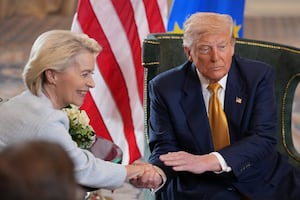
IMF's latest projections come roughly three months after Mr Trump first unveiled his sweeping universal tariff policy on almost all major trade partners, as well as harsher so-called reciprocal tariffs on dozens of other countries.
The fund said the shift reflects stronger-than-expected front-loading in anticipation of tariffs, lower average US tariff rate on partners than previously announced, a weaker US dollar and fiscal expansion in some major economies.

“This modest decline in trade tensions, however fragile, has contributed to the resilience of the global economy so far,” said IMF chief economist Pierre-Olivier Gourinchas.
However, this resilience, Mr Gourinchas said, is “tenuous”.
High uncertainty despite tariff talks
Mr Trump's tariffs shook the world economy following his April 2 Liberation Day announcement.
Although the effective tariff rates are lower than the ones announced, the fund said uncertainty remains elevated, which could weigh on economic activity.
The implementation date for those reciprocal tariffs were delayed until August 1 following an initial bond-market rout, while the US administration has looked to secure trade deals with trading partners. The White House has touted trade agreements struck with some of those partners, including Japan and the EU as major achievements.
On Monday, Mr Trump suggested he is considering increasing the blanket tariff rate between 15 per cent and 20 per cent on imports from countries that have not reached a trade deal with the US. The rate would be in line with what he has recently announced with Japan and the EU.

It would also represent a higher tariff rate for the UAE, Saudi Arabia and other Gulf countries that have neither reached a trade agreement with the US nor received a so-called trade letter from Mr Trump.
Meanwhile, trade tension between the US and China – a major source of concern for the global economy – also somewhat cooled when the two announced a trade truce, lowering their reciprocal tariffs.
“Despite these welcome developments, tariffs remain historically high, and global policy remains highly uncertain,” Mr Gourinchas said, noting the few trade agreements reached since April.
US and China officials resume talks in Sweden this week to extend the temporary truce by three months, ahead of an August 12 deadline.
Revisions mask weaker prospects
Global growth this year should also be seen a consequence of tariff distortion rather than underlying robustness, the IMF said. The latest growth forecasts are lower than what the fund predicted in 2024 (3.3 per cent) and the pre-pandemic historical average of 3.7 per cent.
“While the trade shock could turn out to be less severe than initially feared, it is still sizeable, and evidence is mounting that it is hurting the global economy,” Mr Gourinchas said.
The US economy is estimated to expand at 1.9 per cent this year, 0.1 percentage points higher than the fund's April forecast, before picking up to 2 per cent in 2026, owing to a near-term boost from Mr Trump's One Big Beautiful Act Bill.

It contracted by 0.5 per cent in the first quarter this year due to an import surge ahead of tariffs. The US government is due to release second-quarter gross domestic product figures on Wednesday.
The tariff episode has also led to the dollar depreciating by 8 per cent this year, which has magnified the shock of levies on other countries' competitiveness, Mr Gourinchas said.
China received the biggest revision of countries listed in the fund's latest release.
IMF now expects the world's second-largest economy is now projected to grow by 4.8 per cent this year, up from the fund's previous 4 per cent estimate. The revision reflects the significant reduction in US-China tariffs and stronger-than-expected activity in the first half of 2025, the fund said.
Growth in the Middle East and Central Asia is estimated at 3.4 per cent this year and 4.2 per cent in 2026, while India's growth forecast has been revised slightly upwards at 6.4 per cent in 2025 and 2026.
In the Middle East, the upwards revision is mostly due to stronger than expected growth in Saudi Arabia and Egypt. The IMF projects Saudi Arabia's economy to expand at a 3.6 per cent pace this year and 3.9 per cent in 2026.
“What's behind those upwards revisions – for this year, it's really the higher oil production, in spite of the lower oil prices, and this is linked to … the earlier phasing out of the voluntary oil production cuts,” said Petya Brooks, deputy director at the fund's research department.

Euro-area growth is expected to pick up to 1 per cent in 2025, 0.2 percentage points higher than previously estimated growth that the IMF attributed to strong GDP out-turn in Ireland. Growth in the euro area is projected to be 1.2 per cent in 2026.
The IMF also projects relatively stable growth in sub-Saharan Africa at 4 per cent this year, while growth in Latin America and the Caribbean is expected to slow to 2.2 per cent this year before bouncing back to 2.4 per cent next year.
Inflation trade-offs
Global headline inflation is projected to fall to 4.2 per cent in 2025 and 3.6 per cent in 2026, unchanged from April but with mixed patterns across economies.
The fund anticipates tariffs to eventually pass through to US consumer prices and creep into inflation data in the second half of this year.
Elsewhere, tariffs could be a negative demand shock and lower inflationary pressures, while inflation dynamics in the euro area are expected to be more subdued, the IMF said.
Mixed inflation data has led to major central banks taking different approaches towards rates this year.
The Federal Reserve has been the focus of Mr Trump's anger for keeping its target range on interest rates steady this year at 4.25 per cent to 4.5 per cent.
The European Central Bank on the other hand has cut rates three times this year to its current 2.25 per cent.
Central banks could face difficult trade-offs due to tariffs and geopolitical tensions, warned the fund.
The Israel-Iran war, for instance, led to a brief spike in oil prices before they settled around at the current price point of roughly $69 a barrel. The IMF said escalating tensions in the Middle East and Ukraine could lead to lower growth and rekindle inflationary pressures.
“Central banks could face more difficult trade-offs when they are already grappling with challenges from the trade environment,” the fund said.

