


The total economic losses to Israel following the 12-day war with Iran are estimated at around $6 billion, with infrastructure hit particularly hard.
The war is likely to cost Israel about 1 per cent of its gross domestic product, or about 20 billion shekels ($5.9 billion), Israel Central Bank Governor Amir Yaron told Bloomberg television.
According to Naser Mufrej, professor of finance and economics at the Arab American University in Ramallah, along with heavy damage to property, the total losses also include revenue affected due to the brief closure of Israel’s airspace as well as the impact on manufacturing and agriculture sectors.

“All productive sectors were affected heavily during the war,” Mr Mufrej told The National.
Israel and Iran entered into a fragile ceasefire this week after days of attacking each other. The US also entered the war with a strike on Iran's nuclear sites, after which the President Donald Trump announced the ceasefire.
The conflict began on June 13 when Israel launched a wave of strikes across Iran, killing senior military officials and hitting nuclear sites. Iran also launched retaliatory missile strikes on Israel, hitting a number of targets including residential buildings, a hospital and other infrastructure in Tel Aviv and other cities.
-
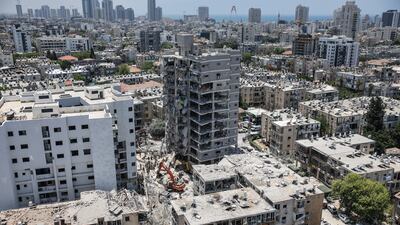
Damaged buildings are seen following a missile attack from Iran, in Bat Yam, Israel, June 15, 2025. REUTERS / Ronen Zvulun -
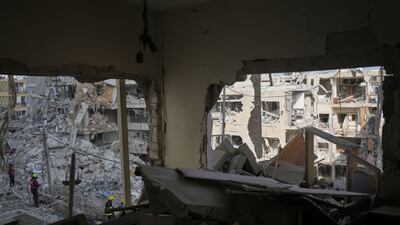
Israeli soldiers search for survivors amid the rubble of residential buildings destroyed by an Iranian missile strike in Bat Yam, central Israel, on Sunday, June 15, 2025. (AP Photo / Ariel Schalit) -
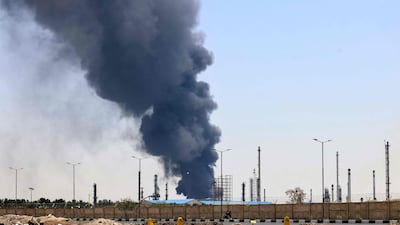
A plume of heavy smoke and fire rise over an oil refinery in southern Tehran, after it was hit in an overnight Israeli strike, on June 15, 2025. Iran fired a fresh barrage of missiles at Israel, state television announced early on June 15, as the rivals exchanged fire for a third day. (Photo by ATTA KENARE / AFP) -
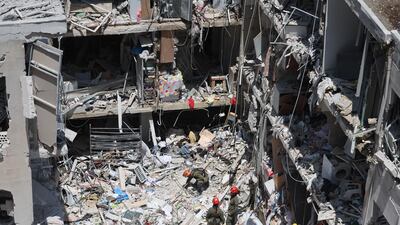
Members of Israel's Home Front Command search for missing people under the rubble of a partially collapsed residential building after Iranian ballistic missiles hit Bat Yam, central Israel, 15 June 2025. Iran launched a barrage of ballistic missiles at Israel overnight in retaliation for Israeli airstrikes on Iranian targets. Magen David Adom (MDA), Israel's national emergency services, reported at least six killed and dozens injured, including two in critical condition. EPA / ABIR SULTAN -
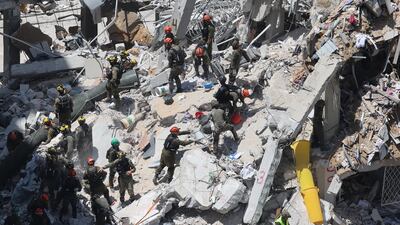
Members of Israel's Home Front Command search for missing people under the rubble of a partially collapsed residential building after Iranian ballistic missiles hit Bat Yam, central Israel, 15 June 2025. Iran launched a barrage of ballistic missiles at Israel overnight in retaliation for Israeli airstrikes on Iranian targets. Magen David Adom (MDA), Israel's national emergency services, reported at least six killed and dozens injured, including two in critical condition. EPA / ABIR SULTAN -
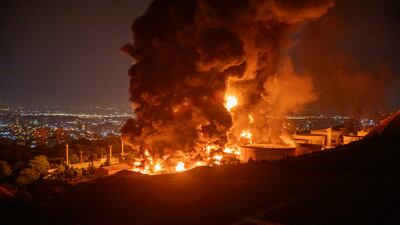
TEHRAN, IRAN - JUNE 15: Fire and smoke rise into the sky after an Israeli attack on the Shahran oil depot on June 15, 2025 in Tehran, Iran. Iran's foreign minister said the country would respond decisively and proportionally to a wave of attacks that Israel launched beginning in the early hours of June 13. The attacks targeted multiple military, scientific and residential locations, as well as senior government officials. (Photo by Stringer / Getty Images) -
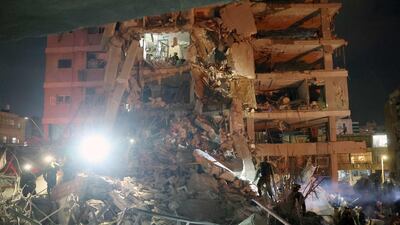
Responders work beside a damaged building following an Iranian ballistic missile attack in the Israeli city of Bat Yam, south of Tel Aviv, on June 15, 2025. Air raid sirens rang out in Jerusalem and Tel Aviv, AFP journalists said, as Israel and Iran exchanged fire for a third day. AFP -

Israeli rescue teams work at the scene where Iranian ballistic missiles hit residential buildings in Bat Yam. According to emergency service Magen David Adom, paramedics pronounced the death of a woman about 60 years old and provided medical care to a total of 65 injured. EPA -

Israeli rescue teams work at the scene. EPA -
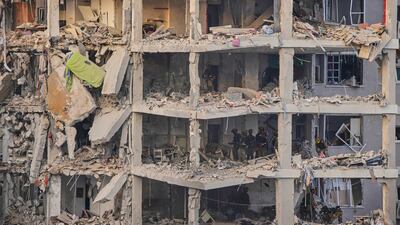
Israeli security troops inspect a destroyed building that was hit by a missile fired from Iran, near Tel Aviv. AP -

Responders take a person on a stretcher following a strike by an Iranian missile in Bat Yam. AFP -
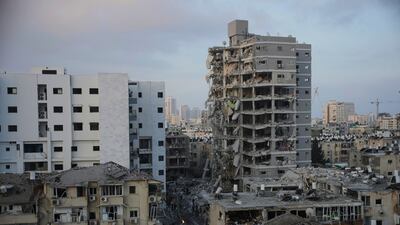
Israeli security troops inspect destroyed buildings that were hit by a missile fired from Iran, near Tel Aviv. AP -
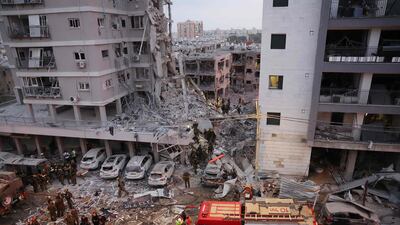
Responders work amid building rubble following a strike by an Iranian missile in Bat Yam. AFP -
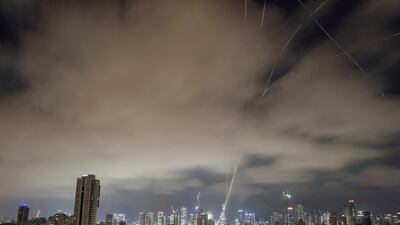
Missiles launched from Iran towards Israel are intercepted. Reuters -
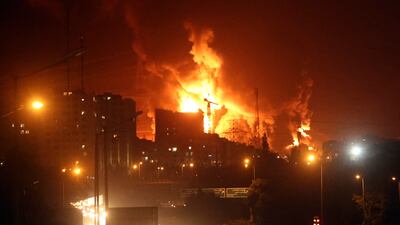
Fire and smoke at Tehran's oil warehouse in Iran. The Israeli army is continuing its strikes on Iran's nuclear programme and energy sites. EPA -
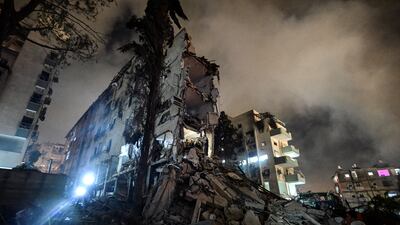
Rescue personel work at a residential building following missile attack from Iran on Israel, at central Israel June 15, 2025. REUTERS/Yossi Zeliger ISRAEL OUT. NO COMMERCIAL OR EDITORIAL SALES IN ISRAEL -
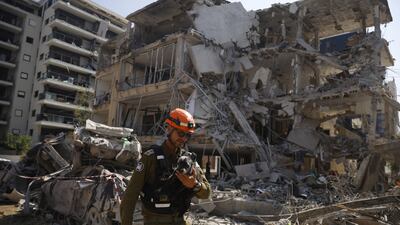
An emergency worker carries a dog rescued from a building damaged in an overnight strike on June 14, 2025 in Ramat Gan, Israel. Getty Images -
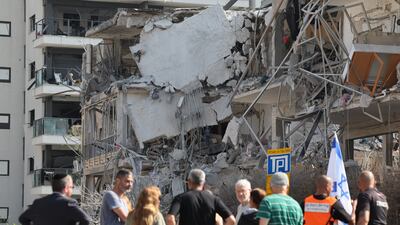
People look at the damage to residential building after a ballistic missile strike in Ramat Gan, near Tel Aviv, Israel. EPA -

Emergency and rescue workers on site at a building in Ramat Gan, Israel. Getty Images -

A rescue worker carries a dog away from a bombed building in Ramat Gan, Israel. Reuters -
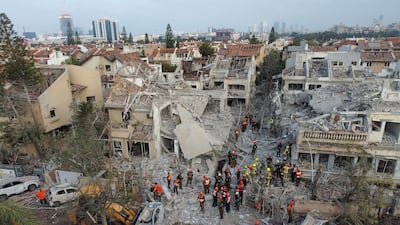
Israeli rescue teams at the site of an Iranian ballistic missile strike on residential Rishon LeZion, near Tel Aviv, where 21 people were injured. EPA -

Rescue teams surrounded by gutted vehicles at a missile impact site in Rishon LeZion, Tel Aviv, on June 14, 2025. Reuters -
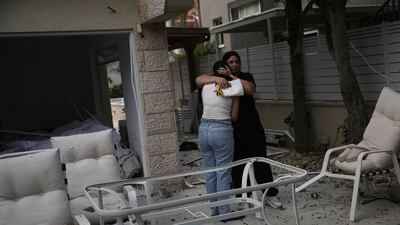
Householders in Rishon LeZion look over the damage to their home. AP Photo -
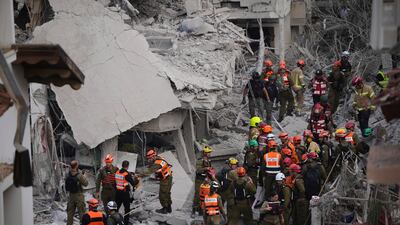
Damage assessments in daylight at Rishon LeZion after a wave of Iranian missiles hit. AP Photo -
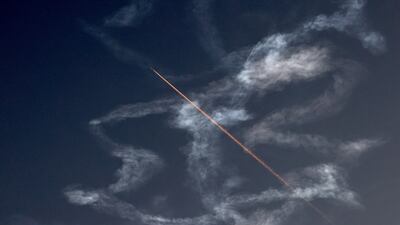
Israel's Iron Dome air defence system is sent to intercept a projectile over the West Bank city of Nablus on June 14. EPA -
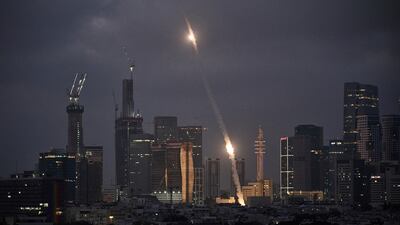
Air defences in action against missiles over Tel Aviv on June 14, 2025. AP Photo

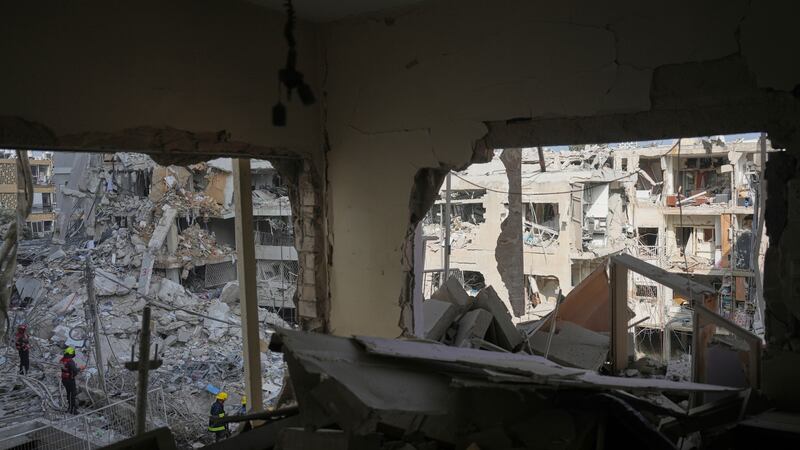


Israel, which has also been attacking Gaza since October 2023, is expected to take a hit to economic growth this year, according to analysts.
"Our forecast for 2025 [for Israel's economy] was downgraded from 3.3 per cent real GDP growth to 1.7 per cent real growth right after the military conflict began between Israel and Iran almost two weeks ago," Ralf Wiegert, head of Mena Economics at S&P Global Market Intelligence.
"So a reduction of 1.6 percentage points is probably at the high end of the spectrum and could be reduced further as Israel is going back to full capacity over the next couple of days."
Mr Wiegert also said that "replenishing the military arsenal will be more costly, which will increase the budget deficit in 2025 from the 5.7 per cent of GDP which we had projected previously".
With missile strikes having damaged vital infrastructure, military spending will push the country's fiscal deficit from 5.5 per cent to 8.5 per cent of GDP, the International Institute of Finance said in a note.
"Public debt will rise from 69 per cent to 74 per cent. Still, Israel’s strong external position, ample reserves, and moderate debt burden offer resilience," it added.
Before the war with Iran, the International Monetary Fund in its World Economic Outlook in April projected Israel's economy to grow 3.2 per cent this year.
Rising compensation claims
Israel's Tax Authority has been receiving thousands of compensation claims from affected people for damaged property and vehicles since the beginning of the war two weeks ago.
As of Wednesday, it had received 41,651 claims, including 32,975 for structural damage, 4,119 for vehicle damage, and 4,456 for damage to contents and equipment.
It is estimated that thousands of additional structures have been damaged, for which no claim has yet been submitted, according to the Israel Tax Authority website.
Last week, Iran hit the Weizzman Institute, a major research institution in Israel, causing heavy damage to the building. It also hit the Bazan oil refinery complex in the port city of Haifa, damaging its infrastructure and shutting down its operations.
The cost of property damages from the Iranian attacks is estimated to be around double the sum of claims stemming from the Hamas attack on October 7 and subsequent attacks in time since then, the head of the Tax Authority’s compensation department told the Knesset finance committee on Monday.
“I believe that we'll reach 5 billion shekels ($1.47 billion) [in compensation],” Amir Dahan said at the time.
“These are amounts we have never seen in direct damage. The Weizmann Institute and Bazan are huge events. In total, we have 25 buildings for demolition; in comparison, from the start of the war until the round with Iran, there was one building for demolition."

