


Business activity in the non-oil private sector economies of Saudi Arabia and the UAE expanded at a brisk pace in February, with the pace of growth hitting an almost five-year high in the Emirates, the Arab world’s second-largest economy.
The seasonally adjusted Riyad Bank purchasing managers’ index – a benchmark gauge of the kingdom’s non-oil economy – rose to 57.2 in February, from 55.4 in January, staying well above the neutral 50 mark that separates growth from contraction.
The rise signals a marked improvement in operating conditions across the kingdom’s non-oil private sector economy, as the rate of growth hit its highest level since September 2023.
Businesses surveyed reported a sharp rise in output, driven by improving client demand and tourism activity in the kingdom.
New work inflows also rose at a sharper pace than in January, but remained softer than in the final quarter of 2023.
While businesses reported new client wins and stronger market conditions, some companies said competition remained strong within the domestic market.
Export orders from the kingdom also recorded a modest rebound in February.
“The upturn reflected the continued thriving of non-oil activities in the kingdom, which recorded a 4.6 per cent increase according to Gastat [General Authority of Statistics] flash estimates [in 2023],” said Riyad Bank chief economist Naif Al-Ghaith.
“The survey results also signalled expectations of a modest recovery in demand this year, driven by the acceleration of Vision 2030 projects,” he said.
The latest data also indicated a faster increase in employment, among the sharpest recorded in the past eight years.
This improvement in the job market came in tandem with increased optimism for the year ahead, as businesses surveyed showed greater confidence in demand trends in the kingdom's non-oil private sector economy.
Saudi Arabia, the world's biggest oil exporter, is transforming its economy under its Vision 2030 diversification agenda.
Riyadh has unveiled a series of initiatives and policy reforms intended to reduce its dependence on oil, broaden its non-oil economic base and support domestic industries and job growth.
The kingdom's economy is projected to grow by 2.7 per cent this year and 5.5 per cent in 2025, after contracting by an estimated 1.1 per cent last year due to cuts in oil output, according to the latest International Monetary Fund estimates.
However, non-oil economic growth has remained robust on government initiatives as the kingdom opens up various sectors for foreign investment.
The kingdom is developing several new projects spanning sectors such as property, tourism, entertainment and infrastructure.
Riyadh also enacted regulations this year requiring multinational businesses to set up a local base or face the risk of losing out on government contracts.
Meanwhile, the headline S&P Global purchasing managers' index for the UAE climbed to 57.1 in February, up from 56.6 in January, broadly consistent with the growth trend seen since the final quarter of last year.
This pace of growth in non-oil private sector's output levels was the sharpest since the middle of 2019.
“The UAE PMI continued to signal strong upwards momentum in the non-oil economy at the start of 2024,” said David Owen, senior economist at S&P Global Market Intelligence.
“One of the PMI's largest components, the output index, rose to its highest level since June 2019, pointing to a rapid expansion of business activity as firms look to take full advantage of strong market growth and maintain a competitive edge.”
The UAE economy is expected to grow by 5 per cent this year, driven by a robust expansion in the non-oil sector and an increase in foreign direct investment, Minister of Economy Abdulla bin Touq said last week.
The non-oil economy currently accounts for 73 per cent of the UAE’s GDP a “historic first for the country”, he said last month.
The country's GDP expanded by 3.7 per cent annually in the first half of 2023, as it continued to pursue its diversification goals, Mr bin Touq said in October.
The latest survey data indicated that 38 per cent of monitored companies in the UAE recorded a month-on-month jump in business activity, driven by new business and stronger marketing.
However, companies in the non-oil private sector of the Emirates “felt a degree of pressure on their supply chains” in February due to commercial shipping challenges in the Red Sea, the survey found.
But overall supplier performance was still positive.
-
-

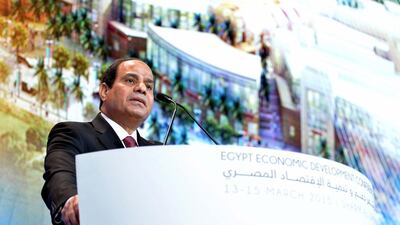
Abdel Fattah El Sisi, Egypt’s president, oversaw an ambitious trade conference and the Suez Canal expansion this year. Hassan Ammar / AP Photo -
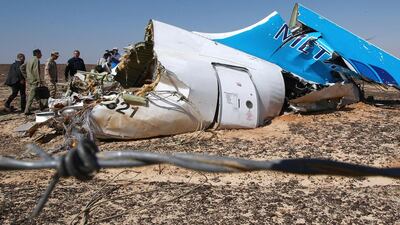
Russian emergency minister Vladimir Puchkov, fourth left, visits the crash site of a A321 Russian airliner in Wadi al-Zolomat, a mountainous area of Egypt’s Sinai Peninsula. Russian airline Kogalymavia’s flight 9268 crashed en route from Sharm el Sheikh to Saint Petersburg on October 31, killing all 224 people on board. AFP -
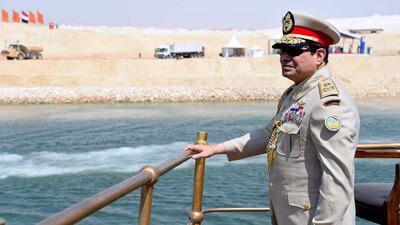
Egyptian president Abdel Fattah El Sisi stands on a yacht leading a naval flotilla during a ceremony on August 6, 2015 to unveil a new waterway at the Suez Canal. EGYPTIAN PRESIDENCY / MOHAMED ABDELMOATY / AFP -
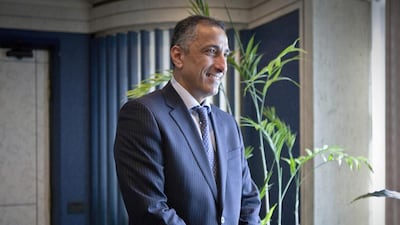
On October 21, Tarek Amer was appointed the new central bank governor. Bloomberg


Meanwhile, business activity across Egypt's non-oil private sector last month contracted at the sharpest rate in slightly more than a year, driven by a worsening foreign exchange crisis and a steep drop in customer sales.
The headline S&P Global purchasing managers’ index for Egypt dropped to 47.1 in February from 48.1 in January, signalling “a solid deterioration in the health of the non-oil sector”.
Th Egyptian non-oil economy suffered in February as “it found itself caught in the middle of the wider regional crisis”, Mr Owen said.
Red Sea shipping disruption has roughly halved the Suez Canal's revenue so far in 2024, which February PMI survey data indicated had a “considerable impact on foreign currency inflows and inflationary pressures”, he said.

