


Growth in the Middle East and North African economies is expected to slow sharply this year as the regional oil exporters continue to cap crude production amid stiff global economic headwinds, according to the World Bank.
Aggregate economic growth in Mena is expected to drop to 1.9 per cent in 2023, sharply down from the 6 per cent gross domestic product expansion recorded last year, the World Bank said in its Mena Economic Update on Thursday.
The latest forecast is lower than the Washington-based lender’s 3 per cent Mena growth projection released in April.
Tight global financial conditions as well as high inflation in many Mena economies are also contributing to the economic slowdown, the World Bank said.
The six-member economic bloc recorded 7.3 per cent GDP growth in 2022.
Growth in developing oil exporting countries – Iraq, Iran and Algeria – is forecast to decline to 2.4 per cent this year from 4.3 in 2022, the World Bank said.
Among the oil-importing countries in Mena, inflationary pressures, tight financial conditions and high interest rates are constraining economic activity.
Growth in these countries including Egypt, Tunisia, Jordan and Morocco, is projected at 3.6 per cent this year, down from 4.9 per cent in 2022.
“These results signal the end of the ‘tale of two Menas’ from 2022, in which the region’s oil exporters were growing much faster than the oil importers,” said the World Bank economists, led by chief Mena economist Roberta Gatti.
Economies in the GCC, which accounts for about a third of the world’s proven oil reserves, grew sharply in 2022 when oil prices surged after Russia’s invasion of Ukraine.
Crude prices, however, fell to $71 per barrel from November 2022 highs of more than $97 a barrel.
The Opec+ group of oil producers, led by Saudi Arabia, has enforced total crude production curbs of 3.66 million bpd, or about 3.7 per cent of global demand, to stabilise crude markets.
These curbs include a reduction of two million bpd agreed last year, and voluntary cuts of 1.66 million bpd, announced in April and extended to December 2024.
Last month, Saudi Arabia, the Arab world’s biggest economy, and Russia announced they would extend their combined supply cuts of 1.3 million bpd to the end of the year.
On Wednesday, Opec+ decided to stick to its current output policy and Saudi Arabia reiterated its commitment of maintaining its output cut of 1 million bpd until December.
“Growth in Mena was projected [earlier] to decelerate in 2023, reflecting both base effects as well as spillover effects from the global slowdown in economic activity,” the World Bank economists said.
The forecast has been “further revised down in the past 12 months” after the oil production cuts announced by Opec+ in October 2022 and April 2023, and the additional cuts announced by Saudi Arabia in June this year, they added.
-
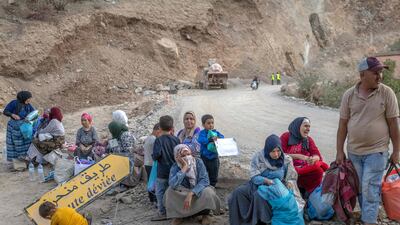
People displaced by the earthquake sit with their belongings by the side of the road between Marrakesh and Taroudant in the Atlas mountains. AFP -
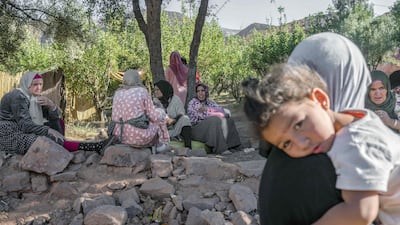
A makeshift camp is set up in the open. AFP -
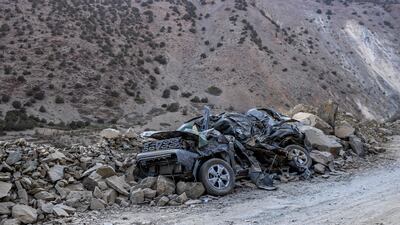
A car is crushed by rubble in the aftermath of the earthquake. AFP -
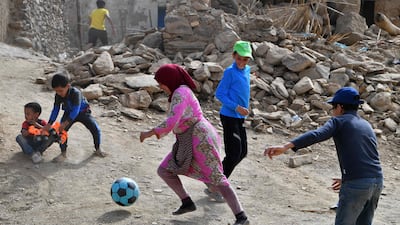
Children play football beside the rubble of collapsed homes in the village of Afella Igir in the Amizmiz region of Morocco. AFP -
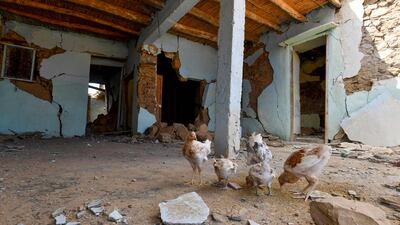
Chickens peck for food at an abandoned home in Afella Igir. AFP -

Not much sign of life in Afella Igir. AFP -

The Moroccan Army on hand in the village of Talat N'Yaaqoub, south of Marrakesh, as the search for victims goes on. EPA -
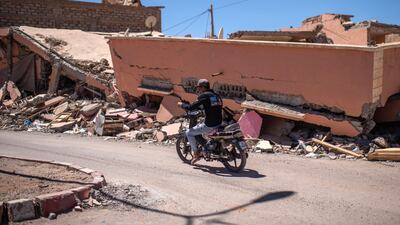
Ruins in the earthquake-hit village of Talat N'Yaaqoub. EPA -
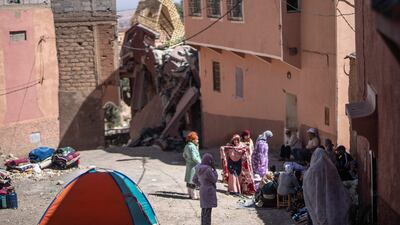
Tents have become homes for people in Moulay Brahim village, whose lives have been turned upside-down by the earthquake. AP -
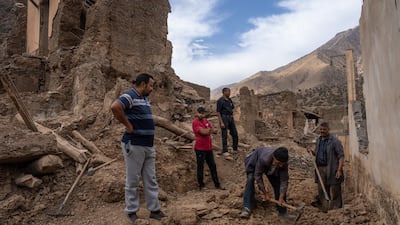
Men clear the rubble of houses that collapsed in Imgdal. Getty Images -
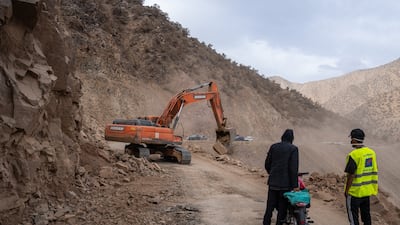
A digger clears a mountain road in Talat N'Yaaqoub. Getty Images -

A badly damaged building leans over in Talat N'Yaaqoub. Getty Images -
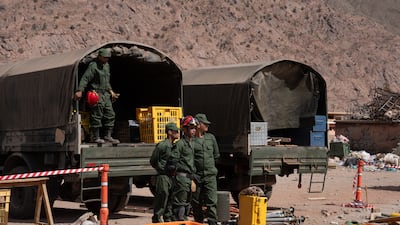
Lorries carrying aid and equipment to be used by rescuers in Talat N'Yaaqoub. Getty Images -
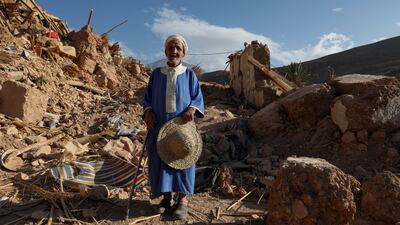
An elderly man is surrounded by rubble in Tikht village, Morocco, days after the quake struck. Reuters -
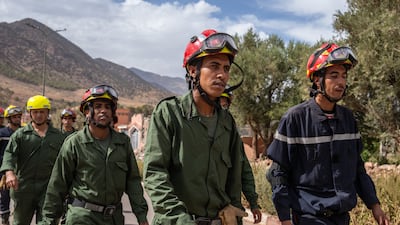
Rescue workers in Talat N'Yaaqoub prepare to search for survivors. Getty Images -
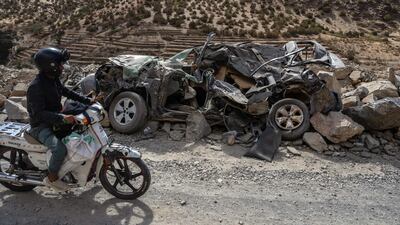
Another crushed car on a mountain road in Talat N'Yaaqoub. Getty Images -
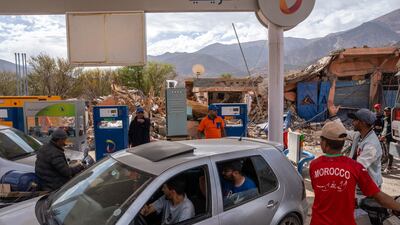
Motorists queue for fuel at one of the few filling stations still open in Talat N'Yaaqoub. Getty Images -
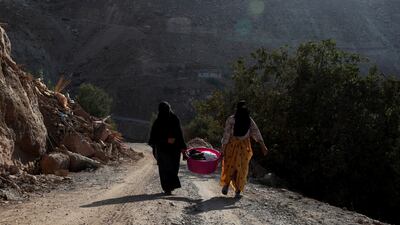
Carrying belongings outside the village of Tikht. Reuters -
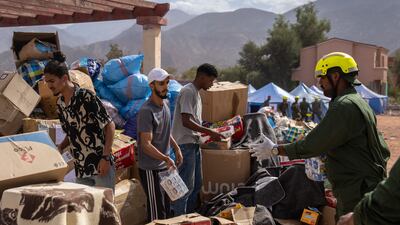
Aid workers distribute relief supplies in Talat N'Yaaqoub. Getty Images -
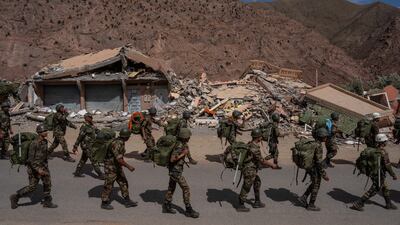
Moroccan troops prepare to embark on relief missions in the mountains near Talat N'Yaaqoub. Getty Images -
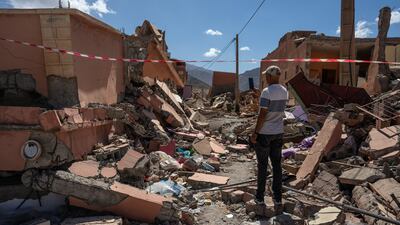
A man films the ruins of collapsed buildings in Talat N'Yaaqoub. Getty Images


Saudi Arabia’s economy grew by 8.7 per cent last year, the highest annual growth rate among the world's 20 biggest economies. Yet earlier this year it received the biggest downgrade in economic growth forecast among the G20 economies by the International Monetary Fund.
The World Bank expects the Saudi economy to contract by 0.9 per cent this year. But the kingdom this week said it expects its real GDP to grow by 0.03 per cent this year, slower than the earlier estimate, “due to a voluntary reduction in oil production”.
“By the end of 2023, only eight out of 15 Mena economies will have returned to their pre-pandemic level of real GDP per capita,” the World Bank said.
Economies in which GDP per capita will be below 2019 levels include Jordan (0.17 per cent below); Qatar (0.3 per cent); Algeria (3.3 per cent); Saudi Arabia (3.6 per cent); Tunisia (4.6 per cent); the West Bank and Gaza, (7.7 per cent); and Iraq (15.3 per cent).
“These gaps are projected to close by the end of 2024 only in Jordan and Qatar,” World Bank economists said.
Per capita income in the broader Mena region is also forecast to decrease from to 0.4 per cent this year from 4.3 per cent in 2022, which underpins the need for structural economic and labour market reforms,
"If the region grows slowly, how will the 300 million young people who will be knocking at the door of the labour market by 2050 find jobs with dignity?” said Ferid Belhaj, World Bank vice president for the Mena region.
“Without proper policy reforms, we could inadvertently worsen the enduring structural challenges faced by Mena’s labour markets as far as the eye can see. The time for reform is now.”
While the World Bank has yet to fully assess the economic effect of floods in Libya and the earthquake in Morocco, it expects the macroeconomic effects to be modest because “the potential disruptions are likely to be short-lived”.

