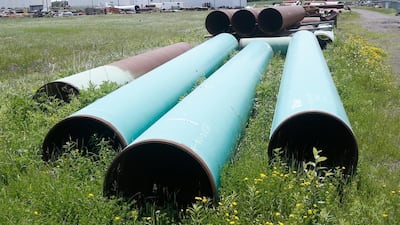
Pembina Pipeline Corporation agreed to acquire Inter Pipeline for about C$8.3 billion ($6.9bn) in an all-stock deal that will create one of the largest energy companies in Canada.
The proposal from Pembina trumps a hostile takeover offer for Inter made by Brookfield Infrastructure Partners earlier this year. Inter spurned that approach and began a review of its options, which included a sale.
The Pembina-Inter combination is the largest Canadian energy transaction in four years. It continues a trend of consolidation in the sector in the face of low oil prices and regulatory uncertainty, highlighted by US President Joe Biden’s cancellation of TC Energy’s Keystone XL oil export pipeline in January.
Adding Inter will give Pembina additional pipeline infrastructure across Western Canada, connecting the region’s oil sands and natural gas producers with domestic and foreign customers. Pembina, a major processor of natural gas liquids, will increase its ability to deliver condensate on Inter’s system to the oil sands, where the product is used to dilute the thick bitumen that’s dug out of the ground so that it can be transported by pipeline or rail.
The two Calgary-based pipeline companies said on Tuesday the takeover will lead to annual cost savings of as much as C$200 million and create an operator with capacity to transport 6.2 million barrels a day of gas, oil and natural gas liquids throughout the region. The merged company will run by Pembina’s senior executive team.
Pembina said its offer values Inter at C$19.45 per share prior to the start of trading, while Brookfield’s offer was C$16.50. Brookfield declined to comment on Tuesday’s merger announcement.
“Brookfield could easily come back at a $19.50 to $20 cash offer and probably still make the numbers work,” Ryan Bushell, a portfolio manager at Newhaven Asset Management, said. “We’ll find out pretty shortly how badly Brookfield wanted this in the first place. But if I had to guess, I’d say they’d probably want to wash their hands of it.”
Inter shares rose 8.8 per cent to C$19.09 while Pembina fell 1.9 per cent to C$38.15 at 12.26 pm in Toronto.
The Inter acquisition follows Pembina’s purchase of a Canadian unit and pipeline assets from Kinder Morgan for about $4.5bn in 2019 and its takeover of British Columbia pipeline operator Veresen for C$5.8bn two years earlier. Pembina chief executive Michael Dilger said his company has tried to buy Inter on two previous occasions.
“Third time is lucky,” he said on a conference call. “This is just the right time.”
Pembina will also take on Inter’s Heartland Petrochemical Complex, which is under construction in Alberta. Inter has been looking for a partner to help fund the C$4.2bn construction cost while also trying to sign long-term sales contracts for 70 per cent of the plant’s capacity.
Pembina previously suspended work on the petrochemical plant it was planning to build in Alberta in a venture with Kuwait’s Petrochemical Industries. The odds of reviving that project “go up a lot now,” Mr Dilger said. “If you can add another plant, you are amortising those costs by half.”
Buying Inter gives Pembina energy terminals in Sweden and Denmark. Inter chief executive Christian Bayle had plans to sell the European assets, Mr Dilger said. “It looks like a good business,” he added. “Is is strategic. We will see.”
Scotia Capital is Pembina’s financial adviser, while TD Securities advised Inter. JPMorgan Chase & Co. is the financial adviser to the special committee of Inter’s board and gave a fairness opinion.

Company Profile:
Name: The Protein Bakeshop
Date of start: 2013
Founders: Rashi Chowdhary and Saad Umerani
Based: Dubai
Size, number of employees: 12
Funding/investors: $400,000 (2018)
ENGLAND SQUAD
Joe Root (captain), Dom Sibley, Rory Burns, Dan Lawrence, Ben Stokes, Ollie Pope, Ben Foakes (wicketkeeper), Moeen Ali, Olly Stone, Chris Woakes, Jack Leach, Stuart Broad
Fixtures and results:
Wed, Aug 29:
- Malaysia bt Hong Kong by 3 wickets
- Oman bt Nepal by 7 wickets
- UAE bt Singapore by 215 runs
Thu, Aug 30: UAE v Nepal; Hong Kong v Singapore; Malaysia v Oman
Sat, Sep 1: UAE v Hong Kong; Oman v Singapore; Malaysia v Nepal
Sun, Sep 2: Hong Kong v Oman; Malaysia v UAE; Nepal v Singapore
Tue, Sep 4: Malaysia v Singapore; UAE v Oman; Nepal v Hong Kong
Thu, Sep 6: Final
NATIONAL%20SELECTIONS
%3Cp%3E6.00pm%3A%20Heros%20de%20Lagarde%3Cbr%3E6.35pm%3A%20City%20Walk%3Cbr%3E7.10pm%3A%20Mimi%20Kakushi%3Cbr%3E7.45pm%3A%20New%20Kingdom%3Cbr%3E8.20pm%3A%20Siskany%3Cbr%3E8.55pm%3A%20Nations%20Pride%3Cbr%3E9.30pm%3A%20Ever%20Given%3C%2Fp%3E%0A
Ten tax points to be aware of in 2026
1. Domestic VAT refund amendments: request your refund within five years
If a business does not apply for the refund on time, they lose their credit.
2. E-invoicing in the UAE
Businesses should continue preparing for the implementation of e-invoicing in the UAE, with 2026 a preparation and transition period ahead of phased mandatory adoption.
3. More tax audits
Tax authorities are increasingly using data already available across multiple filings to identify audit risks.
4. More beneficial VAT and excise tax penalty regime
Tax disputes are expected to become more frequent and more structured, with clearer administrative objection and appeal processes. The UAE has adopted a new penalty regime for VAT and excise disputes, which now mirrors the penalty regime for corporate tax.
5. Greater emphasis on statutory audit
There is a greater need for the accuracy of financial statements. The International Financial Reporting Standards standards need to be strictly adhered to and, as a result, the quality of the audits will need to increase.
6. Further transfer pricing enforcement
Transfer pricing enforcement, which refers to the practice of establishing prices for internal transactions between related entities, is expected to broaden in scope. The UAE will shortly open the possibility to negotiate advance pricing agreements, or essentially rulings for transfer pricing purposes.
7. Limited time periods for audits
Recent amendments also introduce a default five-year limitation period for tax audits and assessments, subject to specific statutory exceptions. While the standard audit and assessment period is five years, this may be extended to up to 15 years in cases involving fraud or tax evasion.
8. Pillar 2 implementation
Many multinational groups will begin to feel the practical effect of the Domestic Minimum Top-Up Tax (DMTT), the UAE's implementation of the OECD’s global minimum tax under Pillar 2. While the rules apply for financial years starting on or after January 1, 2025, it is 2026 that marks the transition to an operational phase.
9. Reduced compliance obligations for imported goods and services
Businesses that apply the reverse-charge mechanism for VAT purposes in the UAE may benefit from reduced compliance obligations.
10. Substance and CbC reporting focus
Tax authorities are expected to continue strengthening the enforcement of economic substance and Country-by-Country (CbC) reporting frameworks. In the UAE, these regimes are increasingly being used as risk-assessment tools, providing tax authorities with a comprehensive view of multinational groups’ global footprints and enabling them to assess whether profits are aligned with real economic activity.
Contributed by Thomas Vanhee and Hend Rashwan, Aurifer
