


French defence and technology group Thales plans to produce radar antennas in the UAE this year for domestic sales and export to global markets, as the UAE seeks more local manufacturing contracts and technical know-how transfers in its deals with international defence suppliers.
The company's wholly-owned unit Thales Emarat Technologies aims to double its workforce this year to 340 people, with 30 per cent of the new hires to be Emiratis, Pascale Sourisse, senior executive vice-president of international development at Thales, told The National in an interview on the sidelines of Idex 2025 in Abu Dhabi. That is up from the current Emiratisation rate of 20 per cent. Thales is also working with local universities to source Emirati talent, mainly engineers, for high-tech jobs.
The radar factory project, first announced in 2021, is “targeted towards the needs of the UAE but also to make sure that this radar competence centre will be included in Thales' global network of competence centres and it will produce radar antennas that we plan to definitely also sell to non-UAE customers”, Ms Sourisse said.
“We are not limiting the market potential only to the region. Thales markets radars all over the world and this UAE competence centre will be used in the Thales global supply chain … our hope is to start producing elements in the year to come and start having the capacity to contribute to some programmes.”
The company plans to capitalise on the UAE's strategic position as an export hub to its customers around the world so that it can maintain “sustainable and competitive” operations and guarantee continuing work loads that will not be impacted by the length of its programmes in the UAE, Ms Sourisse said.

Building 'in-country value'
The move comes as the UAE pushes to develop its own military production capabilities to reduce reliance on foreign suppliers. The strategy is intended to diversify its economy from the oil sector, create more jobs for its citizens, attract highly-skilled workers and become part of the global industrial supply chains.
“It's essential to build capabilities in-country and to give the UAE the possibility to really master the systems that they are going to use in the future, so we are constantly interacting with the UAE Armed Forces and authorities to support them in this direction and working a lot on the questions of sovereignty and localising competencies in-country,” Ms Sourisse said.
Europe's largest defence technology company specialises in aerospace, satellites, cyber security and digital security. Thales Emarat Technologies works in three main areas of radar technology, digital services such as radio communications and defence.
“We plan to grow all these activities and we are actually quite optimistic and positive on the discussions we've had with the Ministry of Defence and Armed Forces that they are counting on us to grow the competencies and capabilities here in the UAE in all these three spheres,” Ms Sourisse said. "Each time they acquire a solution, they want Thales to commit to not only local production, but also to rely on local teams to service and maintain the installed base."
-
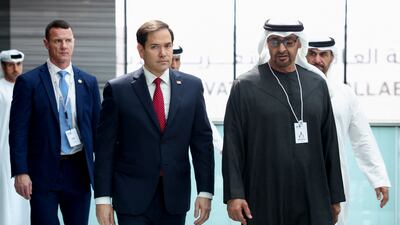
President Sheikh Mohamed and US Secretary of State Marco Rubio visit the International Defence Exhibition and Conference (Idex) in Abu Dhabi. AFP -
Sheikh Mohammed bin Rashid, Vice President and Ruler of Dubai, visited Idex on Tuesday for the exhibition's second day. Photo: Wam -
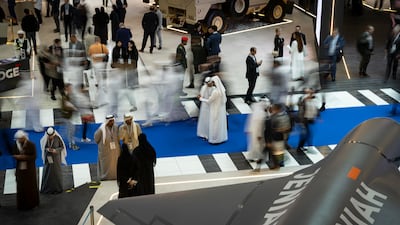
An exhibit by the UAE defence and technology company Edge, which launched more than 46 new systems during the exhibition. Antonie Robertson / The National -

More than 1,565 exhibitors from around the world are in attendance. Antonie Robertson / The National -
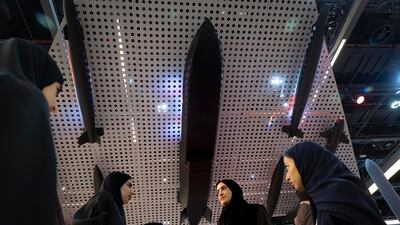
More than 150,000 visitors are expected to attend the week-long event. Antonie Robertson / The National -
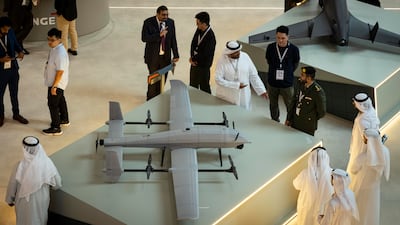
This year's Idex features more than 41 country pavilions. Antonie Robertson / The National -
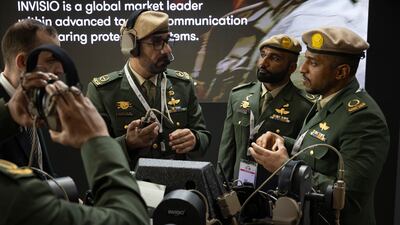
Idex is spread across more than 180,000 square metres of exhibition space. Antonie Robertson / The National -
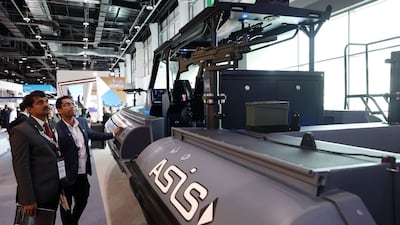
An Asis boat on display during the Naval Defence and Maritime Security Exhibition (Navdex), which is being held alongside Idex. Chris Whiteoak / The National -
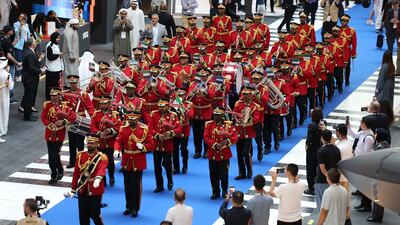
The Abu Dhabi Police band entertain visitors at Adnec, during Idex and Navdex. Chris Whiteoak / The National -
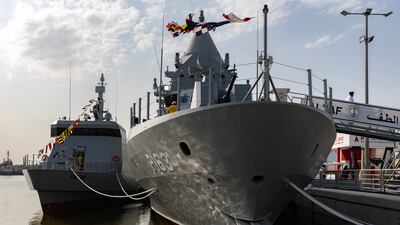
Vessels on display at Navdex. Chris Whiteoak / The National -

Themis Combat, a ground autonomous system. Chris Whiteoak / The National -
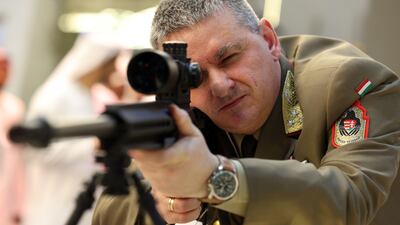
Trying out the hardware on display. Chris Whiteoak / The National -
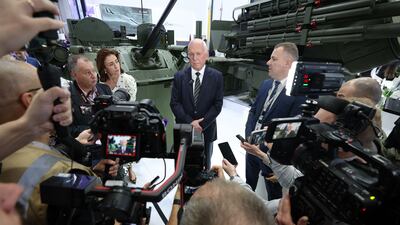
Sergey Chemezov, chief executive of Russian defence company Rostec, addresses journalists at Idex. Chris Whiteoak / The National -
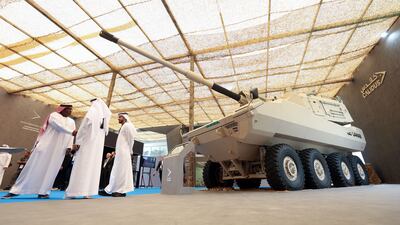
Lahab, a Howitzer made by UAE defence company Calidus. Chris Whiteoak / The National


AI and defence systems
The company sees a “great opportunity” to strengthen its activities in the UAE with artificial intelligence-embedded defence equipment and training Emiratis for its use, Ms Sourisse said.
“AI will be using data that is coming from our military users and this data is very sensitive and sometimes, it is classified. It therefore makes sense to ensure that the work in AI can be performed by Emirati citizens,” she said.
“We are definitely planning on developing competencies in AI to be embedded in the systems we supply to the UAE and to have competencies in the UAE.”
Since AI must be trained based on data from the users and since the UAE is emphasising creation of jobs for citizens, Thales is seeking to hire and train Emirati engineers for such jobs, she said.
Thales has more than 600 experts globally working on AI in mission-critical systems and expects that number to grow “tremendously” in the future, she said.
Thales, which says it is among the top five globally for cyber security, identified the intensification of geopolitical conflicts, the implementation of AI and growing digital reliance as the main challenges this year facing sectors such as energy, finance and transport, in its January report on cyber security.
“We are offering mission-critical systems to our customers, so they need to be cyber secure … our systems embed more and more AI. And AI is not only a question for the future, we area already working on it … we are developing AI solutions for critical missions, so security and lives are at stake,” Ms Sourisse said. “This kind of AI needs to be trustable and transparent.”
AI is embedded in more than 100 of Thales' products, such as radars and the reconnaissance pods below an aircraft, she added. Use of AI in defence systems raises two risks including the threat of hacking and therefore must be cyber-secured, and it must also be certified for safety as lives are at stake, she said.
Rising European defence spending
Political tension in Europe, arising from Russia-Ukraine war and Washington's push for European countries to spend more on protecting themselves is set to boost growth for defence manufacturers, according to some companies such as Swedish conglomerate Saab.
Thales is tracking a similar trend and plans to increase its spending on new products in response to growing market requirements.
“Yes, we are expecting a higher level of demand from a number of customers, certainly in Europe, but our defence markets are growing pretty much everywhere in the world and we plan to see additional investments in developing new solutions,” Ms Sourisse said.
Thales is spending 20 per cent of its annual revenue on research and development (R&D), she said. With annual sales revenue of €20 billion ($20.9 billion), this translates into €4 billion of investment into R&D.
“We see that growing in the future, we plan to reach about €5 billion on investment in R&D by 2028 globally,” she said.

