Passenger traffic across Abu Dhabi's five airports hit a record 29.4 million travellers in 2024, up 28 per cent year-on-year, driven by growth at Zayed International Airport that is home to Gulf major Etihad Airways.
Abu Dhabi's Zayed International Airport handled 28.8 million passengers last year, up from 22.4 in 2023, as the emirate's main hub added airlines and expanded its network, state-owned operator Abu Dhabi Airports said on Wednesday.
Zayed International Airport connected travellers to a network of more than 125 destinations with 29 routes launched last year.
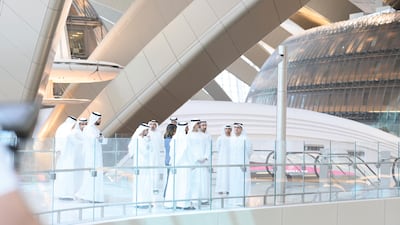
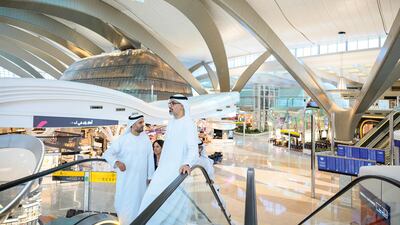
The airport, which opened the new Terminal A in November 2023, added eight airlines last year, including British Airways, Air Astana, Aegean Airlines, US Bangla Airlines, Akasa Air, Hainan Airlines, Flynas and Turkmenistan Airlines.
“2024 was a highly successful year for Abu Dhabi Airports, marked by record-breaking passenger traffic, significant cargo growth, and the successful completion of key infrastructure projects,” Elena Sorlini, managing director and chief executive at Abu Dhabi Airports, said.
In terms of air cargo, Abu Dhabi Airports said it handled 678,990 tonnes in 2024, up 21 per cent from a year ago.
Overall aircraft movements at Abu Dhabi's five airports – Zayed International, Al Ain International, Al Bateen Executive, Delma Island and Sir Bani Yas Island airports – rose 10 per cent year-on-year to 249,747 in 2024. This reflected passenger demand from key markets such as the UK, India, Qatar, and Egypt, the data showed.
Zayed International Airport served as the “primary catalyst” of this growth, Abu Dhabi Airports said.
The hub is home to Etihad Airways, which is pressing ahead with plans to triple passenger numbers to 33 million and double its fleet to 150 planes by the end of the decade. Last year, the airline announced 10 direct routes from Abu Dhabi to destinations in Asia, Africa and the US, including Hong Kong and Atlanta.
Etihad carried 13.6 million passengers in the first nine months of 2024, a 35 per cent increase year-on-year, according to its latest report in November. Capacity, measured in available seat kilometres, increased 31 per cent year-on-year.
Passenger load factor – a measure of how many seats are filled on planes – inched up to 87 per cent in the nine-month period, from 86 per cent from the same time in 2023.
With a fleet of 95 aircraft, including five freighters, as of September 30, the airline flies to 83 destinations, up from 72 in September 2023.
Abu Dhabi is seeking to diversify its non-oil sectors – as part of wider plans to reduce the economy's reliance on hydrocarbons – with a focus on growing strategic industries including tourism, aviation and hospitality.
In April 2024, it announced plans to invest more than $10 billion in infrastructure as part of a new strategy to boost international visitor numbers and cultural activity.
Abu Dhabi's tourism sector is expected to contribute Dh55 billion ($14.97 billion) to the emirate's gross domestic product in 2024, up from Dh46 billion last year, with a “north star” target of more than Dh90 billion by 2030, Saood Al Hosani, undersecretary of the Department of Culture and Tourism – Abu Dhabi (DCT Abu Dhabi), told The National in December.
Globally, passenger demand for air travel rose 10.4 per cent year-on-year in 2024 and was up 3.8 per cent above the pre-pandemic levels of 2019, according to the International Air Transport Association (IATA).

COMPANY%20PROFILE
%3Cp%3E%3Cstrong%3EName%3A%20%3C%2Fstrong%3EKinetic%207%3Cbr%3E%3Cstrong%3EStarted%3A%3C%2Fstrong%3E%202018%3Cbr%3E%3Cstrong%3EFounder%3A%3C%2Fstrong%3E%20Rick%20Parish%3Cbr%3E%3Cstrong%3EBased%3A%3C%2Fstrong%3E%20Abu%20Dhabi%2C%20UAE%3Cbr%3E%3Cstrong%3EIndustry%3A%3C%2Fstrong%3E%20Clean%20cooking%3Cbr%3E%3Cstrong%3EFunding%3A%3C%2Fstrong%3E%20%2410%20million%3Cbr%3E%3Cstrong%3EInvestors%3A%3C%2Fstrong%3E%20Self-funded%3C%2Fp%3E%0A
Specs
Engine: Dual-motor all-wheel-drive electric
Range: Up to 610km
Power: 905hp
Torque: 985Nm
Price: From Dh439,000
Available: Now
World Series
Game 1: Red Sox 8, Dodgers 4
Game 2: Red Sox 4, Dodgers 2
Game 3: Saturday (UAE)
* if needed
Game 4: Sunday
Game 5: Monday
Game 6: Wednesday
Game 7: Thursday
The rules on fostering in the UAE
A foster couple or family must:
- be Muslim, Emirati and be residing in the UAE
- not be younger than 25 years old
- not have been convicted of offences or crimes involving moral turpitude
- be free of infectious diseases or psychological and mental disorders
- have the ability to support its members and the foster child financially
- undertake to treat and raise the child in a proper manner and take care of his or her health and well-being
- A single, divorced or widowed Muslim Emirati female, residing in the UAE may apply to foster a child if she is at least 30 years old and able to support the child financially
World record transfers
1. Kylian Mbappe - to Real Madrid in 2017/18 - €180 million (Dh770.4m - if a deal goes through)
2. Paul Pogba - to Manchester United in 2016/17 - €105m
3. Gareth Bale - to Real Madrid in 2013/14 - €101m
4. Cristiano Ronaldo - to Real Madrid in 2009/10 - €94m
5. Gonzalo Higuain - to Juventus in 2016/17 - €90m
6. Neymar - to Barcelona in 2013/14 - €88.2m
7. Romelu Lukaku - to Manchester United in 2017/18 - €84.7m
8. Luis Suarez - to Barcelona in 2014/15 - €81.72m
9. Angel di Maria - to Manchester United in 2014/15 - €75m
10. James Rodriguez - to Real Madrid in 2014/15 - €75m
Why it pays to compare
A comparison of sending Dh20,000 from the UAE using two different routes at the same time - the first direct from a UAE bank to a bank in Germany, and the second from the same UAE bank via an online platform to Germany - found key differences in cost and speed. The transfers were both initiated on January 30.
Route 1: bank transfer
The UAE bank charged Dh152.25 for the Dh20,000 transfer. On top of that, their exchange rate margin added a difference of around Dh415, compared with the mid-market rate.
Total cost: Dh567.25 - around 2.9 per cent of the total amount
Total received: €4,670.30
Route 2: online platform
The UAE bank’s charge for sending Dh20,000 to a UK dirham-denominated account was Dh2.10. The exchange rate margin cost was Dh60, plus a Dh12 fee.
Total cost: Dh74.10, around 0.4 per cent of the transaction
Total received: €4,756
The UAE bank transfer was far quicker – around two to three working days, while the online platform took around four to five days, but was considerably cheaper. In the online platform transfer, the funds were also exposed to currency risk during the period it took for them to arrive.
The specs: 2017 Ford F-150 Raptor
Price, base / as tested Dh220,000 / Dh320,000
Engine 3.5L V6
Transmission 10-speed automatic
Power 421hp @ 6,000rpm
Torque 678Nm @ 3,750rpm
Fuel economy, combined 14.1L / 100km
Avatar: Fire and Ash
Director: James Cameron
Starring: Sam Worthington, Sigourney Weaver, Zoe Saldana
Rating: 4.5/5
Ferrari 12Cilindri specs
Engine: naturally aspirated 6.5-liter V12
Power: 819hp
Torque: 678Nm at 7,250rpm
Price: From Dh1,700,000
Available: Now
UK-EU trade at a glance
EU fishing vessels guaranteed access to UK waters for 12 years
Co-operation on security initiatives and procurement of defence products
Youth experience scheme to work, study or volunteer in UK and EU countries
Smoother border management with use of e-gates
Cutting red tape on import and export of food
Mercer, the investment consulting arm of US services company Marsh & McLennan, expects its wealth division to at least double its assets under management (AUM) in the Middle East as wealth in the region continues to grow despite economic headwinds, a company official said.
Mercer Wealth, which globally has $160 billion in AUM, plans to boost its AUM in the region to $2-$3bn in the next 2-3 years from the present $1bn, said Yasir AbuShaban, a Dubai-based principal with Mercer Wealth.
“Within the next two to three years, we are looking at reaching $2 to $3 billion as a conservative estimate and we do see an opportunity to do so,” said Mr AbuShaban.
Mercer does not directly make investments, but allocates clients’ money they have discretion to, to professional asset managers. They also provide advice to clients.
“We have buying power. We can negotiate on their (client’s) behalf with asset managers to provide them lower fees than they otherwise would have to get on their own,” he added.
Mercer Wealth’s clients include sovereign wealth funds, family offices, and insurance companies among others.
From its office in Dubai, Mercer also looks after Africa, India and Turkey, where they also see opportunity for growth.
Wealth creation in Middle East and Africa (MEA) grew 8.5 per cent to $8.1 trillion last year from $7.5tn in 2015, higher than last year’s global average of 6 per cent and the second-highest growth in a region after Asia-Pacific which grew 9.9 per cent, according to consultancy Boston Consulting Group (BCG). In the region, where wealth grew just 1.9 per cent in 2015 compared with 2014, a pickup in oil prices has helped in wealth generation.
BCG is forecasting MEA wealth will rise to $12tn by 2021, growing at an annual average of 8 per cent.
Drivers of wealth generation in the region will be split evenly between new wealth creation and growth of performance of existing assets, according to BCG.
Another general trend in the region is clients’ looking for a comprehensive approach to investing, according to Mr AbuShaban.
“Institutional investors or some of the families are seeing a slowdown in the available capital they have to invest and in that sense they are looking at optimizing the way they manage their portfolios and making sure they are not investing haphazardly and different parts of their investment are working together,” said Mr AbuShaban.
Some clients also have a higher appetite for risk, given the low interest-rate environment that does not provide enough yield for some institutional investors. These clients are keen to invest in illiquid assets, such as private equity and infrastructure.
“What we have seen is a desire for higher returns in what has been a low-return environment specifically in various fixed income or bonds,” he said.
“In this environment, we have seen a de facto increase in the risk that clients are taking in things like illiquid investments, private equity investments, infrastructure and private debt, those kind of investments were higher illiquidity results in incrementally higher returns.”
The Abu Dhabi Investment Authority, one of the largest sovereign wealth funds, said in its 2016 report that has gradually increased its exposure in direct private equity and private credit transactions, mainly in Asian markets and especially in China and India. The authority’s private equity department focused on structured equities owing to “their defensive characteristics.”
First Person
Richard Flanagan
Chatto & Windus