The Trump administration has accused Microsoft, Adobe and a half-dozen other companies of abusing a US worker visa programme.
The companies have been suspended indefinitely from the longstanding immigration initiative that’s served as a crucial talent pipeline for Silicon Valley and Wall Street.
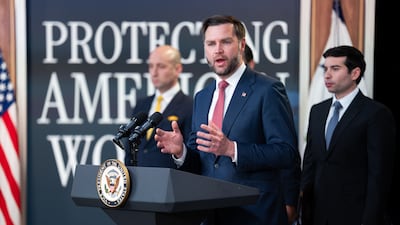
The suspensions, announced on Thursday by US Vice President JD Vance and Labour Secretary Keith Sonderling, included information technology services giants Cognizant Technology Solutions, Infosys, Tata, Wipro, HCL Technologies and Capgemini.

Those companies, either based in India or with large operations there, are often called outsourcers for their role offering contract IT work to other businesses.
At a briefing in Washington, Mr Sonderling said there were multiple federal investigations under way into the use of a system that allows US employers to sponsor foreign workers for permanent residency.
“We are cutting off the head of the snake — the companies that enabled this abuse for decades,” Mr Sonderling told reporters.
Mr Vance singled out Microsoft, the world’s third most-valuable company, for what he characterised as exploitation of the programme. “There has been no company in the United States, unfortunately, that has abused this system more than Microsoft,” he said.
In a statement, Microsoft defended its use of visa programmes and said that it looked forward to providing the administration with additional information. Adobe and the Indian companies named didn’t immediately respond to requests for comment.
Shares of Microsoft fell more than 1.3 per cent in New York trading on Thursday, while Cognizant reversed earlier losses and was up more than 5 per cent. Shares in Indian IT services firms including Tata Consultancy Services and Infosys rose on Friday.
Mr Vance’s comments assailing Microsoft came hours before US President Donald Trump honoured the company’s chief executive, Satya Nadella, with a National Medal of Technology and Innovation at a summit in Washington intended to highlight US scientific leadership. Last week, Mr Nadella joined other tech industry leaders at a White House luncheon to discuss safeguards for artificial intelligence.

“Microsoft is a great American company, and we have a great relationship with them, they do a lot of important things,” Mr Vance said. “Our message to Microsoft is not that we want to harm your company. It’s that we want your company to thrive, but we want it to thrive by employing and empowering your fellow Americans.”
The latest move takes aim at the Permanent Labor Certification Programme, or Perm, which allows companies to sponsor a foreigner who has been working in the US under the H-1B and other visa holders to become a legal permanent resident, the first step to becoming a US citizen.
Silicon Valley’s reliance on foreign workers has long been a flashpoint in the debate over immigration. Since Mr Trump’s return to office last year, the administration has seized on those concerns and pressed tech giants to do more to train and hire US workers.
As part of that effort, Trump has moved to make it harder for companies to use H-1B visas to attract foreign talent, targeting a major source of workers for the industry. The changes have included proposals for $100,000 filing fees for most candidates and tightening the rules of how the H-1B visas are awarded in an annual lottery, giving priority to companies offering the highest salaries.
In his remarks, Mr Vance urged US-based companies to shift their policies to employ more US workers. “Stop defrauding the American worker. Stop importing an indentured servant to do a job that an American worker would happily do,” the vice president said.
Immigration crackdown
The suspensions marked the latest move by the Trump administration to crack down on both legal and undocumented pathways to migration, an effort that’s narrowing a key path linking global scientific and engineering workers with US companies across a range of sectors.
In a nearly simultaneous announcement on Thursday, the administration also said it had opened investigations into foreign exchange visa holders at nine top colleges including Harvard University, Stanford University and MIT. The sweeping fraud probe is focused on J-1 visas, which at universities are often held by international PhD candidates and visiting scholars.
During the Thursday summit where Mr Nadella was honoured by Mr Trump, the administration announced plans to inject more than $100 million into education programmes for American researchers in science, technology, engineering and math. The initiative seeks to boost the number of scientific researchers who are American citizens and reduce the reliance on foreign talent by companies and universities.
Representative Pramila Jayapal, a Washington Democrat, faulted the administration’s decision and said that the Perm programme has a clearly delineated process that’s designed to make it beneficial to the US economy and to ensure that it doesn’t take jobs away from American citizens.
“You don’t fix a broken immigration system by taking a hammer to legal immigration,” Ms Jayapal said in a statement. “Targeting Microsoft or the Perm programme in this way simply undermines legal immigration and weakens America’s ability to innovate.”
Companies like Microsoft often use the H-1B programme to bring in foreign workers and then help some of them remain in the country through the system. Through the third quarter of the 2026 federal fiscal year, which ended September 30, Microsoft had filed about 1,680 such petitions for permanent status, according to Department of Labour data.
In its statement following the suspensions, Microsoft said that of the 6,000 total H-1B visa applications it submitted in the most recent fiscal year, 80 per cent were to extend or change the status of current company employees.
“These were not to hire new people. The remaining filings for new employees were for individuals already legally in the United States who decided to come work for us, and they equal only 1 per cent of our US workforce,” the company said on its corporate blog.
The Permanent Labour Certification Programme is a major retention tool for Microsoft, which has a reputation for helping employees with work visas seek permanent legal status. The Redmond, Washington-based company has long bolstered its US-based workforce with employees in the country on H-1B visas, as well as visas for intracompany transfers and recent university graduates.
Outside the tech industry, Wall Street firms and telecommunications companies have also relied on the H-1B programme through their use of IT contractors from staffing and outsourcing agencies. Staffing companies have developed a lucrative business recruiting programmers and other technology professionals from abroad and placing them with US clients.
In the first nine months of the 2026 fiscal year, Microsoft was the fifth highest user of H-1B visas, with 3,688. The company trailed behind Apple, Infosys, Tata Consultancy Services and Amazon.com, according to H-1B employer data published by US Citizenship and Immigration Services. Over the last decade, Microsoft has used nearly 54,000 such visas, ranking fourth among the largest users, behind Amazon, Infosys and Tata, according to USCIS data.
For years, TCS and other Indian outsourcers were among the heaviest users of H-1B visas, regularly drawing fire for taking over the tech operations at major US companies and then bringing in temporary Indian workers at salaries below their American counterparts. But the Indian companies have pulled back in recent years in the face of political backlash and the Trump administration’s move to hike fees on H-1B visas to $100,000.
Nasscom, a lobbying group that represents Indian IT services companies, said that many of those businesses have significantly reduced their dependence on H-1B visas, a shift that has translated into fewer requests for permanent status.
“While the decision affects a specific immigration pathway, Nasscom has consistently maintained that immigration and skilled talent mobility are two distinct issues and should not be viewed through the same lens,” the group said in a statement.
Even though the tech industry has embraced Mr Trump in his second term, due to policies that have sought to ease their tax and regulatory burden and draw investments to build out AI infrastructure, the administration’s immigration crackdown has been a sore spot.
Curbing the flow of foreign researchers and scientists threatens to undermine US innovation and competitiveness in the long term, according to Ken Mahoney, president and chief executive at Mahoney Asset Management.
“The United States has spent decades establishing itself as the global leader in technology because of its ability to attract some of the brightest minds from around the world,” Mr Mahoney said. “Restricting access to that talent could halt innovation possibly, and you never know who is out there coming up with big ideas that you lose access to.”