

The Saudi Capital Market Authority (CMA) on Tuesday said it will open the kingdom’s capital market to all categories of foreign investors, effective from February 1.
It will allow people from overseas to invest directly in the market for the first time, as Saudi Arabia seeks to expand its investor base.
“The approved amendments eliminated the concept of the Qualified Foreign Investor [QFI] in the main market, thereby allowing all categories of foreign investors to access the market without the need to meet qualification requirements,” the regulator said.
The decision follows the CMA board’s approval of the regulatory framework to allow non-residents to invest directly in the main market.
The move aims to “expand and diversify the base of investors permitted to invest in the main market, thereby supporting investment inflows and enhancing market liquidity”, the CMA said.
International investors’ ownership in the capital market exceeded 590 billion Saudi riyals ($157.3 billion) by the end of the third quarter of 2025, while international investment in the main market reached about 519 billion riyals during the same period, compared to their ownership at the end of 2024, which stood at 498 billion riyals, the regulator said.
The approved amendments are expected to attract additional international investments, it added.
The move comes nearly six months after Saudi Arabia opened its stock exchange to residents of Gulf countries, who were now allowed to invest directly in the kingdom’s main Tadawul market, in a move expected to help attract more foreign direct investment into the Arab world's largest bourse.
In July, the CMA said it would allow residents of Gulf countries to invest directly in the kingdom’s Tadawul market, in a move aimed at boosting the market's international reach.
The approved amendments also allow individual foreign investors who have previously lived in Saudi Arabia or other countries Gulf countries to continue investing in listed equities on Tadawul even after their residency expires, the regulator said, as the kingdom seeks to expand its investor base.
Previously, Saudi investment by Gulf residents was limited to the debt market, the parallel Nomu, investment funds and the derivatives market.
The latest measures come as Saudi Arabia continues to open its economy to foreign investors as part of its Vision 2030 programme. It was launched in 2016 to diversify its economy away from oil, support private-sector growth, improve female workforce participation and reduce unemployment among citizens. The kingdom is spending heavily on sectors such as infrastructure, real estate and tourism, to develop projects and support the growth of its non-oil economy.
Saudi Arabia raised $11.5 billion through a four-tranche dollar bond sale, marking its first issuance this year, as the kingdom continues with its economic diversification plans, the National Debt Management Centre said on Tuesday.
In recent years, the kingdom has introduced new laws, including companies law and civil transactions law, to attract more foreign investment.
The country’s economy is forecast to grow at 4 per cent this year, similar to last year’s projections made by the International Monetary Fund, driven by higher oil production and strong domestic demand linked to the kingdom's reforms.
The latest initiative aims to increase confidence among participants in the kingdom’s main market and support the domestic economy, the CMA said.
“These approved amendments align with the CMA’s gradual approach to opening the market, building on previous phases and paving the way for complementary steps aimed at further opening the capital market,” the regulator said. “The goal is to position the market as an international marketplace capable of attracting greater flows of foreign capital.”
-
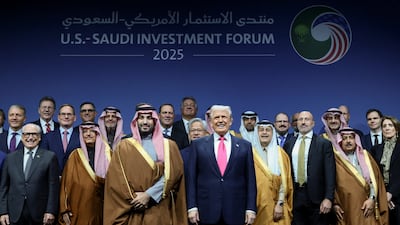
US President Donald Trump, centre, poses for a family picture with Saudi Crown Prince Mohammed bin Salman and other officials during the US - Saudi Investment Forum in Washington, DC. Reuters -
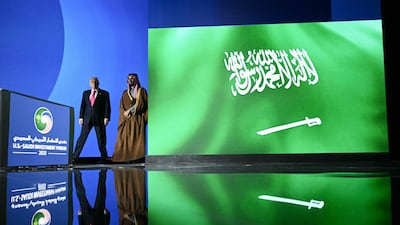
Mr Trump and Prince Mohammed arrive at the forum. AFP -
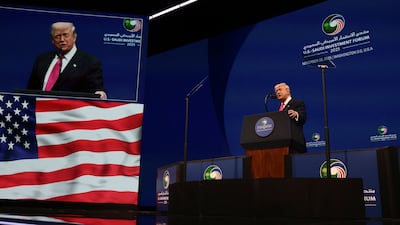
Mr Trump speaks. Reuters -

Mr Trump and Elon Musk speak during the forum. Reuters -

US Secretary of Treasury Scott Bassent, Prince Mohammed and Mr Musk. AFP


Saudi Arabia has been seeking to revive its $2.23 trillion equity market. Development of the kingdom's financial markets is a central plank of the kingdom's economic overhaul and the CMA has been consistently updating regulations to make the capital markets more attractive to investors.
The kingdom’s stock market surged by 5.1 per cent on September 24, recording its biggest gain in more than five years following reports about the kingdom planning to ease foreign ownership limits for listed companies. The Tadawul All-Share Index reached 11,426.5 points on the day, with more than 598.3 million shares traded at a total value of nearly 14.5 billion riyals, about 195 per cent above the 90-day average, EFG Hermes estimated.

