

Activists in Japan view Israel’s latest attacks on Iran's nuclear sites as uncomfortably familiar.
Plumes of smoke over incinerated debris in Tehran and charred remains in Gaza from Israel’s nearly 21-month assault – altogether bring back a painful and generational trauma from Hiroshima and Nagasaki after the Second World War.
On Wednesday, US President Donald Trump probably reinvigorated their anguish with his remarks justifying his country’s first direct strike on Iran attacking three nuclear sites.
“That hit ended the war,” he said, referring to the Israel and Iran conflict.
“I don't want to use an example of Hiroshima. I don't want to use an example of Nagasaki. But that was essentially the same thing. That ended that war,” he added.
Organiser and member of Palestinians of Japan
Except it did not, in the case of Israel and Iran. Retaliatory attacks ensued the very next day despite Mr Trump’s claim of a ceasefire. Since Tuesday, however, a fragile ceasefire has been in place.
His rhetoric about Israel’s war with Iran, and also Gaza, hit home for many Japanese.
“I remember a feeling I had that resonated … we can't let what happened to Hiroshima happen to Gaza,” said Star Myata, a Japanese American whose family was incarcerated in the 1940s US internment camps and were also originally from Hiroshima.
Israel’s attacks on Iran, and the US bombing on Iran “absolutely echo the same violent logic the US used on Japan in Hiroshima and Nagasaki”, said Hanin Siam, who is a key organiser and member of Palestinians of Japan.
“This is nuclear colonialism in real time. It’s not about defence, it’s about domination, with zero regard for human life or environmental catastrophe.”
In August 1945, the US used uranium and plutonium filled bombs with the names Big boy and Fat Man to annihilate Hiroshima and Nagasaki. Big Boy killed up to 75,000 people on impact, Fat man 45,000. By the end of the year, about 140,000 died due to injuries and radiation.
Japanese American and member of Kifu for Palestine
Meanwhile, Israel chose more valiant names in parallel, such as Operation Swords of Iron, which has so far led to the direct killing of about 55,000 Palestinians, mostly civilians, since October 7, 2023. As of May, the casualty count rose to 109,000 when taking into account indirect causes of death such as starvation and disease, according to estimates by The Economist.
Ms Myata said through the lens of her family experience, and similarities between the experiences of Hiroshima and Gaza, she felt connected despite being thousands of kilometres away across time zones, world views and geopolitical realities.
“So the urgency to act, I feel, comes from that. You don't want the same thing to happen to other people.”
She is a member of Kifu for Palestine. Kifu, which means donation in Japanese, is an eight-member volunteer group that relies on community fund-raising through events to aid victims in Palestine.
“I didn't have this move towards action until October 7, and that was, you know, being in Tokyo, seeing what was happening, and having this really deep fear of, but they will not stop, like the bombing will not stop,” Ms Myata explained.
Dealing with ethics
Kifu for Palestine was formed in March last year after a call for support from Ms Siam. Her Palestinians of Japan group of about 50 people has cross-country volunteers who protest and encourage government institutions and corporations to conduct more ethical dealings.
Like in the case of Itochu, one of Japan's largest trading companies valued at more than $70 billion, that entered a strategic partnership with major Israeli defence company Elbit Systems in March 2023.
“This is a mega company, that's a trading company, that's import, export, and many Japanese students really want to go work for Itochu,” said Ms Siam, a digital finance graduate degree holder.
-
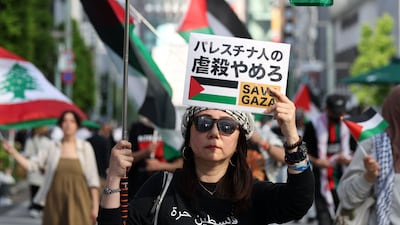
Pro-Palestinian activists protest through the streets of Ginza. Tokyo, Japan. Chris Whiteoak / The National -
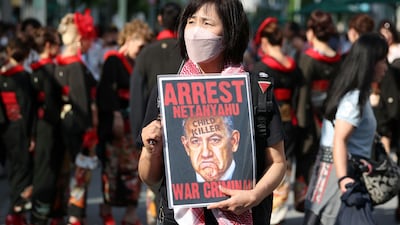
Pro-Palestinian activists protest through the streets of Ginza. Tokyo, Japan. Chris Whiteoak / The National -
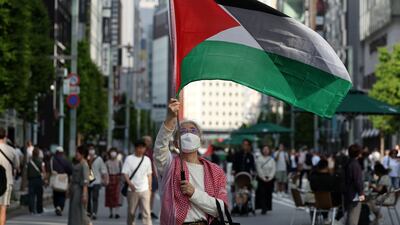
Pro-Palestinian activists protest through the streets of Ginza. Tokyo, Japan. Chris Whiteoak / The National -
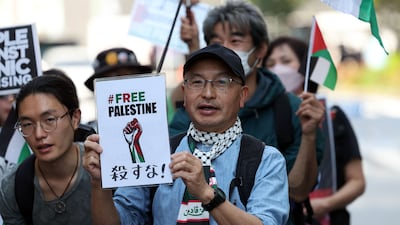
Pro-Palestinian activists protest through the streets of Ginza. Tokyo, Japan. Chris Whiteoak / The National -
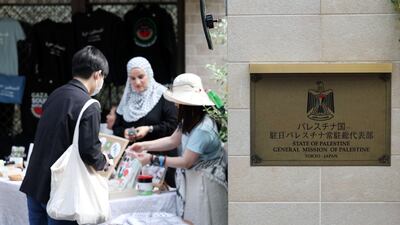
Palestinians in Japan hold a fundrasing and awareness event at the Palestine embassy. Tokyo, Japan. Chris Whiteoak / The National -
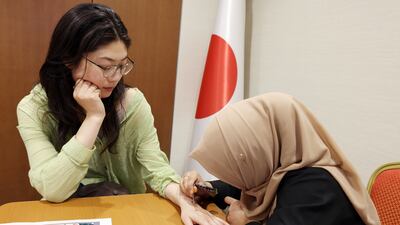
Henna is painted. Palestinians in Japan hold a fundrasing and awareness event at the Palestine embassy. Tokyo, Japan. Chris Whiteoak / The National -
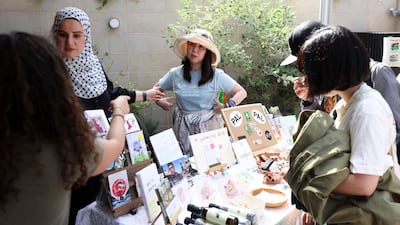
Palestinians in Japan hold a fundrasing and awareness event at the Palestine embassy. Tokyo, Japan. Chris Whiteoak / The National -
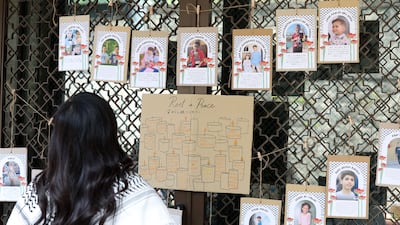
Children that have passed away during the conflict. Palestinians in Japan hold a fundrasing and awareness event at the Palestine embassy. Tokyo, Japan. Chris Whiteoak / The National -
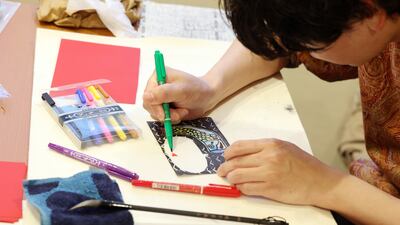
A printing workshop. Palestinians in Japan hold a fundrasing and awareness event at the Palestine embassy. Tokyo, Japan. Chris Whiteoak / The National -
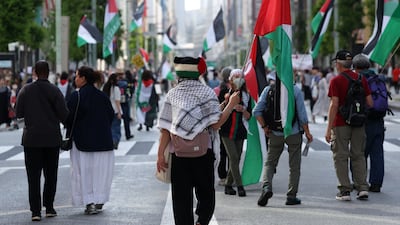
Pro-Palestinian activists protest through the streets of Ginza. Tokyo, Japan. Chris Whiteoak / The National


“Once we knew that they were complicit because they had signed a Memorandum of Understanding with Elbit Systems, we knew that we had to do something about it,” she said.
They conducted a series of protests, sit-ins, marches, film screenings, and exhibitions to educate Japanese people and leaders of companies and state about its impact on Palestinian lives.
This led to people in Malaysia, Canada, and other places showing support by not shopping at Itochu's famed convenience story Family Mart, Ms Siam said.
After the International Court of Justice ordered Israel to stop the genocide against Palestinians in Gaza in January, Itochu a month later ended its partnership with Elbit Systems.
“That was the biggest success,” said Ms Siam, 28, who is now targeting Japan's Government Pension Investment Fund that manages about $1.7 trillion. About 50 per cent of the fund's investments in equities and bonds are abroad.
Information about how much of those investments are in Israeli companies and in which is not publicly available.
Japan's imports from Israel were valued at $1.44 billion in 2024, according to the UN Comtrade database. Electronic equipment, medical apparatuses, fruits and vegetables, and also nuclear reactors were some of top valued imports.
Israel imported about $1.94 billion from Japan the same year, with vehicles, boilers, and also nuclear reactors as the most valued imports, reported the database.
From peace to liberation
Ms Siam, who was born in Gaza and raised in Japan for about 10 years, is the daughter of Palestinian Ambassador to Japan, Waleed Siam.
She is one of the few Palestinians living there. In 2023, there were only 95 Palestinians in Japan among the 124 million people living there, according to the country's Statistics Bureau of Japan and the Ministry of Foreign Affairs.
This number might be increasing as Japanese residents are gradually becoming more aware and connected to what's happening in the Middle East. Before October 7, knowledge about the region was minimal, according to Ms Myata.
“For many people, they might not even know where Palestine is. They might hear the name and mistake it for, like, Pakistan,” she said, although that is changing.
“It's [the common bond] often very closely tied to the general anti-war or anti-nuclear weapon, which is big here in general,” Ms Myata said.
Aiko Yamakita, an organiser at Kifu for Palestine, said that Japan has always had interest in humanitarian issues.
“There's a lot of peace-washing that happens, and we're trying to change that narrative as well – that before peace, we need liberation,” she said, adding that while many ceasefires and peace agreements have taken place in Gaza, they do not last long.
For Japanese, the work that's been done since October 7 is noticeable, especially given that Japanese people do not like disruption, explained Ms Yamakita.
Organiser at Kifu for Palestine
“I didn't expect to see protests in Japan, and whenever you see them, I think people are always surprised and try to avoid,” she said.
“But with that [said], I think it's definitely grown over the past year and a half, so we're definitely seeing a shift.”
Chris Whiteoak contributed to this report

