


The UAE's aviation industry has soared to great heights since the country welcomed its first travellers in the 1960s, developing over the decades into a global powerhouse for air connectivity and standing in the post-Covid era at the cusp of a changing landscape with plans for sustainable and technology-driven future growth.
The local aviation industry's development over the decades, starting with a sand-compacted runway in Dubai International Airport in 1960 and the first flights of Emirates airline with two wet-leased aircraft in 1985, has transformed the nation from a fishing and pearl-diving spot into a global centre for air transport.
"The development of the UAE as a global aviation powerhouse started with a bold vision in the 1960s Collaboration. Careful planning and open competition have played a key role in the rise as a global aviation hub over the past few decades," said Linus Bauer, founder and managing director of Bauer Aviation Advisory.
The UAE's rise as a modern centre connecting East and West is a story of globalisation and an ambitious bet on the future of air travel as the nation celebrates its Golden Jubilee on December 2.
Over a series of milestones, Dubai transformed from a little-known desert airfield to a global airport connecting far-flung corners of the globe. Driving its success is the UAE's strategic location between Europe and Asia within an eight-hour flight radius of two thirds of the world’s population, operating a pre-pandemic network of 240 destinations and home to the world’s largest long-haul airline Emirates.
Enabling the ease of decision-making and mapping out the larger picture, Sheikh Ahmed bin Saeed Al Maktoum is the airline's chairman and also runs the airport operator, as well as the aviation regulator.
In its aggressive pursuit for growth, Dubai International has retained its title of the world’s busiest airport by international passengers for seven years, as the emirate developed into a centre for transcontinental traffic between America and Europe with Asia.
The aviation industry has been a key pillar of the UAE's economy and a driver of business activity, contributing about 13 per cent to the national gross domestic product, while boosting related sectors from hospitality to trade. It is now home to six national airlines ranging from low-cost to full-service operators.
"The aviation sector has been an essential factor behind the transformation of the UAE economy since the 1980s and its development into a regional and then global service hub," said Monica Malik, chief economist at Abu Dhabi Commercial Bank. "This is not only the direct contribution of the sector but also its role in developing areas such as tourism, hospitality, logistics and trade and finance."
Dubai took a long-term strategic decision to diversify its economy in the 1980s, focusing on developing its aerospace sector as part of a push to boost its non-oil revenue, transform the city into a business centre, create jobs and attract tourists. Open skies policies, large investment in infrastructure and a foreign, investor-friendly business environment have spurred the development of the aviation industry.
Hand in hand with the development of the sector, Dubai has spent billions of dirhams on new attractions and eased visa rules to enable the arrival of more tourists, remote workers and high-skilled talent.
In a forward-looking strategy, the UAE sought to become part of the aerospace supply chain, rather than only a customer of billion-dollar aircraft orders placed with the world's biggest plane makers.
Strata. based in Al Ain, Mubadala Investment Company’s aerospace manufacturing unit, became the Arabian Gulf's first producer of composite aircraft parts and is a key part of the UAE's economic diversification and local industrialisation plan. It started operations in 2010 and now makes components for jet wings from the Boeing 777X empennage ribs to the Airbus A350 flap support fairings.
"The UAE government created a well-articulated strategy that included various strategic projects that were implemented right across the full aviation-related value chain," said Andre Martins, partner in the Middle East and Africa transport and services practice at Oliver Wyman.
-
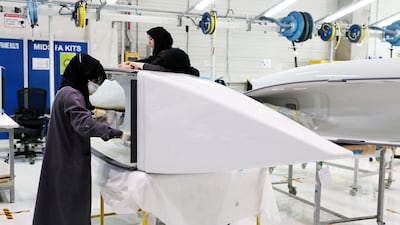
Employees work on parts for Airbus and Boeing in the Assembly section at the Strata Manufacturing facility in Al Ain. Pawan Singh / The National -
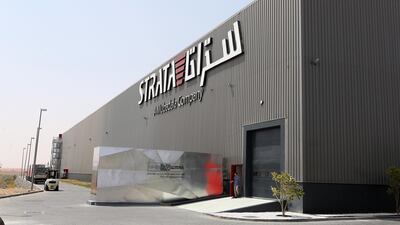
Outside view of the Strata Facilities in Al Ain. Pawan Singh / The National -
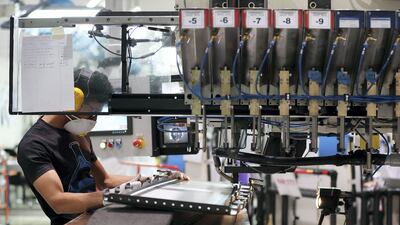
An employee works on parts for Airbus and Boeing in the CNC section (Computer Numerical Control) at the Strata Manufacturing facility in Al Ain. Pawan Singh / The National -
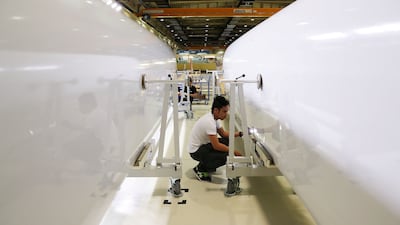
Employees work on parts for Airbus and Boeing in the Assembly section at the Strata Manufacturing facility in Al Ain. Pawan Singh / The National -
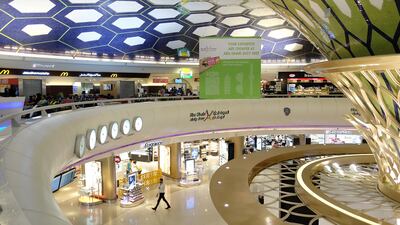
Passengers at Abu Dhabi International Airport can take advantage of Duty Free Shopping at the many shops at the airport. Delores Johnson / The National -
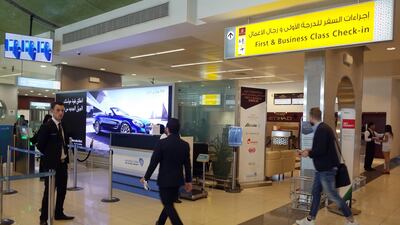
Passengers travel to the First and Business Class check-in desks at Abu Dhabi International Airport. Delores Johnson / The National -
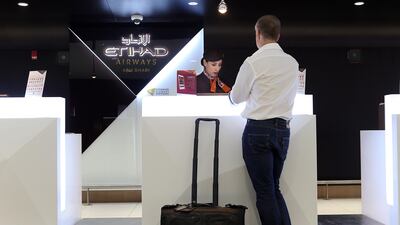
A passenger checks in at the Etihad Airways Business Class guest counter at Abu Dhabi International Airport. Delores Johnson / The National -
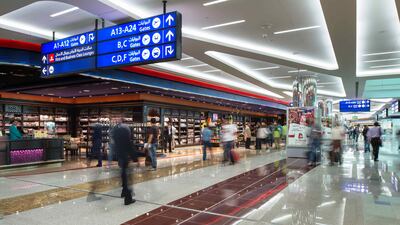
Dubai Airports has partnered with Deliveroo to bring passengers food orders directly to their gate at DXB's Terminal 3. Courtesy Dubai Airports -

Etihad has introduced a Covid-19 self-assesment tool for travellers and is offering at-home PCR tests in partnership with Mediclinic for UAE travellers. Courtesy Etihad -
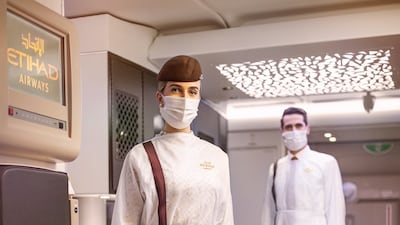
Etihad has introduced a series of new measures to protect passengers from Covid-19 when travelling. Courtesy Etihad -

Fit to Fly, a touchless self-service check-in and health screening system being trialled in Abu Dhabi by Etihad Airways. Victor Besa / The National -
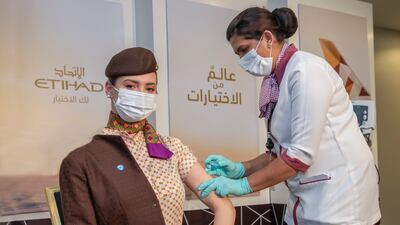
An Etihad Cabin Crew member receives a Covid-19 vaccine. -
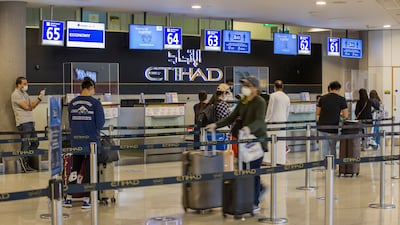
Stickers on the floor encouraging passengers to remain 2 metres apart while queueing. Courtesy of Etihad Airways. -
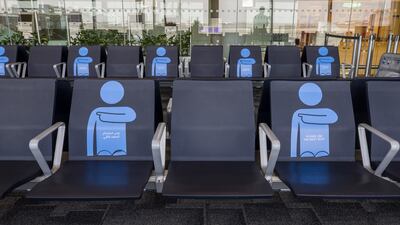
Signage encouraging social distancing on public seating in Abu Dhabi International Airport. Courtesy of Etihad Airways -
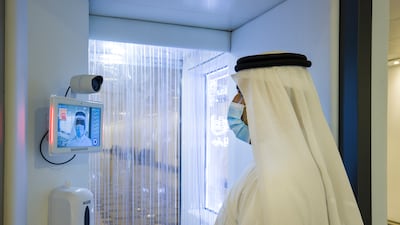
Temperature scanning before boarding a flight. Courtesy of Etihad Airways. -
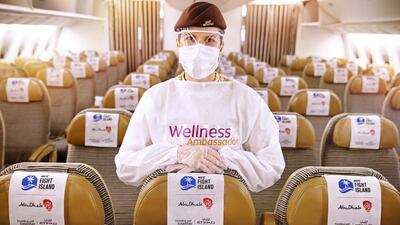
An Etihad in-flight 'Wellness Ambassador'. Courtesy of Etihad Airways -
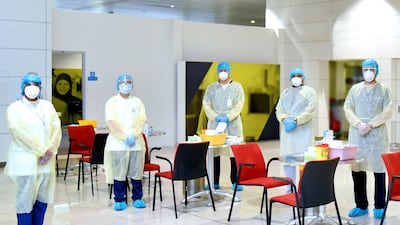
Emirates was the first airline to conduct on-site rapid Covid-19 tests for passengers. The quick blood test was conducted by the Dubai Health Authority (DHA) at Terminal 3, Dubai International Airport. Courtesy Emirates -
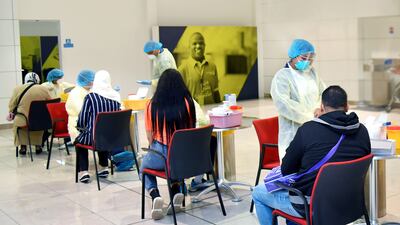
Emirates passengers headed to Tunisia undergo rapid tests for Covid-19 at Dubai International Airport. The results of the tests were available within 10 minutes. Courtesy Emirates -

A member of staff cleans to protect travellers from Covid-19 as people travel from Dubai Airport terminal 3 in Dubai. -
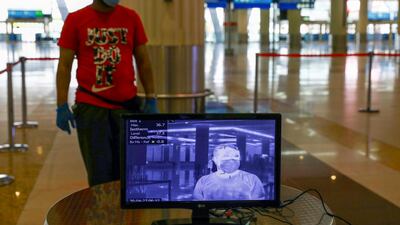
A man is seen through a thermal camera at Dubai International Airport, as Emirates airline resumed limited outbound passenger flights amid the coronavirus outbreak. -
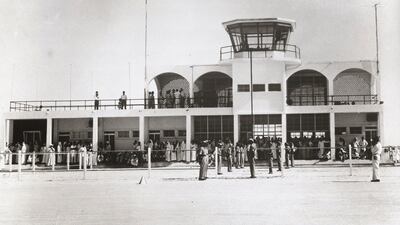
Dubai International airport as seen in the 1960s. -
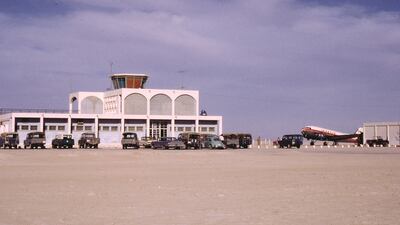
Dubai International airport as seen in the 1960s. -

An air display by the Airbus A 350 on the second day of the Dubai Airshow 2021. Chris Whiteoak/ The National -

Visitors attend the second day of the Dubai Airshow 2021. Chris Whiteoak/ The National -
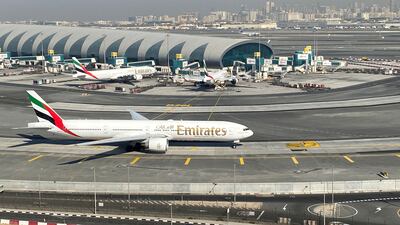
Emirates airliners are seen on the tarmac of Dubai International Airport on January 13, 2021. Reuters


The UAE has also invested more widely into smart transport. For example, the DP World-backed Virgin Hyperloop high-tech travel system will carry passengers and freight via floating pods in vacuum tubes at speeds of more than 1,000kph.
The UAE's dynamic aviation sector will help accelerate the country's continuing economic recovery from the Covid-19 pandemic as it brings in more tourists, investors, workers and expatriates to the leisure and business centre of the region.
"The airlines and sector will be central to the ongoing recovery of the UAE from the pandemic. We are seeing more routes returning and more planes," Ms Malik said. "Going forward, the focus will likely be on working with their partners towards a greener and more fuel-efficient aviation sector."
Environmental sustainability has been a top priority for local airlines such as Abu Dhabi's Etihad Airways, that announced its target of net-zero carbon by 2050 nearly two years ago.
Etihad, which has been focused on its fleet of GEnX-powered Boeing 787’s under its Greenliner sustainability programme, will now include the Rolls-Royce XWB-powered Airbus A350 fleet. The first of Etihad’s A350s, launched at the air show as the “Sustainability50”, marks the airline’s commitment to the 2050 target of net-zero carbon emissions.
Local airlines have adopted the latest technology to restart travel safely, cut queues and minimise human contact through the use of face-recognition, biometrics and touchless points at airports.
"Embracing open competition and focusing on reopening and connecting markets through efficient operations in a safe way are keys for Abu Dhabi and Dubai to emerge stronger as global aviation hubs in the post pandemic era," Mr Bauer said.
While the face of the UAE's aviation industry has changed dramatically over the past 50 years, the coming decades promise more developments in sustainability, technology and business models to keep up with the changes in air travel.
"In 50 years from now, the aviation industry will be very different," Mr Martins said.
"There will be many new technologies, innovative business models will emerge; airports and ground handling will be fully automated; travel will be seamless and more enjoyable; aircraft will be green, with completely different seat configurations and experiences; new emerging start-ups will appear to control travel end-to-end with hyper-customisation of offers using the power of predictive analytics," he said.
"People will have different lifestyles living and commuting more often between different places, faster, easier and cheaper than today."

