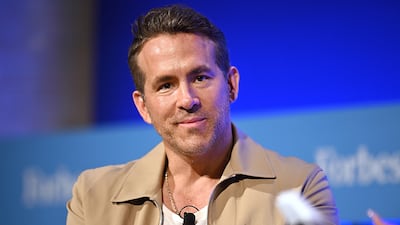
Ryan Reynolds has praised Abu Dhabi for the way it has developed its arts and culture scene, saying culture can play an important role in giving cities a sense of identity.
He said the emirate has “done very, very well” in building its artistic sector, while discussing how attracting and retaining younger generations can transform modern cities.
“Suddenly you're bringing that and you're creating eccentricity as well, and suddenly you have yourself a boom town.”

The Canadian actor, producer and entrepreneur, best known for playing the title character in the Deadpool films, was speaking at LiveX in Abu Dhabi on Tuesday about what makes cities and communities thrive.
The three-day event at Adnec brings together government figures, developers, investors and international experts to explore how cities can improve liveability and respond to challenges such as rapid growth, changing demographics and mobility.
His comments come as Abu Dhabi continues to expand its cultural offerings, particularly on Saadiyat Island. The district is already home to Louvre Abu Dhabi, teamLab Phenomena Abu Dhabi, Zayed National Museum and Natural History Museum Abu Dhabi, with the Frank Gehry-designed Guggenheim Abu Dhabi set to open on December 11.
The largest museum in the Guggenheim network will focus on art from the 1960s to the present, with works by Jackson Pollock, Mark Rothko, Andy Warhol and Jean-Michel Basquiat alongside artists from the Arab world, Africa and Asia who have received less international attention.
Reynolds, who grew up in Vancouver and is co-owner of Welsh football club Wrexham AFC, said successful cities often have a strong understanding of their own identity.

“I think of communities that function and thrive, and it's usually because they have a very healthy sense of self,” he said. “They have an identity, a strong pride in what they are and something that they believe in.”
Reynolds also spoke about his own creative identity, saying he considers himself more of a storyteller than a conventional actor.
“I just love storytelling,” he said. “I don't think of myself as an actor in the sense that you won't see me playing a 15th-century Dutch impressionist in a movie because I would laugh myself off that film set. But I do consider myself a storyteller.”
He said that while making the Deadpool films, he can be acting while simultaneously keeping an eye on camera positions and visual effects, and thinking about how dialogue could be rewritten.
“I'm in like 50 places at once, which is why I'm not a pure actor,” said Reynolds, who's also credited as a writer in two of the Deadpool films. “I'm looking at the whole thing all at once and it's like a symphony.
“And it sounds great, but it's a living, breathing hell. Because I would love to just focus on the one thing and just do this one thing. But I look at that also as an incredible gift. It really allows me to see things that I wouldn't otherwise see.”
Reynolds traced that way of thinking partly back to his childhood, when he said he was constantly expecting what might happen next.
“You're constantly jumping into the future thinking, 'what's the threat? What could happen?'” he said. “You're inventing entire storylines, and all of this is actually a form of creativity.”
That approach also shapes the way he works with other writers. Reynolds said he sometimes introduces an idea to a co-writer by saying: “Here's the bad version.”
“And why I say 'here's the bad version' when I pitch an idea is because I want to give him permission to dissent,” he said.
“I want him to say, ‘No, that's terrible. What if we did that and this?’ And then suddenly you're building something amazing.”
For Reynolds, admitting uncertainty can be as important creatively as having an answer.
“Most people I know who are really good at stuff or [have] accomplished something have 80 per cent more stuff that they've failed at,” he said.
“Because they walk into situations and say, ‘I don't know.’ When you say, 'I don't know,' you co-opt other people's goodwill and patience. And I love that.”
Mina Rzouki contributed to this report

