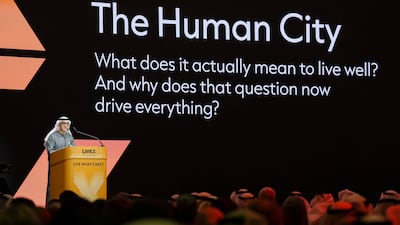
Abu Dhabi is moving beyond a one-size-fits-all approach to ‘liveability’ and hosts LIVEX 2026 from today as part of the conversation to take it and other world cities forward.
The UAE capital is using district-level priorities as well as residents' insights and data to understand what individual communities need – and to ensure Abu Dhabi’s growth improves everyday life.
With LIVEX taking place over the next three days and the word liveability increasingly used by cities around the world, Mohamed Ali Al Shorafa, chairman of the Department of Municipalities and Transport, explains what it means for someone living in Abu Dhabi.
“At its simplest, liveability is about everyday life,” he tells The National. “It means being able to move easily around your neighbourhood, having somewhere safe for your children to play, and being within easy reach of green space, education, healthcare, and everyday services.”
While these things may sometimes sound small when compared with major infrastructure projects, they have an enormous impact on how people experience a city.

“Our leadership has set a clear ambition for Abu Dhabi to become the world’s most liveable and loveable destination,” Mr Al Shorafa continues. “To achieve that, we need to look beyond what a city has on paper and understand how well it actually works for the people who live there.”
Mr Al Shorafa says LIVEX 2026 is where several threads come together, namely planning capacity ahead of demand, listening to residents through initiatives like the Dream Neighbourhood Survey, and using data and cross-government co-ordination “to turn that insight into better places to live”.
The event at ADNEC is expected to bring together 20,000 delegates and 1,500 investors from more than 50 countries.
Mr Al Shorafa explains: “It also puts government, developers, investors and international experts in the same room, which matters because none of this gets delivered through planning alone.
“The private sector has an important role in developing and managing places that serve communities over the long term. LIVEX provides an opportunity to build the partnerships needed to deliver that work.”
Abu Dhabi already performs strongly in international quality-of-life rankings. Mr Al Shorafa says such international benchmarks are useful as they allow leaders to understand how the city is performing overall and where they can improve.

But a citywide average can only tell its leaders so much, he explains, as people experience cities at the neighbourhood level, and two communities in the same city can have very different needs.
One may require better public transport connections or easier access to key destinations. Another may be experiencing congestion or pressure on schools and healthcare.
“Elsewhere, residents may want more parks, running tracks, cycling infrastructure or community spaces,” says Mr Al Shorafa.
“That is why we take a district-by-district approach. We look at what a community has, what it lacks, how people move through it and, importantly, how well the different elements of everyday life actually work together.”
Mr Al Shorafa suggests there is no “single template for the perfect neighbourhood” and cites listening to residents as fundamental in decision-making, via public engagement initiatives such as the Dream Neighbourhood Survey.
“We can hear directly from people about what they value in their communities, the challenges they experience and what they would like to see improved.
“Residents can highlight priorities that broad planning data alone may not reveal, such as smoother traffic flow, safer routes to school, better-fit streets or places for neighbours to gather.
“We combine that insight with data from across government to build a much more detailed picture of individual districts. As communities grow and change, their needs change too, so this must remain an continuing conversation.”
Matching quality with growth
Indeed, as a city like Abu Dhabi rapidly grows, the challenge is ensuring quality of life keeps pace.
Mr Al Shorafa identifies planning ahead as essential, rather than waiting for growth to create pressure. Abu Dhabi has to anticipate demand for housing, schools, healthcare, mobility, utilities and public space and consider them as parts of “one connected urban system”.
Mr Al Shorafa further stresses connectivity as an important part of that, highlighting how on September 30, Etihad Rail’s passenger network will expand to Dubai and Al Dhaid, creating a new passenger rail connection between Abu Dhabi and Dubai.
“It gives people another way to move between two of the country’s major population and economic centres and is a good example of the kind of integrated connectivity that becomes increasingly important as our cities grow,” he says.

And that approach is backed by significant investment; the Abu Dhabi Executive Council has allocated Dh42 billion to the next phase of Abu Dhabi’s Liveability Strategy, supporting improvements across communities throughout the emirate.
“But investment alone is not enough,” says Mr Al Shorafa. “Urban planning, infrastructure, mobility, municipal services and real estate development all need to work together, reflecting the whole-of-government approach that runs through everything we do.
“Government cannot deliver that alone, either. Developers and other private-sector partners have an important role in creating and activating places that work for communities over the long term.”
Co-ordination between DMT and other government entities is also important.
DMT’s mandate already spans urban planning, infrastructure, mobility, municipal services and real estate, so a great deal of this co-ordination starts within DMT, Mr Al Shorafa confirms.
“But liveability across the emirate depends on more than DMT alone, so we work closely with colleagues across government responsible for education, healthcare, utilities and the other services that shape everyday life in a community.
“That co-ordination is what turns district-level insight into action. When a survey tells us residents in one area need better access to green space, or when data shows congestion building in another, the response has to be joined up across the entities responsible for each part of that picture, not left to any one of them alone.”
During LIVEX this week, visitors will experience that co-ordination visually at the One Abu Dhabi Pavilion, as government comes together to show, in one place, how the emirate is planned, managed and experienced.
Embracing technology and history
Attendees will also be able to discuss the role of technology in the capital’s next phase, as it will enable the understanding of cities “in ways that simply were not possible before”.
Mr Al Shorafa says data and artificial intelligence can help DMT understand how people move through neighbourhoods, where facilities are being used, where services are under pressure and where intervention may be needed.
“At the same time, the technologies shaping cities are developing quickly.
“Autonomous vehicles, robotics, the Internet of Things and wearable technology will influence everything from mobility and last-mile delivery to waste management and healthcare.
“But technology is not the objective; people are. The test of a smart city should not be how much technology it has, but whether that technology makes everyday life better.”
At the same time, those looking towards Abu Dhabi’s future face the challenge of not losing the city’s unique feel as it expands and modernises.

Mr Al Shorafa agrees that growth should not mean losing what makes a place distinctive but can go hand in hand.
“Abu Dhabi has its own identity, landscape, culture and way of life,” he says. “These should guide how we plan and design communities across the emirate, not things we think about afterwards.
“We can embrace new technology, new infrastructure and new ways of living while protecting our natural assets, cultural heritage and local character.”
Mr Al Shorafa says a “future-ready city” does not have to look like every other future-ready city.
“Our aim is to ensure Abu Dhabi continues to evolve while remaining recognisably Abu Dhabi. It’s a story we’re glad to share when the world visits for LIVEX 2026.”
Mr Al Shorafa goes on to describe the event as an opportunity to bring all of the above conversations together.
He says governments, developers, investors, technology companies and urban experts from around the world are dealing with many of the same challenges, namely accommodating growth, responding to changing demographics, improving mobility, and understanding how technology can improve everyday life.
“Abu Dhabi has experiences to share, particularly around our increasingly integrated, district-level and data-informed approach,” Mr Al Shorafa adds. “But we also have much to learn from other cities … that is why LIVEX matters.
“It gives us a platform to compare what is working, learn from one another and build partnerships that can translate those ideas into better places.”
This page was produced by The National in partnership with LIVEX 2026

