
During a tour of her Abu Dhabi home, Huda Alkhamis-Kanoo stops in a majlis dating back about 200 years, its walls lined with intricately carved wooden panels.
The room once formed part of the home of a Christian family in the Levant and had been passed down through generations. Kanoo knew the family for years and understood why they never wanted to part with it. When recent conflict put the house and its contents at risk, however, they turned to her, trusting that she would preserve what the room represented.
It was carefully dismantled, brought to Abu Dhabi and rebuilt in her home. “No matter who we are or what we believe in, we have a responsibility to preserve our heritage, tell our story and pass it on,” Kanoo says. “This room belonged to a Christian family, but the principle is the same for all of us. Christians, Muslims, wherever we are, we preserve what carries our history.”

Kanoo grew up with that atmosphere in Beirut. Her mother cooked with music playing, her father hosted poets, businessmen and thinkers, and the sounds outside ranged from church bells to people calling in the street.
“I lived with music, art, culture and literature,” she says. “It was at home, at school, outside. I lived it. It opened something in my heart.”
What Kanoo wanted to recreate in Abu Dhabi was that sense of culture as part of everyday life, shared among artists, families and young people. It became the purpose behind establishing the Abu Dhabi Music and Arts Foundation, now celebrating its 30th anniversary, and later its flagship event, Abu Dhabi Festival, which opens on Saturday with a concert by the UAE National Orchestra at Etihad Arena.

To understand that journey, Kanoo recalls Admaf’s beginnings as a small desk at the Abu Dhabi offices of the Kanoo Group, the long-established Gulf family business, when Cultural Foundation and the National Theatre hosted much of the capital’s cultural activity.
“There was always this idea I found when I came to Abu Dhabi that culture was essential,” Kanoo says. “You can see that in some of the city’s most loved and historic buildings, which are now on the heritage register. Cultural Foundation was there. The National Theatre was there.
“I think the contribution I wanted to make by setting up Admaf was simply to widen that access further, particularly to young people.”
Kanoo went into public schools, organised buses and brought pupils to Cultural Foundation for concerts, operas and ballets.
“I still remember watching the young people watching The Nutcracker at Cultural Foundation not long after we opened,” she recalls. “They were so enthralled. We had small gifts and a lunch box, but it was their reaction, seeing them happy. It was about exposing them to art and giving them an opportunity to decide for their lives in the future.”
At times, these excursions required convincing families first, particularly when young women at university needed permission to attend.
She adds: “Some families did wonder what the aim was, and I said, ‘Fair enough.’ I told them: ‘Let them open their horizons, listen to something new, watch something new, do something new. Let them enjoy. Why don’t you come with them?’”

In the early years, much of the work was funded by Kanoo and her husband, Mohamed Abdul Latif Kanoo, a businessman and self-taught painter and gallerist who has long been active in Abu Dhabi’s visual arts scene.
“I didn’t know if I was going to be successful,” she says. “I couldn’t dare ask for public funds or private funds when I didn’t yet know if it would work.”
The programmes spread through schools, the Cultural Foundation, Al Ain, Dubai and Liwa. Performances were paired with workshops and masterclasses, while artists spoke to students about music and the worlds from which it came.

Much of that grassroots model would later be carried into Abu Dhabi Festival, with major performances given equal weight alongside school visits, workshops, talks and masterclasses. Launched in 2004, the festival was, Kanoo says, a natural evolution of what Admaf had already been doing.
Before Emirates Palace became one of the festival’s major performance hubs, the Cultural Foundation, the National Theatre and other community halls were used, and Kanoo’s home served as backstage and storage space for visiting artists.
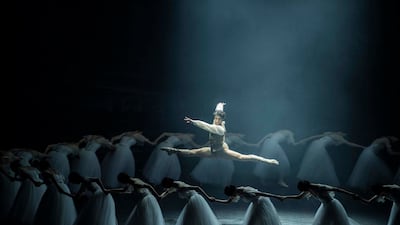
As the festival drew greater official support, major artists and ensembles, including Placido Domingo, the Mariinsky Ballet and Orchestra, London Symphony Orchestra, Al Jarreau and Natalie Cole appeared during its first decade. Many also made side trips to visit schoolchildren and take part in Admaf’s wider programme across Abu Dhabi.
“We ask them to go to Liwa, to sit with students from public schools who probably didn’t have a violin to play with,” she says. “You tell them, ‘Do you mind helping me spread music to the young?’”
Kanoo says none refused. “They said, ‘We’ll do it together,’ and, ‘We’re thankful you are giving us the opportunity.’ This is the generosity of the artists.”

As Admaf and Abu Dhabi Festival grew, international co-commissions became another way of extending that exchange. One of the earliest came in 2009, when Abu Dhabi Festival joined Manchester International Festival and Holland Festival to commission a portable concert pavilion designed by Zaha Hadid.
This was followed by major international stage productions including Verdi’s opera Aida, co-produced with Madrid’s Teatro Real (2022); Maria Pages’s flamenco production De Scheherazade a Yo, Carmen at Barcelona’s Gran Teatre del Liceu (2022); and Debussy’s opera Pelleas et Melisande in collaboration with Opera national de Paris (2025).
“With these productions come opportunities for Emirati talent, whether through placements, workshops or performances abroad,” Kanoo says.
“It’s not for one year. It is for future generations to understand how we did it, how a production was made and how a co-commission works at that level. You create something together and that knowledge remains. Khalas, it’s an investment forever."
Admaf also began taking UAE art abroad from Berlin to London, commissioning artists and supporting exhibitions and acquisitions.

More exhibitions followed through a reciprocal partnership with Seoul Museum of Art. In May 2025, Layered Medium: We Are in Open Circuits brought 48 works by 29 Korean artists to Manarat Al Saadiyat. That December, Proximities took more than 110 works by 48 UAE-based artists, including 33 Emiratis, to Seoul.
"When I established the festival, music was the heart, but there was also our story: what is happening in the UAE?" Kanoo says. "When guests and artists come, they also want to see what is happening here. What is the visual art movement? You cannot segment it. It is one engine."
Kanoo points to how far Abu Dhabi’s cultural landscape has developed since Admaf was launched, from Louvre Abu Dhabi and NYU Abu Dhabi Arts Centre to the institutions of Saadiyat Cultural District, many of which now have children’s and family programmes built into their regular calendars.

The creation of the UAE National Orchestra in 2025 is another sign of that growth, and it will open this year’s Abu Dhabi Festival at Etihad Arena on October 10.
With the festival now staging performances in arenas at home and commissioning abroad, Kanoo says its value cannot ultimately be reduced to box-office returns.
“Ticket sales can give you an indication of your programming choices, but ultimately you do not measure culture by ticket sales,” she says. “If you want to speak purely about economic impact, yes, cultural events move everything in your country: airports, hotels, buses, taxis. Everyone works.
“But culture lives for years to come. It is the impact, the influence, the thinking and the creativity it inspires.”
The UAE National Orchestra opens Abu Dhabi Festival at Etihad Arena on Saturday at 8pm; tickets start from Dh225