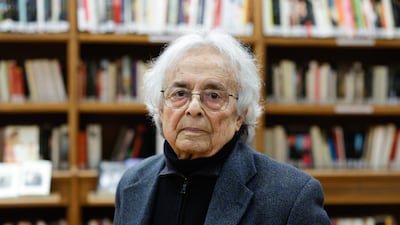

With the Nobel Prize in Literature set to be announced on Thursday, attention is turning to the writers who could receive one of the world’s most prestigious literary honours.
Ahead of the announcement, there is little firm information to work with. Candidates are nominated by eligible figures including literary academy members, university professors, previous laureates and representatives of recognised writers’ organisations. The Nobel Committee for Literature assesses the nominations before the Swedish Academy selects the winner.
The names remain confidential for 50 years, so any list of favourites is necessarily speculative.
Egyptian novelist Naguib Mahfouz became the first Arab writer to win the prize in 1988 and remains its only Arab laureate. Nearly four decades later, several writers from across the region have strong claims to follow him.
Adonis
If there is one Arab writer whose name has become almost permanently attached to Nobel speculation, it is Adonis.
Born Ali Ahmad Said Esber in Syria in 1930, he helped transform modern Arabic poetry through both his writing and his role in co-founding the influential journal Shi’r.
His poetry broke sharply with inherited forms and drew on mythology, politics and history in ways that reshaped the possibilities of Arabic poetry.
The Goethe Prize in 2011 and the PEN/Nabokov Award in 2017 only reinforced a reputation that had already been decades in the making.
Ibrahim Al Koni

The Sahara is the great recurring presence in Ibrahim Al Koni’s work.
The Libyan Tuareg novelist has spent decades turning the desert into a space of myth, spirituality, memory and survival, drawing on a cultural inheritance rarely represented on such a scale in modern fiction.
He has written more than 80 books, with translations appearing in more than 35 languages, and was a finalist for the 2015 Man Booker International Prize.
What distinguishes Al Koni is not simply his subject matter, but the completeness of the literary world he has built around it.
Amin Maalouf

Amin Maalouf’s strongest claim may lie in the breadth of the territory his work covers.
Across novels, essays and historical writing, the Lebanese-born author has returned repeatedly to questions of migration, identity and the meeting of civilisations.
Leo Africanus and The Crusades Through Arab Eyes remain among his best-known works, while The Rock of Tanios won the Prix Goncourt in 1993.
Maalouf has since become a central figure in French literary life. He joined the Academie Francaise in 2011 and has served as its permanent secretary since 2023.
Hoda Barakat

War is rarely distant in Hoda Barakat’s fiction. Its consequences seep into memory, relationships and the private lives of her characters.
The Lebanese novelist’s major works include The Stone of Laughter, The Tiller of Waters and Voices of the Lost, each marked by an interest in people living through rupture and displacement.
Barakat was a finalist for the 2015 Man Booker International Prize and won the International Prize for Arabic Fiction in 2019.
Her case rests less on scale than on precision: a sustained body of work that examines conflict without reducing its characters to symbols.
Tahar Ben Jelloun

Few writers on this list have moved as comfortably between literary cultures as Tahar Ben Jelloun.
The Moroccan novelist, poet and essayist writes primarily in French, but much of his work remains rooted in questions of Moroccan identity, migration and political repression.
The Sand Child and The Sacred Night established his international reputation, with the latter winning the Prix Goncourt in 1987. This Blinding Absence of Light later became one of his most acclaimed works.
His membership of the Academie Goncourt reflects a career that has long straddled North African and French literary traditions.
Leila Aboulela

Faith sits at the centre of Leila Aboulela’s fiction in a way that remains unusual in contemporary English-language literature.
The Sudanese novelist has explored belief, migration and belonging through works including The Translator, Minaret and River Spirit.
Her characters often negotiate more than geography. They move between cultures, languages and expectations while trying to maintain a coherent sense of self.
Aboulela became the first winner of the Caine Prize for African Writing in 2000. Since then, she has built a body of work that places Sudanese and Muslim experiences firmly within contemporary literary fiction.
Samar Yazbek

Samar Yazbek’s career cannot be separated from the upheaval in Syria.
Her writing has moved between journalism, memoir, literary testimony and fiction, often circling the same questions from different angles.
The Crossing documented her journeys into opposition-held Syria, while Planet of Clay and Where the Wind Calls Home transformed the experience of war into fiction.
The latter was a finalist for the 2024 National Book Award for Translated Literature.
Yazbek has also won the PEN Pinter Prize and the Tucholsky Prize, recognition of a body of work shaped by exile, conflict and witness.
Bushra Al Maqtari

What Have You Left Behind? begins with a simple but devastating premise: to record the people killed in Yemen’s war as lives rather than numbers.
Bushra Al Maqtari built the work from interviews with families who had lost relatives, creating a form that sits between testimony, reportage and literature.
That approach has become central to her writing, which repeatedly returns to political violence and its human consequences.
The Yemeni novelist and journalist received the Tucholsky Prize in 2024, bringing greater attention to work that has documented a conflict often treated internationally through statistics and geopolitical shorthand.
Salim Barakat

Salim Barakat is perhaps the least straightforward candidate here, and that is part of what makes him interesting.
The Kurdish-Syrian writer is known for pushing the Arabic language towards its limits, using dense imagery, unusual vocabulary and highly experimental structures across poetry, fiction and autobiography.
His books include The Iron Grasshopper and The Universe, All at Once, and his career was closely connected to Mahmoud Darwish and the Palestinian literary journal Al-Karmel.
Barakat’s readership is smaller than that of several names on this list, but his influence rests on the radical originality of his prose and poetry.