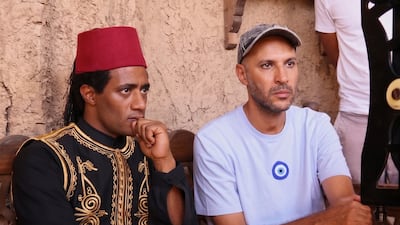

Mohamed Diab’s entire career had been building to this. After years of gaining acclaim in the Arab world and beyond for his intense, provocative films, the Egyptian director reached what he had grown up seeing as his final destination: Hollywood.
The project was Marvel’s Moon Knight. The series, steeped in ancient Egyptian mythology, seemed like a culmination of everything he had once wanted from cinema, giving Diab a rare chance to bring his culture to one of the world’s biggest entertainment franchises.
Its star, Oscar Isaac, is a Golden Globe-winning actor whose career had moved between major studio films and acclaimed work with the Coen brothers, Denis Villeneuve and Paul Schrader.

When the two met over coffee before production began in 2021, Diab told Isaac how much he admired his work. To his surprise, Isaac returned the sentiment. He had watched Diab’s previous films, including Clash and Amira, and his reaction caught the director off guard.
“He told me: ‘Mohamed, what are you doing here? You’re too good for this,’” Diab tells The National.
Even in the wake of Moon Knight's success, Isaac's question never left his mind. The series, released in 2022, became one of Marvel’s more distinctive projects, earning a devoted fan base, particularly in the Middle East. But what was Diab doing here, exactly?
As he began to navigate Hollywood, he began to ponder that more and more. And as numerous projects gestated, he began to think more seriously about what it would mean to bring Hollywood's blockbuster sense of scale back to the Arab world, and whether the summit he had long been chasing was closer to home than he had planned for.
“I just realised what I always had,” he says. “What I needed was a good story. I still want to make big-budget movies if there is a story that I want to tell, but it made me value what I had already done more and more.”

That realisation shaped Asad, his first directorial effort since Moon Knight. Starring Mohamed Ramadan, the film takes viewers into a period of Egyptian history Diab says has rarely been explored on screen.
“I was reading a book about slavery in Egypt,” he says. “Later on I was watching films about slavery, Django Unchained and others, and I realised we haven’t seen any stories about slavery from our part of the world.”
He kept thinking about the slaver – the person who could run a home and a business around buying and selling other people. In the world of the film, Diab says, enslaved people are treated as merchandise – protected only because they have financial value.
“The idea of a human selling a human was something interesting to me,” he says.
The film also became Diab’s test of what a large-scale Egyptian production could look like after the machinery of Marvel. He says Asad was made for about $6 million, with ambitions far beyond that figure.
“This looks like a $20 million or $30 million film,” he says.
But just because every dollar went further didn't mean it was easier – far from it. On Moon Knight, the scale came within a well-oiled system made by one of the most resourced companies in entertainment. In Egypt, without that same infrastructure, Diab had to build the scale through constant problem-solving.

“When you’re working in Hollywood, everything is planned six months prior, so nothing can go wrong on the day,” he says. “Here, everything goes wrong on the day. But that chaos is a disadvantage and, at the same time, a big advantage. You play with what you have.”
The process also changed how Diab saw the Egyptian crew around him. After years of associating that type of filmmaking only with Hollywood, he watched each department find ways to make the film feel larger than its budget, even with one per cent of the workforce.
“Every shot you get on camera feels like a miracle,” he says.
Ramadan’s role in the film also pushed Diab past some of his own assumptions. The actor is one of the Arab world’s biggest stars, with the reputation and visibility that comes with that position, but Diab says the experience of working with him was defined by artistic commitment rather than celebrity.
“Everyone warned me that he’s a big diva,” Diab says. “But he was completely committed to this film. Two years working together, absolute commitment.”
At one stage, after Diab decided the film needed more shooting, the two men helped finance the additional work themselves.
“This is how much he believed in the film,” Diab says.
Despite its historical setting, Asad became increasingly tied in Diab’s mind to the present day. He says the film’s exploration of slavery pushed him to think about modern labour systems, economic inequality and the distance between legal freedom and lived reality.
“Modern-day slavery is here,” he says. “I still think to workers around the world, capitalism is modern-day slavery. We just lost the names. No one is a 'slave' any more. Everyone is free. But, actually, when you look in the mirror …
“Asad is that mirror. We are still controlling people.”
The film arrives during a period when Diab is continuing to develop projects internationally, though he says his approach to Hollywood has changed since Moon Knight. Several scripts and pilots remain in development, including The Note, a Netflix project he describes as being about “the facade of the American dream”.
“If you’re making something in Hollywood, that’s the way it is,” he says. “You knock on so many doors and you don’t know which one is going to open in the end. We wrote pilots, we wrote scripts, and we'll see what happens first.”

What connects those projects, he says, is that each remains tied in some way to the Arab or Muslim experience.
“They’re all about our culture,” he says. “Each story is in the West or for the world, but it’s about us in a way. That’s the place that I always start making a film: am I the best person to tell that story or not?”
Hollywood remains part of Diab's future, but no longer the singular destination it once represented.
“Now that I’ve done it, I feel like, no, it’s not a step up,” he says. “It’s just a step. The hierarchy that I saw as a kid, of American films above all, is completely wrong.”
And even though he's been disillusioned, he still speaks about Hollywood with excitement, particularly the opportunities it creates for Arab filmmakers working inside global franchises.
One moment from Moon Knight remains especially meaningful to Diab: the introduction of May Calamawy’s Scarlet Scarab, which gave Arab audiences a superhero who looked and sounded closer to them than any that had appeared on screen before.

“You don’t know how many girls and women approached me and told me they cried at that moment,” he says. “It’s a very important moment. When you see only white people as superheroes, you don’t feel equal.”
He remembers similar emotions inside his own family. His daughter, now 15, spent years wanting to straighten her curly hair because the princesses she saw on screen rarely resembled her.
“Those small things matter,” he says.
But Diab's realised something greater along with that. If the stories he tells on screen reflect the value of the Arab experience, his own actions off screen do, too.
He can add his voice in Hollywood, but he also has to bring that same dedication to telling stories outside of the system that once excluded them, and in doing so, help build something new.
With Asad, Diab is bringing that ambition back into Arab cinema, using a story from the region’s own history to build something large enough to meet the films he once thought only Hollywood could make.
Isaac’s question no longer sounds to him like a dismissal of his dual ambitions. Now, it sounds closer to a challenge. Whether back home or in Hollywood, Diab is no longer chasing one destination. Instead, he is moving with a clearer sense of what he owes to the work, and to the world that made him.
Asad releases in UAE cinemas on May 21