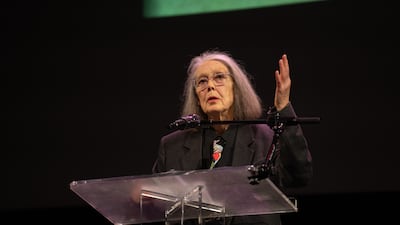

Canadian poet Anne Carson has won the 2026 Nobel Prize in Literature, with the Swedish Academy recognising her experimental approach to writing and her ability to bring ancient Greek literature into the modern world.
The 76-year-old author, whose best-known works include Autobiography of Red, The Beauty of the Husband and Nox, was announced as this year's laureate on Thursday.
The academy awarded Carson the prize “for her bold and inventive oeuvre that, in playful dialogue with the classical tradition, has created new forms for contemporary literature”.

Anders Olsson, chairman of the Nobel Committee for Literature, said Carson's achievement lay in her ability to combine classical scholarship with poetry, fiction and other literary forms.
“Almost all her literary production has centred upon the intersection between the philologist's obsession with words and the poet's desire for new meaning,” he said during the announcement.

Carson has spent four decades drawing on ancient mythology, poetry and philosophy to explore love, grief, desire and identity. Her books frequently combine poetry with fiction, essays, translation and visual art, challenging conventional distinctions between literary forms.
Ingrid Carlberg, permanent secretary of the Swedish Academy, said she had reached Carson by telephone shortly before the announcement. The writer was in Iceland, where she had been “listening to the wind”.
“She was taken by surprise, but very happy. I can hear that in her voice,” Carlberg said.
Carson succeeds Hungarian novelist Laszlo Krasznahorkai, who won the prize in 2025, and South Korean author Han Kang, the 2024 recipient.
The award carries a prize of 12 million Swedish kronor (approximately $1.2 million) and will be presented in Stockholm on December 10.
Who is Anne Carson?
Born in Toronto in 1950, Carson developed an interest in ancient Greek literature while at secondary school, where a Latin teacher began teaching her Greek during lunch breaks.
She went on to study classics at the University of Toronto, earning a doctorate in 1981, and subsequently taught at universities across Canada and the United States, including McGill University and the University of Michigan.

Carson has also translated major ancient Greek writers, including Sappho, Sophocles and Euripides, while reimagining their stories in her own work.
Her previous honours include a MacArthur Fellowship in 2000, the TS Eliot Prize in 2001 and Spain's Princess of Asturias Award for Literature in 2020. She has also won the Griffin Poetry Prize twice, in 2001 and 2014.
Which works explain her Nobel Prize win?
Among the works highlighted by the Nobel Committee was The Glass Essay (1995), a long poem about a woman recovering from a failed relationship who visits her mother in the moorlands, bringing with her the writings of Emily Bronte.
Olsson said the work demonstrated Carson's ability to combine poetry, storytelling and literary criticism, with the narrator's experiences becoming entwined with those of her mother and Bronte.
“The poetry needs the story, and the story is in turn given energy by the leaps and scene shifts of poetry,” he said.
One of Carson's most acclaimed works is Autobiography of Red (1998), a novel written in verse that reimagines the ancient Greek myth of Geryon, a monster killed by the hero Herakles.
Carson transforms Geryon into a young man with red wings, following his journey through adolescence, heartbreak and self-discovery. The book combines a contemporary coming-of-age story with the fantastic imagery of classical mythology.
Olsson praised Carson's “extraordinary ability to give the classical literary tradition an intensely contemporary feel”, highlighting her use of modern language and experiences to reinterpret ancient stories.
He also recalled that Carson had once described boredom as her greatest enemy, saying she confronted it with “drastic humour and wit”.

She followed Autobiography of Red with The Beauty of the Husband (2001), subtitled A Fictional Essay in 29 Tangos. The book follows a woman reflecting on her marriage to an unfaithful husband, with each of its 29 sections opening with lines from the Romantic poet John Keats.
Olsson described the work as a confrontation between Keats's ideas about beauty and the painful realities of a deteriorating marriage. The book won Carson the 2001 TS Eliot Prize, making her the first woman to receive the British poetry award.
Grief became the subject of Nox (2010), created following the death of Carson's brother Michael. The book is presented as an accordion-folding collection of photographs, letters, drawings and poetry, drawing on an elegy by the ancient Roman writer Catullus, who also mourned the death of his brother.
Olsson described Nox as “a creation as sculptural as it is literary”, highlighting how Carson uses the physical form of the book to examine memory and loss.
Her engagement with Greek tragedy also produced Antigonick (2012), an illustrated reworking of Sophocles' Antigone, while Red Doc> (2013) returned to the characters of Autobiography of Red as adults.
Carson's most recent collection, Wrong Norma (2024), contains 25 pieces of poetic prose accompanied by her own artwork. It was a finalist for the 2024 National Book Award for Poetry and won the National Book Critics Circle Award for Poetry in 2025.
Olsson said Carson's influence extended beyond literature through collaborations with visual artists, choreographers and theatre directors.
“This demonstrates the freedom with which she relates to literary expectations and rule systems,” he said, describing her work as an important influence on international art and literature since the 1990s.